
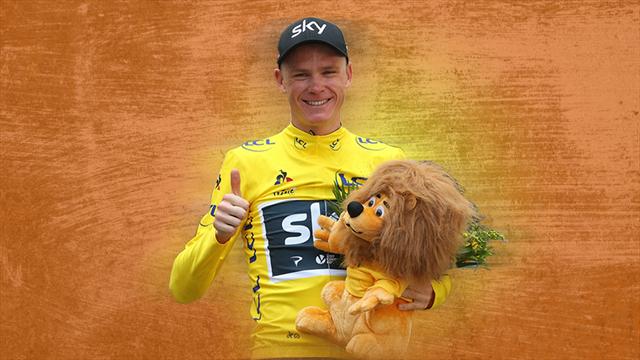
To a list that includes Firmin Lambot (1922), Roger Walkowiak (1956), Gastone Nencini (1960), Lucien Aimar (1966), Greg LeMond (1990) and Oscar Pereiro (2006), we can now officially add Chris Froome (2017).
The narrowest of the Briton’s four Tour wins to date has also proved to be his narrowest (just 54 seconds over Rigoberto Uran) and his least prolific – with Froome standing atop the podium in Paris not only without registering a single stage win in the three preceding weeks since the race left Dusseldorf, but without a single victory to his name all season.
Froome came close on the roads of France this July, most notably finishing third on four occasions – at La Planche des Belles Filles in Stage 5, at Chambery in Stage 9, at Serre-Chavalier in Stage 17 and in the Marseille time trial in Stage 20.
And were it not for the heavy rain in Dusseldorf, too, it could well have been Froome and not his Sky team-mate Geraint Thomas who donned the maillot jaune at the first possible opportunity.
Of the six previous riders on the list of non-winning winners, Frenchman Walkowiak stands out as perhaps the least talented of the bunch – certainly the only one never to have won a Tour stage at all in his career.
The seeds of Walkowiak’s 1956 win were sowed in the seventh stage when he finished in a break of 31 riders that came home more than 18 minutes ahead of the peloton. The advantage gave this supposedly insignificant rider the yellow jersey which his rivals were never able to wrest from his shoulders.
Fifty years later, Spaniard Pereiro owed his own Tour victory to getting in a break “a la Walkowiak” – that and seeing Floyd Landis retrospectively stripped of the title after testing positive for a medley of banned substances.
Before Pereiro, Eurosport’s own LeMond won the 1990 Tour without taking a stage – twice finishing runner-up (in the prologue at Futuroscope and atop Alpe d’Huez, where he was pipped by Gianni Bugno).
And of course, we should mention Alberto Contador – another winner who, like Landis, was later stripped of his win – who had become the seventh rider to emerge stage-less from winning the Tour in 2010 before his Clenbuterol antics ejected him from the record books.
Instead of Contador, then, it’s Froome who is the seventh member of this niche club. And if Froome hardly won the 2017 Tour “a la Walkowiak” – that would have required him being part of an attacking move in what was a largely entirely passive race for the 32-year-old – then he didn’t rely on too much luck or circumstance.
In fact, he played to his strengths – and in a race with the fewest amount of time trial kilometres in the Tour’s history, Froome made them count: racing against the clock a combined 1’16” faster than his former team-mate, Uran.
So, will Froome have been disappointed that he did not win a stage this year?
Victory in the opening time trial – and the race’s opening time trial – may have proved a burden for Froome, and he would have been delighted to have seen team-mate Thomas be rewarded for his years of service by stealing some of the limelight.
It’s clear Froome would have valued a second victory on La Planche des Belles Filles – although his third place behind Fabio Aru and Dan Martin was enough for him to take over Thomas’ yellow jersey.
Given the circumstances of Stage 9 – with his friend and key rival Richie Porte crashing out on the descent of Mont du Chat – Froome would have been more relieved to have arrived in Chambery in one piece than annoyed at another third place finish.
But Sky and Froome made no secret in their desire to win in the Alps – and while Froome’s priority was to keep his rivals in check, his attack on the Izoard showed that he valued a victory there.
The Izoard has a proud place in Tour history and it would have been fitting for the yellow jersey to win on the legendary climb for its first summit finish in the Tour’s 114-year history. That would have disappointed Froome – as would missing out to Polish duo Maciej Bodnar and team-mate Michal Kwiatkowski in the Marseille time trial.
Instead, Froome headed to Paris with the narrowest lead for a decade – since Contador beat Cadel Evans by 23 seconds in 2007. Froome’s 54-second advantage is the seventh narrowest ever.
He becomes the fifth rider in history to win the Tour three times in a row after the Frenchman Jean Bobet and Jacques Anquetil, the Belgian Eddy Merckx and the Spaniard Miguel Indurain.
Froome is now the only rider in history to have won exactly four Tours and – Lance Armstrong aside – has just four riders ahead of him, all tied on five Tour wins: Anquetil, Merckx, Indurain and the Frenchman Bernard Hinault.
If Froome has now joined the non-winners winners’ club then he will be more concerned about joining the Five Tour club next year. And before that, there’s the small matter of the Vuelta a Espana – a race he has never won, but has finished runner-up in on three occasions.
Should Froome go on and complete a rare Tour-Vuelta double he become only the third rider – after Anquetil and Hinault – to do so. Tellingly, he would be the first rider to win such a double since the Vuelta shifted its position in the calendar from April to August/September.
But to be fair, it’s likely that none of this was playing on Froome’s mind as he rode those eight laps on the Champs-Elysees. Winning a stage would have been the cherry on the cake, but it was always about winning a fourth Tour.
And that was worth raising what suspiciously looked like a plastic glass of Kir royale to…