
At least one iPhone 8 model is expected to include a flexible OLED display and Apple has already signed a deal with Samsung to produce OLED displays for devices set to debut in 2017.
Samsung will provide Apple with an estimated 160 million OLED panels to be used for the rumored ~5-inch OLED iPhone. That will account for approximately 80 percent of all the panels used for the device, and while other companies like AU Optronics, Sharp, Japan Display are working on OLED displays, they won’t be ready for production until 2018, meaning Apple will need to rely heavily on Samsung in 2017.
An OLED display eliminates the need for the backlighting that’s used in traditional LCDs, which would allow Apple to cut down on the thickness and weight of the display used in the device. OLED displays can also be flexible, perhaps allowing Apple to create a device with a more curved or wraparound display.
OLED displays offer better contrast ratio, truer colors, improved viewing angles, better power efficiency to maximize battery life, and a faster response time than an LCD for faster refresh rates. On the downside, OLED displays don’t have the lifespan of an LCD display and they’re more prone to water damage, two issues Apple will need to overcome. Apple already uses OLED displays in the Apple Watch.

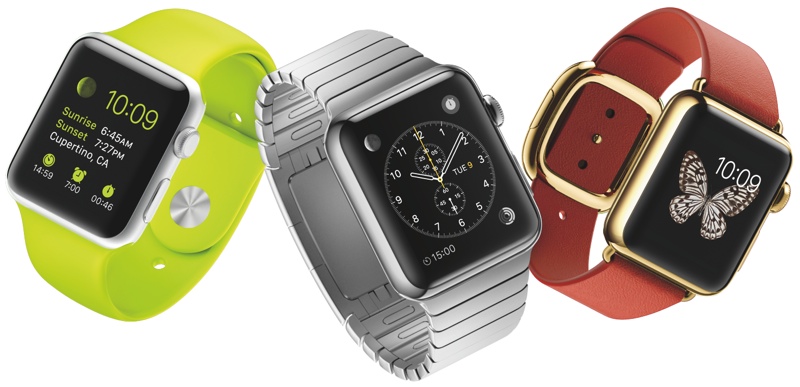
The Apple Watch has an AMOLED display
There are multiple rumors about the size and type of the panels Apple will be using, and rumors indicate Apple is testing more than 10 iPhone prototypes. One rumor suggests Samsung is supplying Apple with 5.5-inch OLED panels, while another says Apple is seeking a 5.8-inch OLED display to be used in one of the iPhone 8 models.
In addition to conflicting information on the display size of the iPhone, there’s also mixed information available on the design of the display. On the whole, it’s sounding like the display will perhaps be somewhat curved and edge-to-edge with no bezel, but rumors have been all over the place. We’ll need to wait for additional information to get a clear picture of what to expect from the device, but some of the rumored possibilities are listed below.
First of all, and perhaps most interesting, Apple blogger John Gruber says he’s heard some “scuttlebutt” suggesting Apple has plans to implement an edge-to-edge display. That means the phone would have no top, bottom, or side bezels, with the display taking up the entire front of the device.
Gruber’s information has been confirmed by reports from The Wall Street Journal and Bloomberg, both of which believe Apple is working on an edge-to-edge display that makes the iPhone look like a single piece of glass.
Sensors like Touch ID and the front-facing camera will be embedded in the display, invisible to the naked eye, and there will be no iconic Home button on the device. Apple has been working on developing touch and display driver (TDDI) chips since 2015, so it’s definitely possible that the iPhone 8 will have no Home button, and Apple has also patented a method for embedding Touch ID and an ambient light sensor in the display.
With the edge-to-edge display, KGI Securities analyst Ming-Chi Kuo believes Apple will continue to use a 2.5D curved display, like the existing display in the iPhone 7. Unlike some other rumors, he does not predict more dramatic curves that cover the sides of the device.
In this scenario, it’s not clear if Apple will shrink down the iPhone to the size of the display or expand the display to match the existing iPhone sizes, but Kuo believes that if Apple introduces a large-screen edge-to-edge OLED iPhone that’s around 5.8 inches, the active display area could be smaller, approximately 5.1 to 5.2 inches.
If Apple does not completely eliminate the bezels in the iPhone 8, there’s a chance that a 5.8-inch display hints at plans for a wraparound screen or a screen with dramatic curved edges, as has been mentioned in some display rumors. Display expert Ray Soneira has speculated a wraparound screen is a possibility, as seen in the mockup below, and Apple has patented similar concepts.

When applied to the height of an existing 5.5-inch iPhone, a 5.8-inch display like the one Apple is rumored to be working on would leave an extra 7.25mm of display on each side that could be used to wrap around the edges of the device. This would extend the display across the front and sides of the iPhone, perhaps enabling side-based gestures and buttons. We don’t know what shape an iPhone with side bars could take, but the rumored 5.8-inch size of the display is about right to add side panels to current-generation iPhones.
Based on information sourced from the Asian supply chain, IHS analyst Kevin Wang also believes the 2017 iPhone will include a “dual-curve” OLED display that covers the left and right edges of the device. It is not clear from Wang’s statement how far the display will extend to the edges of the device or whether it will be a subtle curve for design purposes or a functional wraparound display as Samsung uses in its Galaxy Edge devices.
Should Apple use a display with curved edges, it may also implement new touchscreen technology that would allow the edges of the device to respond to touch gestures.
As previously mentioned, Apple is rumored to be planning on debuting three devices, one premium model with an OLED display and two standard models that use traditional LCD panels. While there is confusion over the size of the OLED panel, the LCD iPhones are expected to be 4.7 and 5.5 inches, the same sizes as the iPhone 7 and iPhone 7 Plus.
All of the information above largely applies to the iPhone with an OLED display — it’s not entirely clear if the standard LCD models that are rumored will share the same display design or will use a traditional 2.5D flat display like the iPhone 7 and iPhone 7 Plus.