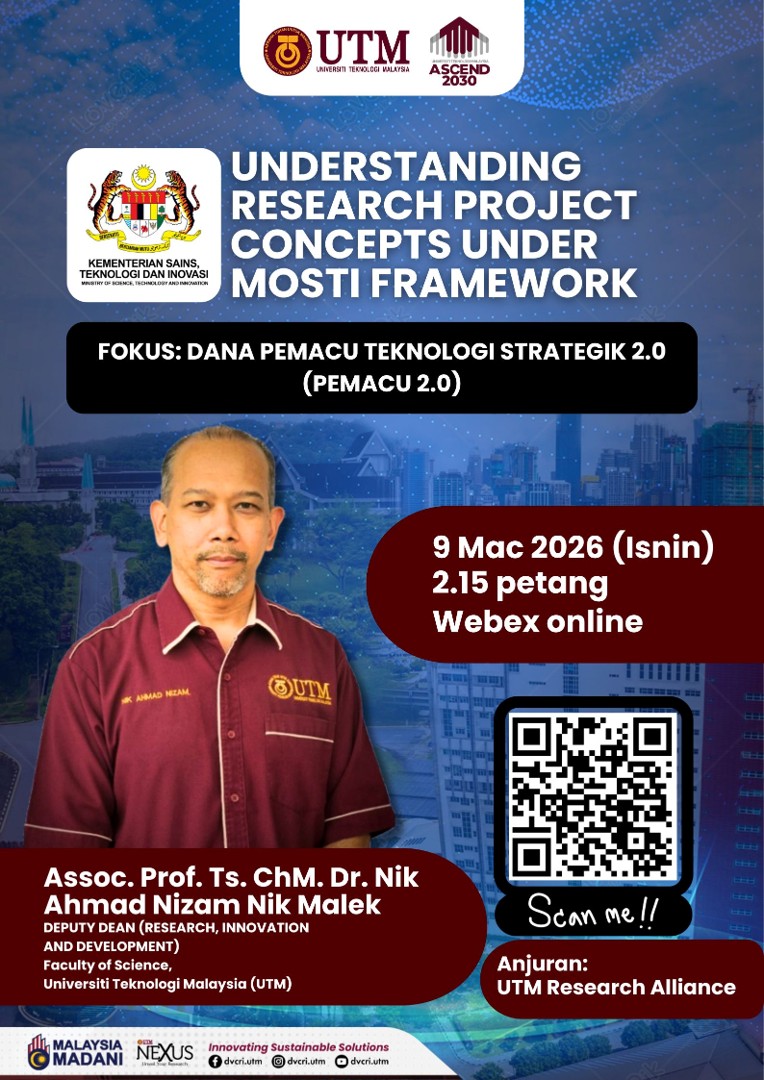
**This article is adapted from the sharing session entitled “Understanding Research Project Concepts under the MOSTI Framework” delivered by Assoc. Prof. Ts. ChM. Dr. Nik Ahmad Nizam Nik Malek, Deputy Dean (Research, Innovation and Development), Faculty of Science, Universiti Teknologi Malaysia (UTM), during a knowledge-sharing programme organized by UTM Research Alliance on 9 March 2026. The session focused on the Dana Pemacu Teknologi Strategik 2.0 (PEMACU 2.0) funding scheme under the Ministry of Science, Technology and Innovation (MOSTI), providing practical guidance on developing competitive research proposals based on Technology Readiness Levels (TRL) and commercialization-oriented research planning.
Introduction
Research funding has become increasingly competitive, requiring researchers to demonstrate not only scientific excellence but also clear pathways toward innovation, technology development, and socioeconomic impact. In response to these expectations, the Ministry of Science, Technology and Innovation (MOSTI) has adopted funding frameworks that emphasize research translation, industrial relevance, and commercialization potential.
Among these initiatives is the Dana Pemacu Teknologi Strategik 2.0 (PEMACU 2.0) programme, which supports technologies capable of progressing from laboratory research to practical implementation. Developing successful proposals under this framework requires researchers to understand the relationship between scientific research, Technology Readiness Levels (TRL), project planning, and commercialization strategies.
Moving Beyond Research Towards Innovation
Many researchers view a research project primarily as an opportunity to generate publications. While scientific publications remain essential outputs, modern funding agencies increasingly expect research to create broader value through intellectual property, prototypes, industrial collaboration, technology transfer, and commercialization.
A competitive research proposal therefore begins with a clear vision of how scientific discoveries will evolve into technologies capable of solving real-world problems. Researchers should identify potential users, industrial partners, market demands, regulatory requirements, and commercialization pathways during the proposal development stage rather than after completing the research. This strategic perspective increases both the competitiveness of funding applications and the long-term impact of the research itself.
Technology Readiness Levels as a Research Roadmap
One of the central concepts within the MOSTI framework is the Technology Readiness Level (TRL) system. Originally developed to evaluate technological maturity, TRL has become an effective framework for planning research progression from basic scientific discovery to commercial deployment.
The TRL scale consists of nine levels. The earliest stages focus on understanding fundamental scientific principles and developing technological concepts. Intermediate stages involve laboratory validation, prototype development, and testing under relevant conditions. The highest levels involve operational validation, regulatory compliance, industrial deployment, and commercialization.
Rather than treating TRL solely as an assessment tool, researchers should use it as a strategic roadmap that guides project objectives, experimental design, resource allocation, and expected deliverables throughout the entire research lifecycle.
Designing Research Projects Around TRL
A common weakness in research proposals is the lack of alignment between objectives, methodology, milestones, and expected outputs. Under the MOSTI framework, every project should clearly define its starting TRL and identify the target TRL to be achieved by the end of the funding period.
Project objectives should correspond directly to technological progression. Each objective should contribute to advancing the technology toward the next readiness level, while project milestones should provide measurable evidence that the target TRL has been achieved. The research methodology, experimental activities, project timeline, and Gantt chart should all demonstrate a logical sequence that supports this progression.
Such alignment enables reviewers to understand how the proposed research will systematically reduce technological uncertainty while increasing innovation readiness.
Generating Evidence for Technology Development
Progressing through the TRL stages requires more than conducting experiments. Researchers must generate supporting evidence that demonstrates technological maturity at each level.
This evidence may include scientific publications, technical reports, laboratory validation data, prototype development, intellectual property filings, previous research grants, concept descriptions, and supporting documentation. Public visibility through websites, databases, or innovation platforms further strengthens the credibility of the proposed technology.
Maintaining comprehensive documentation throughout the research process not only supports funding applications but also facilitates technology assessment, intellectual property management, and future commercialization activities.
Bridging the “Valley of Death”
One of the greatest challenges in innovation is the transition from successful laboratory research to commercial products or industrial implementation—a stage often referred to as the “Valley of Death.” Many promising technologies fail during this transition because researchers focus exclusively on scientific outcomes without considering manufacturing, regulatory approval, market demand, or industrial adoption.
To overcome this challenge, researchers should establish collaborations with industry partners early in the project, understand relevant standards and regulations, develop functional prototypes, and identify realistic commercialization pathways. Options may include licensing intellectual property, forming spin-off companies, establishing joint ventures, or collaborating directly with industrial partners.
By incorporating commercialization planning into the research proposal, technologies are more likely to progress successfully beyond the laboratory.
Integrating Sustainability and Societal Impact
Modern research funding increasingly emphasizes contributions to environmental sustainability, economic development, and societal well-being. Researchers are therefore encouraged to align their projects with Environmental, Social and Governance (ESG) principles, either directly or indirectly.
This alignment may involve developing environmentally friendly technologies, improving public health, supporting sustainable industries, reducing waste, promoting circular economy practices, or contributing to national strategic priorities. Demonstrating broader societal impact strengthens both the competitiveness and relevance of research proposals.
Collaboration as a Driver of Innovation
Successful innovation rarely occurs in isolation. Researchers are encouraged to build multidisciplinary teams involving scientists, engineers, industry experts, clinicians, policymakers, and commercialization specialists. Such collaborations provide complementary expertise while ensuring that technological development remains scientifically rigorous and commercially relevant.
Industrial collaborators play particularly important roles in validating market needs, providing technical advice, facilitating field testing, ensuring regulatory compliance, and supporting eventual commercialization. Their involvement enhances proposal credibility and increases confidence that the technology can progress successfully beyond academic research.
Developing Competitive Research Proposals
A winning proposal is not simply a collection of scientific ideas. It is a carefully designed roadmap that demonstrates how research activities will systematically generate knowledge, validate technology, achieve measurable milestones, and deliver meaningful impact.
Researchers should ensure that every component of the proposal—including objectives, methodology, TRL progression, timeline, budget, personnel involvement, expected outputs, and commercialization strategy—forms a coherent and integrated framework. Clear planning enables reviewers to appreciate both the scientific merit and the practical feasibility of the proposed project.
Conclusion
The MOSTI research framework represents a shift from traditional research funding toward innovation-driven, impact-oriented research. Understanding Technology Readiness Levels, aligning project objectives with technological progression, generating appropriate evidence, and planning for commercialization are now essential skills for researchers seeking competitive funding.
Ultimately, successful research is measured not only by the knowledge it generates but also by its ability to create technologies that improve lives, strengthen industries, contribute to national development, and support sustainable economic growth. By embracing the principles embedded within the MOSTI framework, researchers can develop projects that are scientifically robust, strategically planned, and capable of delivering lasting societal impact.