


From Research Draft to Submission-Ready Manuscript: A Practical Strategy for Finalising a Research Book
Completing the first draft of a research book is an important milestone, but it does not mean that the manuscript is ready for publication. A strong research book requires a systematic finalisation process that brings together its content, scientific evidence, visual presentation and publisher requirements into one coherent package.
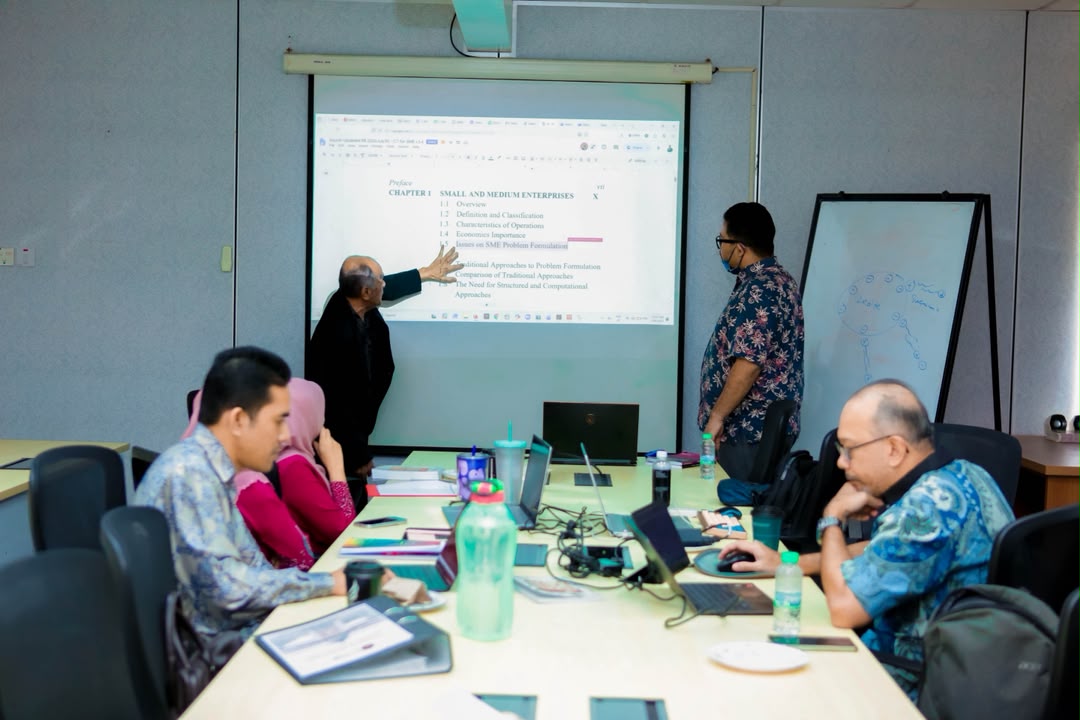
The presentation “Strategy for Finalizing the Research Book: From Research Draft to Submission-Ready Manuscript” highlights practical approaches for transforming a completed research draft into a manuscript that is ready for submission. The strategies are illustrated using examples from Innovation of Zeolite in Fertilizer Agriculture and other practical research-book outputs.
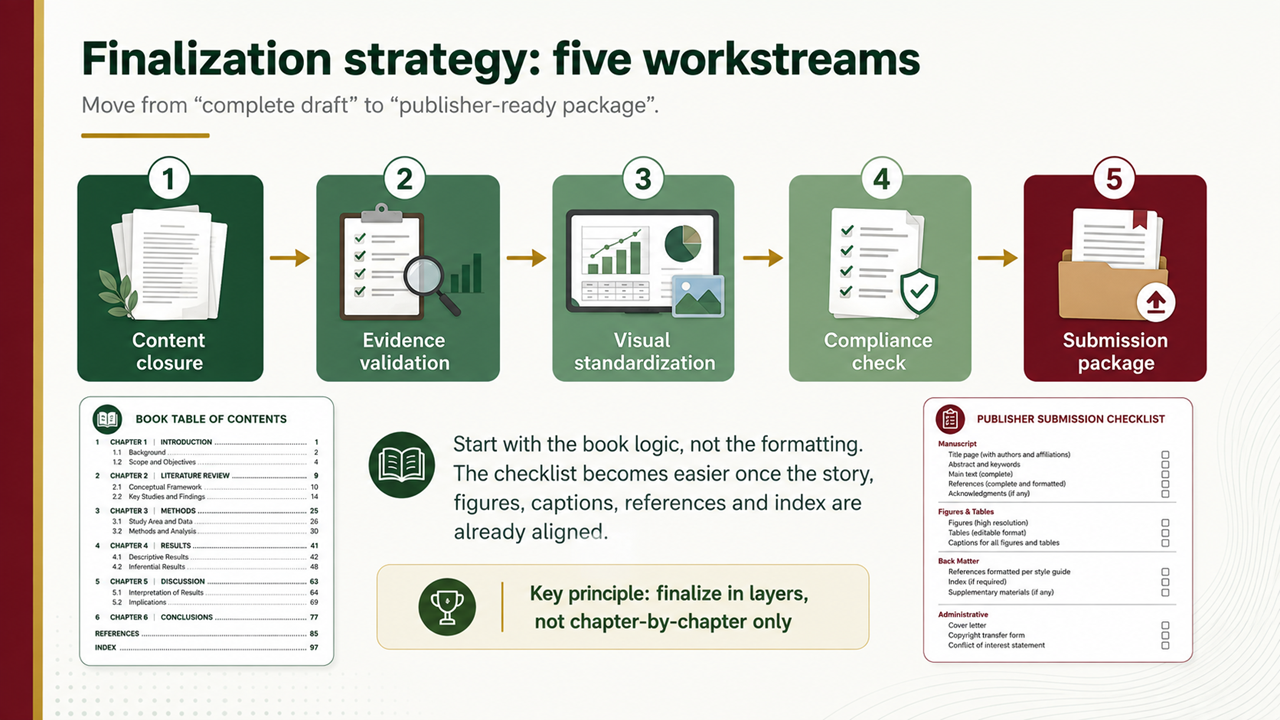
Finalising a Research Book in Five Workstreams
One of the key principles introduced in the presentation is that research-book finalisation should be approached through five interconnected workstreams: content closure, evidence validation, visual standardisation, compliance checking and preparation of the submission package. Rather than completing one chapter at a time and assuming that the manuscript is finished, authors should review the book as an integrated scholarly product.
Content closure involves ensuring that every chapter, section and subsection is complete and that all parts of the book contribute to its central narrative. Evidence validation requires authors to carefully verify experimental results, interpretations, references and technical statements. Visual standardisation ensures consistency in figures, tables, captions, terminology and image quality. These are followed by a compliance check against the publisher’s requirements and, finally, the preparation of a complete submission package.
Build One Coherent Story
A research book should not read like a collection of disconnected research reports. Instead, it should develop a clear scholarly argument from beginning to end.
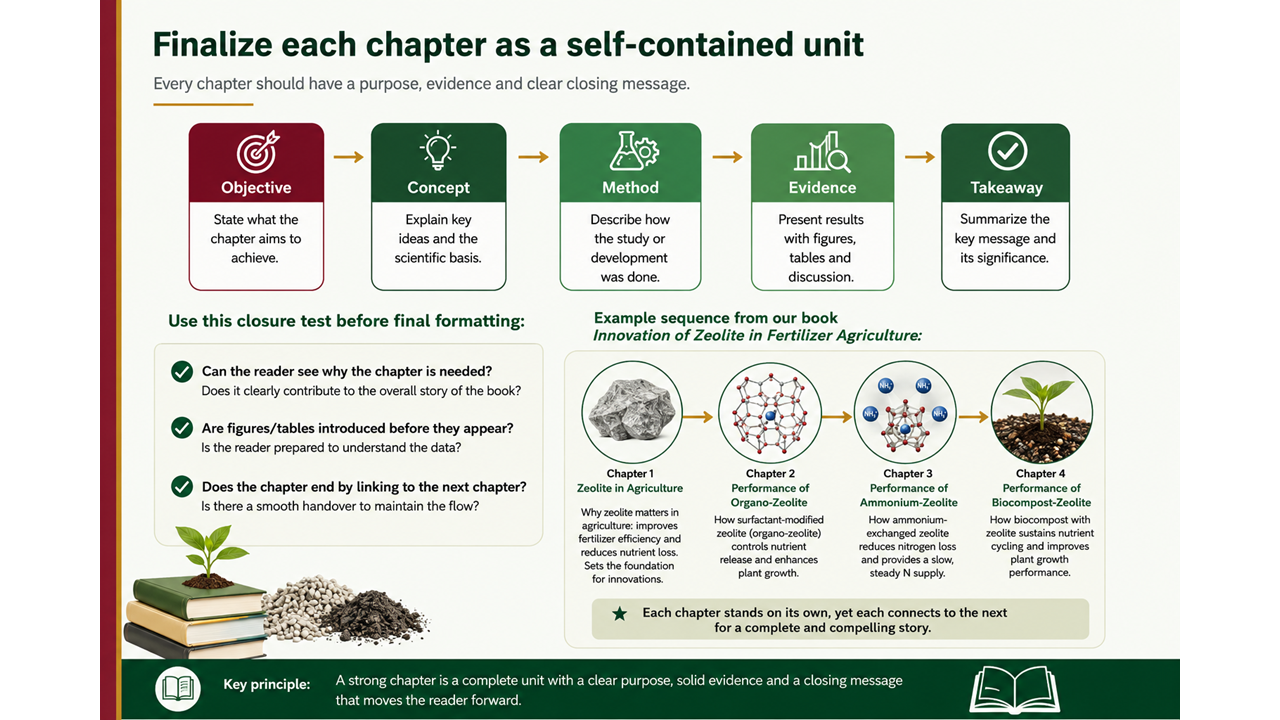
In Innovation of Zeolite in Fertilizer Agriculture, for example, the storyline begins with the challenges associated with conventional fertiliser use and nutrient loss before progressing towards material innovations involving organo-zeolite, ammonium-zeolite and biocompost-zeolite. Subsequent chapters provide evidence through nutrient-release studies and plant-growth performance.
This structure demonstrates an important principle for research-book authors: every chapter should contribute to the overall purpose of the book while remaining understandable as a self-contained unit.
A strong chapter should therefore have a clear objective, introduce the relevant scientific concepts, explain the methods or development process, present supporting evidence and conclude with a meaningful takeaway. It should also provide a logical transition to the chapter that follows.
Transform Research Results into Teachable Knowledge
Research books serve a different purpose from journal articles. Authors should therefore go beyond reporting what was done and what was discovered.
Figures, experimental results and case studies should be used to teach the underlying concept and demonstrate why the findings are important. The presentation illustrates this using examples such as surfactant-modified zeolite and ammonium-zeolite, where one figure can explain a scientific mechanism while another demonstrates its practical performance.
The key question for authors is therefore not simply, “What result should I include?” but also, “What should the reader learn from this result?”
This shift helps transform a research manuscript from a record of completed experiments into a useful scholarly reference that can support researchers, students and practitioners.
Use Visuals to Carry the Scientific Argument
Figures and tables are essential components of a research book. However, poorly prepared visuals can make an otherwise strong manuscript difficult to understand.
The presentation recommends redrawing low-resolution figures, maintaining a consistent numbering system such as Figure 1.1 and Table 1.1, and ensuring that captions explain the key message rather than merely identifying the object shown.
Concept diagrams can be used to explain theoretical relationships, characterisation data can provide scientific evidence, and graphical representations of plant or material performance can communicate outcomes efficiently.
Well-designed visuals should ultimately reduce the amount of explanation required from the text rather than create additional confusion.
Ensure That Methods Are Reproducible
Another important feature of a quality research book is reproducibility. Method sections should contain sufficient information for another researcher to reproduce or adapt the work.
Essential details may include sample formulations, masses, volumes, concentrations, treatment conditions, exposure times, collection intervals, analytical methods and calculations.
The example of NPK–organo-zeolite preparation in the presentation demonstrates how a method can be converted into a clear step-by-step process involving surfactant modification, filtration and washing, drying, nutrient loading and preparation of the final product.
A useful final question for authors is:
Can a new researcher reproduce the preparation, analysis and interpretation using only the information presented in the chapter?
If the answer is yes, the methodological description is likely sufficiently complete.
Do Not Leave Front and Back Matter Until the End
Authors often focus heavily on the chapters while postponing supporting sections of the manuscript. However, incomplete front and back matter can delay submission even when the scientific chapters are already complete.
Important components highlighted in the presentation include the preface, table of contents, list of figures and tables where applicable, references, index, synopsis, author biodata and photograph, copyright documentation and plagiarism screening requirements.
The index, in particular, should not be regarded merely as a publisher requirement. A well-designed index improves navigation and makes the research book considerably more useful to readers.
Apply Quality-Control Gates Before Submission
Before a manuscript is submitted, it should pass several levels of quality control.
The presentation proposes four major checks covering technical accuracy, editorial consistency, ethical clearance and production readiness. These include verifying terminology, units and symbols, interpretation of data, heading hierarchy, caption style, references, plagiarism requirements, permissions, authorship information and the completeness of manuscript files.
Performing these checks as a complete-manuscript review can prevent small technical or administrative issues from delaying publication.
A Four-Week Finalisation Strategy
For researchers who already have a substantially completed manuscript, the presentation proposes a practical four-week action plan.
During Week 1, authors can focus on content closure by reviewing chapter objectives, transitions and missing sections. Week 2 can be devoted to figures, tables and evidence verification. In Week 3, attention shifts towards references, indexing, glossary preparation and copyright permissions. Finally, Week 4 focuses on the submission package, including front and back matter, plagiarism screening, forms, proofreading and preparation of the required manuscript files.
This approach makes the finalisation process manageable by dividing a large manuscript into clearly defined tasks.
Completion Before Perfection
One of the strongest messages from the presentation is that authors should not allow the pursuit of perfection to prevent them from completing their manuscripts.
A research book can continue to improve through editorial review, peer feedback and the publishing process. The more productive approach is to first complete a strong, useful and coherent manuscript, and then refine it systematically.
Ultimately, a submission-ready research book can be expressed through a simple formula:
Coherent story + verified evidence + reproducible methods + standardised visuals + complete publisher requirements = a strong research book manuscript.
By approaching finalisation as a structured process rather than an endless cycle of revision, researchers can transform valuable research findings into accessible, credible and impactful scholarly books.