About Dr. Norshahirah Binti Mohamad Saidi

Senior Lecturer
Department of Physics, Faculty of Science
Universiti Teknologi Malaysia (UTM)

Email: norshahirah.ms@utm.my


Biography
Dr. Norshahirah Binti Mohamad Saidi is a Senior Lecturer at the Department of Physics, Faculty of Science, Universiti Teknologi Malaysia (UTM). Her research integrates nanomaterials, polymer electrolytes, and sustainable energy technologies, with a focus on developing innovative materials for energy harvesting, energy storage, and functional coatings.

She obtained her Doctor of Philosophy (Physical Science) from Universiti Malaya through the CREST R&D Fast Track Programme, where her work centered on the rational design of polymer blend gel electrolytes for dye-sensitized solar cells (DSSCs). She graduated with First-Class Honours in Materials Science from the same university.

Dr. Norshahirah has published over 30 ISI-indexed journal papers, a book chapter, and received more than 600 citations (h-index: 15). Her research excellence has been recognized with numerous innovation awards, including Gold Medals at ITEX, CITREX, MTE, and AIINEx, as well as the Researchfora Excellent Paper Award.

She has participated in several prestigious international programs, including the 71st Lindau Nobel Laureate Meeting (Germany), the Erasmus+ Programme at Ca’ Foscari University of Venice (Italy), and research internships at the National University of Singapore and the National Center for Nanoscience and Technology (China).

Her current work focuses on advanced 2D materials and hybrid polymer systems for sustainable and high-performance energy devices, supporting Malaysia’s commitment to green technology and net-zero carbon goals.


Self-Leadership In Higher Education

One Year, Many Lessons.

When I first stepped into Universiti Teknologi Malaysia as a new lecturer in June 2024, I felt both excitement and responsibility. The title “lecturer” is more than a position; it carries the weight of shaping young minds and guiding future researchers. Now, one year and three months into this journey, I find myself reflecting on what self-leadership means to me and how it has shaped my growth so far.

For me, self-leadership is about training myself to be the kind of leader my students deserve. It is not just about instructing them in lectures, but also guiding undergraduates in their learning process and helping postgraduate students navigate their research. In academia, there is no strict manual to follow; it is a constant process of learning, adapting, and improving. To lead others effectively, I must first lead myself. That is why self-leadership matters so much in my career.

I have always believed that teaching begins with empathy. I try to put myself in my students’ shoes, to imagine the struggles they face in understanding complex topics. By doing this, I can adapt my explanations and ensure that my teaching reaches them in meaningful ways. This ability has become one of my greatest strengths as a lecturer. At the same time, my love for research continues to drive me. I have always enjoyed designing and conducting experiments, and I was fortunate to be trained thoroughly during my PhD by my supervisor, Professor Ramesh from Universiti Malaya. Under his mentorship, I not only developed technical skills but also learned the value of patience and persistence. Guiding undergraduates in their final year projects during my doctoral years gave me a head start in understanding how to balance my own work while helping students achieve theirs.

Time management is another strength that I rely on. Academia requires juggling multiple roles at once: teaching, supervising, conducting research, and handling administrative responsibilities. While this balancing act is never easy, I have learned to plan carefully and manage my schedule so that no part of my role is neglected.

Of course, the journey is not without challenges. One of the areas I continue to struggle with is finding the right balance between all my responsibilities. At times, the demands of teaching consume the hours I wish to spend writing papers or developing new experiments. I also recognize that I am still in the process of building my scholarly voice. Publishing impactful work and positioning myself as an independent researcher in the international community is a long journey, one that requires persistence and confidence. Another challenge is expanding my academic network. While I have begun collaborating with colleagues and guiding students, I know that to make a greater impact, I need to extend my collaborations regionally and internationally.

Despite these challenges, I look forward with optimism. In the next ten years, I envision myself growing into a stronger scholar and academic leader. I aspire to be recognized at UTM for my contributions as both a lecturer and researcher. I also see myself leading a research team dedicated to polymer electrolytes, specializing in dye-sensitized solar cells, batteries, and supercapacitor applications. These areas of study excite me not only for their scientific potential but also for their role in advancing sustainable energy solutions. Alongside these goals, I hope to achieve the title of Associate Professor, a milestone that reflects years of effort, teamwork, and scholarly dedication.

To reach these aspirations, I know I must continue practicing self-leadership. Goal setting will be vital: I will need to define clear and realistic targets for teaching, research, and publications. Self-reflection will allow me to pause and evaluate what went well and what I could do better after every semester and every project. Self-regulation will help me manage my time wisely and focus on what truly matters, even if that means saying no to unnecessary tasks. Most importantly, self-motivation will keep me moving forward when faced with setbacks like rejected manuscripts or failed experiments. I have learned that in academia, small victories matter — whether it is a student finally understanding a concept or a successful experiment after many trials. Celebrating these moments sustains my motivation.

Looking back at my journey so far, I see how self-leadership has guided me through my first steps in academia. It has taught me to recognize my strengths, acknowledge my weaknesses, and set my eyes on the future. Teaching and research are not separate paths but intertwined roles that shape who I am becoming as a scholar. With self-leadership as my foundation, I believe I can continue to grow with purpose, resilience, and vision. I want to inspire my students not only through knowledge but through example — showing them that with discipline, reflection, and motivation, they too can achieve their goals.

My journey has just begun, but I carry with me the belief that the next decade will be filled with opportunities to grow, to lead, and to contribute meaningfully. Academia is a lifelong pursuit, and with self-leadership as my compass, I am ready to navigate its challenges and embrace its rewards.

Self-Leadership In Higher Education

One Year, Many Lessons.

When I first stepped into Universiti Teknologi Malaysia as a new lecturer in June 2024, I felt both excitement and responsibility. The title “lecturer” is more than a position; it carries the weight of shaping young minds and guiding future researchers. Now, one year and three months into this journey, I find myself reflecting on what self-leadership means to me and how it has shaped my growth so far.

For me, self-leadership is about training myself to be the kind of leader my students deserve. It is not just about instructing them in lectures, but also guiding undergraduates in their learning process and helping postgraduate students navigate their research. In academia, there is no strict manual to follow; it is a constant process of learning, adapting, and improving. To lead others effectively, I must first lead myself. That is why self-leadership matters so much in my career.

I have always believed that teaching begins with empathy. I try to put myself in my students’ shoes, to imagine the struggles they face in understanding complex topics. By doing this, I can adapt my explanations and ensure that my teaching reaches them in meaningful ways. This ability has become one of my greatest strengths as a lecturer. At the same time, my love for research continues to drive me. I have always enjoyed designing and conducting experiments, and I was fortunate to be trained thoroughly during my PhD by my supervisor, Professor Ramesh from Universiti Malaya. Under his mentorship, I not only developed technical skills but also learned the value of patience and persistence. Guiding undergraduates in their final year projects during my doctoral years gave me a head start in understanding how to balance my own work while helping students achieve theirs.

Time management is another strength that I rely on. Academia requires juggling multiple roles at once: teaching, supervising, conducting research, and handling administrative responsibilities. While this balancing act is never easy, I have learned to plan carefully and manage my schedule so that no part of my role is neglected.

Of course, the journey is not without challenges. One of the areas I continue to struggle with is finding the right balance between all my responsibilities. At times, the demands of teaching consume the hours I wish to spend writing papers or developing new experiments. I also recognize that I am still in the process of building my scholarly voice. Publishing impactful work and positioning myself as an independent researcher in the international community is a long journey, one that requires persistence and confidence. Another challenge is expanding my academic network. While I have begun collaborating with colleagues and guiding students, I know that to make a greater impact, I need to extend my collaborations regionally and internationally.

Despite these challenges, I look forward with optimism. In the next ten years, I envision myself growing into a stronger scholar and academic leader. I aspire to be recognized at UTM for my contributions as both a lecturer and researcher. I also see myself leading a research team dedicated to polymer electrolytes, specializing in dye-sensitized solar cells, batteries, and supercapacitor applications. These areas of study excite me not only for their scientific potential but also for their role in advancing sustainable energy solutions. Alongside these goals, I hope to achieve the title of Associate Professor, a milestone that reflects years of effort, teamwork, and scholarly dedication.

To reach these aspirations, I know I must continue practicing self-leadership. Goal setting will be vital: I will need to define clear and realistic targets for teaching, research, and publications. Self-reflection will allow me to pause and evaluate what went well and what I could do better after every semester and every project. Self-regulation will help me manage my time wisely and focus on what truly matters, even if that means saying no to unnecessary tasks. Most importantly, self-motivation will keep me moving forward when faced with setbacks like rejected manuscripts or failed experiments. I have learned that in academia, small victories matter — whether it is a student finally understanding a concept or a successful experiment after many trials. Celebrating these moments sustains my motivation.

Looking back at my journey so far, I see how self-leadership has guided me through my first steps in academia. It has taught me to recognize my strengths, acknowledge my weaknesses, and set my eyes on the future. Teaching and research are not separate paths but intertwined roles that shape who I am becoming as a scholar. With self-leadership as my foundation, I believe I can continue to grow with purpose, resilience, and vision. I want to inspire my students not only through knowledge but through example — showing them that with discipline, reflection, and motivation, they too can achieve their goals.

My journey has just begun, but I carry with me the belief that the next decade will be filled with opportunities to grow, to lead, and to contribute meaningfully. Academia is a lifelong pursuit, and with self-leadership as my compass, I am ready to navigate its challenges and embrace its rewards.

Manners and Ethics as an Educator

Becoming a lecturer is not merely about delivering knowledge in classrooms; it is a profound responsibility that carries the weight of shaping minds and nurturing future leaders. The role comes with duties that extend far beyond teaching, including guiding, supervising, researching, and embodying the values of integrity and professionalism. At Universiti Teknologi Malaysia (UTM), these responsibilities are further anchored in the UTM Professional Code of Ethics, the Public Service Ethics of Malaysia, and the UTM Educational Goals, which collectively emphasize producing graduates who are knowledgeable, ethical, and globally competitive. Thus, the values of ethics, integrity, professionalism, and trustworthiness are central to the academic profession.

Since beginning my journey as a lecturer at UTM, I have realized the importance of courtesy in oral and written communication. Effective communication is more than just the transmission of information; it is a bridge for building meaningful relationships. With students, respectful and empathetic communication creates a positive learning environment. When students feel that their voices are heard and valued, they are more willing to engage, ask questions, and seek guidance. Among colleagues, courteous communication fosters collaboration, reduces misunderstandings, and encourages collective growth in teaching and research. With university administrators, the ability to communicate ideas clearly and respectfully strengthens trust and ensures smoother cooperation. Beyond the institution, in the wider academic community, the tone and professionalism in our written work — whether in publications, reports, or conference presentations — reflect not only personal credibility but also the reputation of UTM.

In addition to communication, appropriate and dignified personal appearance plays an essential role in reflecting professionalism. As lecturers, the way we dress and conduct ourselves is a mirror of our integrity. Dressing neatly and appropriately for academic contexts signals respect for the profession and sets a standard for students. A lecturer who embodies professionalism in appearance naturally earns the respect of students, who view their lecturer not only as a source of knowledge but also as a role model. Furthermore, appropriate presentation builds confidence among colleagues and university leaders, particularly when representing the institution at conferences, seminars, or collaborative events. Professional demeanor thus becomes a form of silent communication that reinforces credibility and respect.

Nevertheless, the academic profession cannot thrive without academic integrity, professionalism, and trustworthiness. In teaching, integrity requires lecturers to deliver accurate, relevant, and up-to-date content, while avoiding plagiarism or misinformation. In research and publications, integrity demands honesty in reporting data, acknowledging the contributions of others, and resisting the temptation to manipulate findings for personal gain. Supervising students also calls for dedication and patience, as each student faces unique challenges that require tailored guidance. In administration, lecturers are entrusted with responsibilities that must be carried out fairly and without personal bias. These values are explicitly emphasized in the UTM Code of Ethics and the Public Service Ethics of Malaysia, which stress transparency, accountability, and dignity in service. They remind us that academic professionalism is not just a job, but a trust.

As a new lecturer, I am beginning to experience the real challenges of embodying these values. The first challenge is balancing multiple roles. On one hand, I must dedicate time to teaching and ensure my students achieve their learning outcomes. On the other hand, I must pursue research to establish myself as an independent scholar. Administrative duties further add to the workload. At times, my research focus is disrupted by heavy teaching commitments, and sometimes the reverse occurs. This constant juggling of roles is a source of pressure, as each area demands full attention. I have come to realize that effective time management and clear prioritization are the keys to addressing this challenge.

The second challenge is building confidence in delivery. Although I gained teaching experience during my PhD, stepping into the lecture hall as an official lecturer carries much greater weight. Each lecture is no longer just a presentation of notes; it requires active engagement, continuous assessment, and alignment with UTM’s educational goals. Moreover, the expectations from both the university and the students are high, as they anticipate quality teaching that inspires and motivates. At first, I felt nervous about meeting these expectations, but I soon realized that confidence comes with preparation, openness to feedback, and a willingness to continuously improve my teaching methods.

The third challenge is building a research network. As an early-career academic, I am still in the process of establishing my scholarly identity. I understand that high-quality research cannot be achieved in isolation. Collaboration with colleagues — both within and outside the university — is essential to strengthen research outcomes, access funding, and increase international visibility. However, the challenge lies in finding the time and opportunities to cultivate these collaborations amidst teaching and administrative commitments. To address this, I have resolved to be more proactive in attending conferences, seminars, and networking sessions to position myself within a wider research community.

In facing these challenges, I believe there are concrete steps I can take to strengthen my practice of ethics, professionalism, and trustworthiness. First, I must discipline myself through systematic time management, such as creating weekly schedules that balance teaching, research, supervision, and administrative tasks. Second, I am committed to continually improving my communication skills, both in teaching delivery and in daily interactions, so that I can build stronger relationships with students, colleagues, and administrators. Third, I intend to strategically build research networks by seeking collaborators whose expertise complements mine, and by being willing to step outside my comfort zone to join new academic communities.

This reflection reminds me that the academic profession is not simply about teaching or publishing; it is an enduring trust that demands exemplary character. Values of ethics and integrity serve as guiding principles in every aspect of academic life, from dealing with students and colleagues to engaging with the global research community. Professionalism and trustworthiness are the pillars that determine how much impact I can create. While challenges will always exist, I believe that with determination to strengthen my values and with commitment to self-improvement, I can grow into a lecturer who is competent, respected, and capable of contributing meaningfully to the university, my students, and society at large.

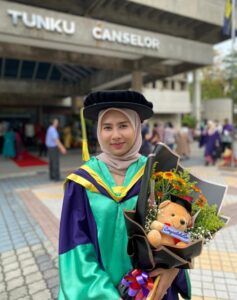
DR. NORSHAHIRAH MOHAMAD SAIDI

Senior Lecturer
Department of Physics, Faculty of Science
Universiti Teknologi Malaysia (UTM)

Email: norshahirah.ms@utm.my

Biography
Dr. Norshahirah Binti Mohamad Saidi is a Senior Lecturer at the Department of Physics, Faculty of Science, Universiti Teknologi Malaysia (UTM). Her research integrates nanomaterials, polymer electrolytes, and sustainable energy technologies, with a focus on developing innovative materials for energy harvesting, energy storage, and functional coatings.

She obtained her Doctor of Philosophy (Physical Science) from Universiti Malaya through the CREST R&D Fast Track Programme, where her work centered on the rational design of polymer blend gel electrolytes for dye-sensitized solar cells (DSSCs). She graduated with First-Class Honours in Materials Science from the same university.

Her current work focuses on advanced 2D materials and hybrid polymer systems for sustainable and high-performance energy devices, supporting Malaysia’s commitment to green technology and net-zero carbon goals.