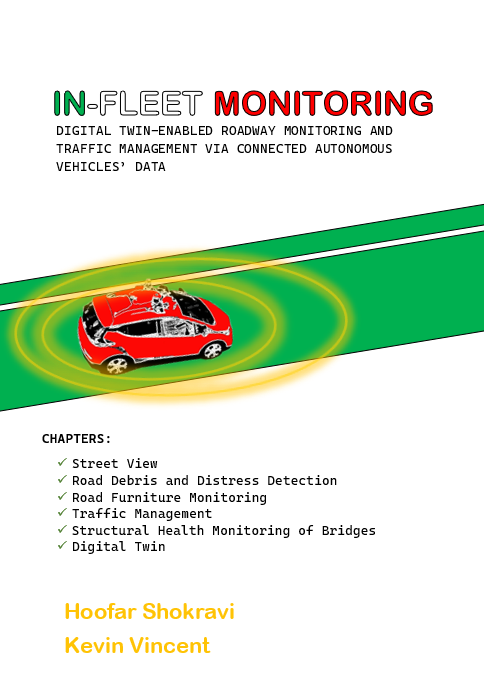
The tentative book title, “In-Fleet Monitoring: Digital-Twin-Enabled Roadway Monitoring and Traffic Management via Connected Autonomous Vehicles’ Data,” has been selected to clarify and explain the conceptual framework and capabilities of the proposed In-Fleet monitoring approach. The volume will be developed under the editorship of the project’s principal investigator, Hoofar Shokravi, and Kevin Vincent, Director of the Centre for Connected and Autonomous Automotive Research and the National Transport Design Centre at Coventry University. While existing scholarly work predominantly focuses on vehicle-centric safety applications of connected autonomous vehicles (CAVs)—such as road perception, localization, and inter-vehicle communication—no prior traffic-centric research has systematically leveraged real-time CAV data streams to develop a unified, scalable framework for proactive roadway condition monitoring and adaptive traffic management.
To our knowledge, this represents the first effort to integrate CAV-derived data holistically across infrastructure networks, transcending isolated safety applications to address system-wide efficiency and resilience. This work addresses critical gaps in modern intrusion detection systems by introducing a cyber-physical platform that fulfills all five pillars of Industry 4.0 and Smart City frameworks:
- Real-time responsiveness
- Network-wide coverage
- Continuous operation
- Crowdsourced data integration
- Full automation
While existing methods (e.g., stationary CCTV, IoT sensors) excel at real-time and automated detection, they lack scalability, crowdsourcing, and holistic network integration—limitations that undermine their utility in adaptive traffic management. Our platform uniquely leverages CAVs as dual-purpose sensor-actuator networks, combining their multimodal perception systems (LiDAR, GNSS, IMUs, cameras) and V2X connectivity to achieve sub-meter localization accuracy and system-wide interoperability. Building on the In-Fleet framework for bridge health monitoring, we expand CAVs’ role to enable:
- Proactive roadway diagnostics: Early detection of pavement distress, debris, and congestion via direct vehicle-pavement interaction and crowdsourced LiDAR/telemetry data.
- Adaptive traffic control: Real-time rerouting and speed adjustments using network-wide CAV-derived traffic flow analytics.
- Cost-efficient scalability: Elimination of dedicated infrastructure through the reuse of CAV sensor data across jurisdictions.
This integration of mobile sensing, edge computing, and participatory data fusion establishes the first end-to-end solution for roadway monitoring and traffic management that concurrently satisfies all five Industry 4.0 requirements.
