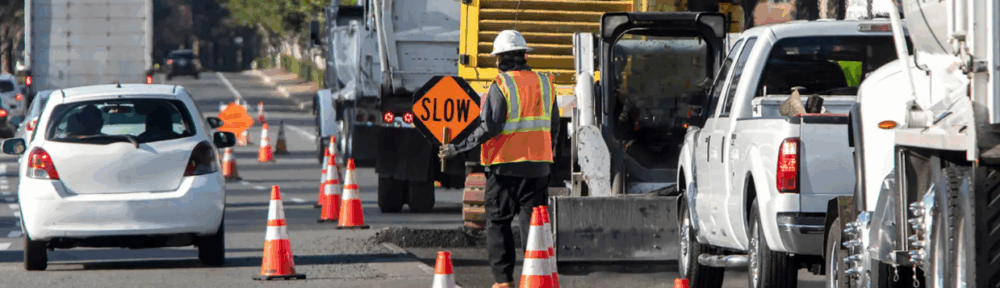
Robust intrusion detection system (IDS) is essential for modern transportation safety in temporary road construction and maintenance zones, integrating both classical and advanced methodologies to address dynamic safety challenges. These transient zones—defined by traffic cones, portable flashing lights, flaggers, and partial lane closures—represent some of the most hazardous environments in transportation infrastructure, as they face elevated crash risks due to unpredictable traffic patterns and reduced visibility.
Unlike permanent infrastructures, temporary work zones lack fixed sensors, standardized communication protocols, and predictable driver behavior patterns. Traditional methods primarily rely on passive visual cues—such as cones and signage—and human flaggers. However, these approaches suffer from high latency in driver response and poor visibility in low-light conditions, underscoring the need for more responsive, reliable safety solutions.
A safe and reliable IDS for road construction must integrate Real-time responsiveness, Network-wide coverage, Continuous operation, Crowdsourced data integration, and Automated decision-making. Real-time capability is vital because delays in alerts fail to prevent collisions in dynamic work zones where vehicles operate at high speeds and demand extremely short reaction times. Network-wide coverage ensures holistic monitoring across multiple jurisdictions, eliminating blind spots and unexpected encounters. Continuous operation addresses the around-the-clock nature of hazards—such as nighttime intrusions or equipment failures—which intermittent systems may not capture. Crowdsourced data leverages user-generated inputs from connected vehicles and navigation apps to overcome sensor coverage gaps and enhance detection accuracy. Finally, Automated processes reduce human latency and bias, enabling proactive measures such as automatic speed adjustments or lane closures. Collectively, these attributes form a cyber-physical safety framework that supports scalability and resilience against unpredictable road construction hazards.
Below is Table 1, which categorizes various work zone safety detection methods under Stationary, Mobile, or Hybrid configurations. It also indicates whether each method supports Real-time, Network-wide, Continuous, Crowdsourced, and Automated capabilities. Although many solutions offer Real-time alerts and at least partial Automation, most lack Network-wide functionality, Crowdsourced data integration, or truly Continuous coverage. Consequently, no single method fully addresses all five criteria, highlighting the need for a combination of approaches to achieve a robust, comprehensive intrusion detection system for road construction zones.
