
| School/Faculty: | Electrical Engineering/Engineering |
| Program name: | Master in Electrical Engineering |
| Course code: | MKEE 1013 |
| Course name: | Research Methodology in Electrical Engineering |
| Credit hours: | 3 |
| Pre/co requisite: | Nil |
| Course synopsis: | This course discusses the fundamental processes in conducting an academic research, particularly in the field of electrical engineering (EE). Among the topics that will be covered are introduction to research and its philosophy, problem formulation and research objective, literature review, research methodology and design, data collection procedures and data analysis, research management and ethics. Another important aspect that will focused is on technical writing that can be utilized for scientific publications, research proposal and thesis. Despite the specific application on the field of EE, the general principles can be used in other discipline. |
| Course coordinator/ Lecturer | Prof. Dr. Zulkurnain Abdul Malek P06-101 (UTM JB) +6012-7167607 zulkurnain@utm.my people.utm.my/zulkurnain |
Mapping of the Course Learning Outcomes (CLO) to the Programme Learning Outcomes (PLO), Teaching & Learning (T&L) methods and Assessment methods:
| No. | Course_Learning_Outcomes (CLO) | PLO (Code) | Taxon./ Generic Skills | T&L methods | Assessment methods |
| CLO1 | Comprehend the process in conducting academic research | PLO1 PLO2 | C3, P1, A2 C4, P5, A3 | Lecture, active learning | T, F |
| CLO2 | Formulate research problem from research papers | PLO1 PLO3 PLO5 | C4, P4, A3 C5, P6, A2 C6, P4, A3 CS1-CS4 | Lecture, active learning | T, F |
| CLO3 | Design suitable techniques/ methodology for the proposed research | PLO2 PLO6 | C6, P4, A3 C6, P4, A4 LL1-LL3 | Lecture, active learning | PRR, Pr |
| CLO4 | Communicate, and express knowledge and ideas effectively in oral and written presentations. | PLO4 PLO5 PLO6 | CS3, P1, A5, EM3 C5, P5, A4, CS1-CS4 C4, P2, A2, LL1-LL3 | Project-based learning | PRR, Pr |
Details on Innovative T&L practices:
| Active learning | Conducted through in-class activities |
| Project-based learning | Conducted through design assignments. Students are to develop a research proposal as thought in the course involving the literature review analyses, method design and plans for implementation. Compliance to the research proposal specifications need to be given in the form of oral presentation and written reports. |
Weekly Schedule:
Students are expected to turn-on their cameras during lectures as if they have entered the Virtual ClassRoom. Thank you for your cooperation.
| Week_Dates_Hrs 1 31 Jul-1 Aug 16 hours | Introduction to MKEE 1013 (1 hr) |
| Chapter 1. Introduction to Research (1 hr) What is research? Purpose of research, Type of research Worldwide Scenario of Research Activities Breaking the knowledge boundary Level of research: Research Contribution (MEE of PhD) Research outputs Chapter 2. Hypothesis, Problem Formulation, and Objectives (5 hrs) Overview of the research process What is Hypothesis? What is a research problem: Step in formulating a research problem How to identify the research gap? Formulation of Problem Statement Research question and / or hypothesis Writing Research objectives Research Scopes Research outcomes Lecture Video 31 Jul 9am-1pm Lecture Video 31 Jul 2pm-5pm Assignment 1 (on Problem statement and objectives) (10%) DUE DATE: 5pm Submit Assignment 1 Chapter 3. Literature Review (5 hrs) What is literature review? Rationale for literature review Framework of literature review How to look for literature: sources; quality of sources; databases. Information search methods: internet search, library search Managing reading material: Writing critical notes; making sense of information; Making proper referencing Information Search Endnote Turnitin1 Turnitin2 Lecture Video 1 Aug 9am-1pm Lecture Video 1 Aug 2pm-5pm Assignment 2 (on LR) (10%) DUE DATE: 5pm Submit Assignment 2 | |
| Chapter 4. Research Design (updated) (4 hrs) What is research design? Understanding research resources Purpose of research design Selecting and developing research instruments Evaluation of research methodology and design Building research design matrix Gantt Chart and milestones | |
| Assignment 3 (on Research Design) (10%) DUE DATE: 5pm Submit Assignment 3 | |
| 2 21-22 Aug 16 hours | Chapter 5. Data Collection And Analysis (updated) (4 hrs) What is data collection? Types of data: primary vs secondary. qualitative and quantitative Methods, tools and techniques for data collection Types of data analysis Steps in data analysis Connecting research objective to data analysis Quantitative and Qualitative analysis Assignment 4 (on data and analyses) (10%) DUE DATE: 5pm Submit Assignment 4 Please use Power Point Slides to present this assignment |
| Chapter 6. Technical Writing I (Overview of scientific writing) (5 hrs) What is scientific publication? Motivation to publish during study Scientific databases: Scopus, WoS, Google Scholar Journals: Types, Impact factor, Quartile Citations, h-index; Journal selection Other publications: Conference Proceedings, Book Chapters, Research Monographs Types of articles: Original research, Review, Letters Editorial processes | |
| Chapter 7. Technical Writing II (Mechanics of writing) (5 hrs) Format of scientific papers: IMRAD Formulating Title Writing Structured Abstract Writing Introduction Section Writing Method Section Writing Results and Discussion Section Writing Structured Conclusion References Lecture Video 11 Sep 2pm-5pm Lecture Video 12 Sep 9am-1pm | |
| Assignment 5 (on Technical Writing) (20%) DUE DATE: 5pm Submit Assignment 5 Lecture Video 21 Aug 9am-1pm Lecture Video 21 Aug 2pm-5pm Lecture Video 22 Aug 9am-1pm Lecture Video 22 Aug 2pm-5pm | |
| 3 11-12 Sep 16 hours | Chapter 8. Thesis (2 hrs) What is MEE/PhD Thesis? Structure of Thesis: Conventional, Journal paper compilation When to start writing Format and styles Submission and examination and correction |
| Chapter 9. Research Proposal (8 hrs) What is Research Proposal? Types of Research Proposal Funding for research Components: Objective, Method, Outcomes, Budget Writing a winning proposal Defending Research Proposal Assignment 6 (on Research Proposal) (40%) Thesis Manual DUE DATE: 5pm Submit Assignment 6 Sample of A Complete Proposal & Its Presentation Slides Another sample of research proposal (Warning: Not UTM Thesis Format! and some components in Chapter 3 are missing) In-Lecture Sample Presentation Slides for Assignment 6 (max 20 slides) Chapter 10. Research Management (2 hr) Project planning Intellectual properties: publications, patents, copyrights, start-ups. Ethical issues: Fabrication, falsification, plagiarism. Examples of high-profile cases | |
| Course Summary and Revision | |
| Submit e-ppp | |
| Starting |
Transferable skills (generic skills learned in course of study which can be useful and utilised in other settings):
- Verbal communication (via in-class presentation)
- Written communication (Report writing)
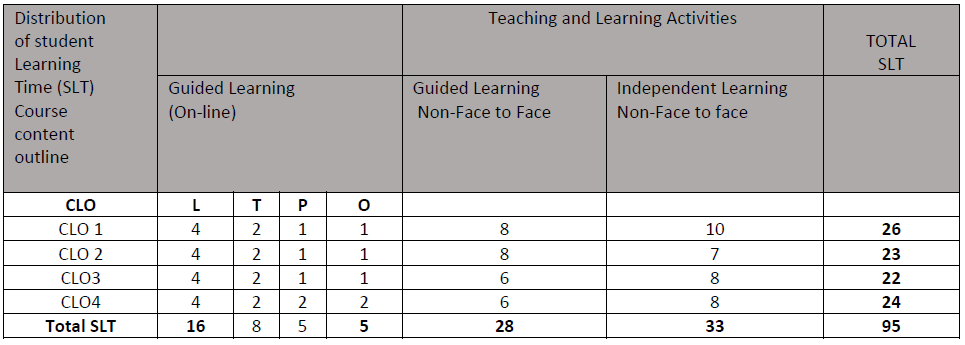
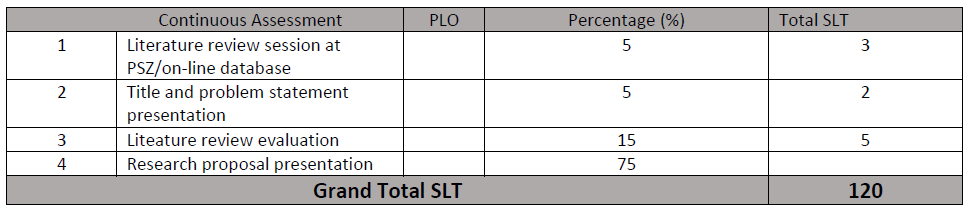
Student learning time (SLT) details:
Assessment Samples
- x
Special requirement to deliver the course (e.g: software, nursery, computer lab, simulation room):
- Access to computers
Learning resources:
Main references
- Nil
Additional references
- Welman, C. , Mitchell, B. & Kruger, F. (2005). Research Methodology. 3rd Edition. Cape Town: Oxford University Press.
- Yogesh Kumar Singh , (2006). Fundamental Of Research Methodology & Statistics, New Age International (P) Ltd. , Publishers.
- C. R. Kothari, (2004). Research Methodology Methods and Techniques, New Age International(P) Ltd. , Publishers.
- Dawson, Catherine, 2002, Practical Research Methods, New Delhi, UBS, Publishers’ Distributors
- Kumar, Ranjit, 2005, Research Methodology-A Step-by-Step Guide for Beginners,(2nd.ed.),Singapore, Pearson Education.
Online
- WA https://chat.whatsapp.com/EF4G54rjcxX1lC90UKKpVc
- https://people.utm.my/zulkurnain/teaching/mkeu-0013-introduction-to-research-methodology-in-ee/
Academic honesty and plagiarism:
Assignments are individual tasks and NOT group activities (UNLESS EXPLICITLY INDICATED AS GROUP ACTIVITIES)
Copying of work (texts, simulation results etc.) from other students/groups or from other sources is not allowed. Brief quotations are allowed and then only if indicated as such. Existing texts should be reformulated with your own words used to explain what you have read. It is not acceptable to retype existing texts and just acknowledge the source as a reference. Be warned: students who submit copied work will obtain a mark of zero for the assignment and disciplinary steps may be taken by the Faculty. It is also unacceptable to do somebody else’s work, to lend your work to them or to make your work available to them to copy.
Disclaimer:
All teaching and learning materials associated with this course are for personal use only. The materials are intended for educational purposes only. Reproduction of the materials in any form for any purposes other than what it is intended for is prohibited.
While every effort has been made to ensure the accuracy of the information supplied herein, Universiti Teknologi Malaysia cannot be held responsible for any errors or omissions.