INTRODUCTION
Globalisation hit us hard. The world we live in today is totally different from the world we once knew. The world today knows no border, yet this does not mean that people are all the same. In the work setting convergence seems the norm; if you walk into an office in Cambridge, Kuala Lumpur or Canberra it will look very similar. However, in domestic settings, at home, with friends, and having fun, the differences become apparent; the colours, the food, the sense of humour, the social relationships. Even back in the office look at the attitudes and the social structures within the work environment; the diversity of user communities is clear.
There are many examples that prove the existence of diverse backgrounds in the computing world. Nearly every usability study requires the investigators to identify participants’ backgrounds. We use the information to tell us whether the results of the experiments or studies may be influenced by the diversity effects. In other work the differences are the focus of the design or experiments, for example, long-standing work on internationalisation and national culture [5], or Desmet et al. [6] who acknowledge between-culture differences by measuring emotional responses to products.
This emotional response is critical. Both in work-oriented products, where individual efficiency is closely linked to personal motivation, and even more in domestic, entertainment and e-commerce areas, the importance of the user experience is becoming important if not paramount. For some this sort of issue has been a long-term interest [10] but it has increasingly become ‘mainstream’ in HCI textbooks [8, 13] and the launch of the ACM SIGCHI ACE conference in 2004. In particular, the term ‘funology’ has recently been coined in response to this new perspective that tries to move usability to enjoyment, or fun [3].
So whilst we acknowledge the existence of diversity amongst the user communities, we would like to relate this directly with funology and enjoyable experiences. This paper attempts to discover in what way (if any) the emotions when we experience fun are different between cultures. To address this, we focus on the terminology of ‘fun’, by comparing its definitions with the closest words in the Malay language that give similar meanings. We have chosen the Malay language partly due to the conspicuous differences between Eastern and Western cultures. This makes it interesting to identify and understand the context of fun from the English and Malay points of view: do the definitions correspond to one another, and what are the contexts that only exist in one culture that cannot be described in another? In addition, one of the authors is herself Malay. It is difficult, or perhaps impossible, to study these issues of felt experience without some direct knowledge of the cultures involved.
It is important to understand these differences for two reasons. On the one hand, it highlights a problem: we need to be able to design ‘fun’ interfaces that can support diverse user communities. On the other hand, it offers us an opportunity: to see the words in the different languages take a different ‘cut’ through the conceptual landscape of ‘fun’ and help us to understand finer details and distinctions. The difficulty with studying common-felt experience is that it is just too common, too tacit. The differences between languages foreground otherwise hidden issues.
WHAT IS FUN?
For many years, usability has focused on efficiency and robustness, concepts such as tasks, efficiency, ease of use, and ease of learning. However, new ideas of usability include issues of aesthetics, enjoyment, play and, user experience [3]. These ideas are valuable as they won’t just make the designs better but would also create a more exciting interaction with the technology compared to the days when the ultimate aim is to get the operation and precision correct.
Increasingly research in software applications, games, learning and even consumer devices is paying attention to enjoyment in user experience: for example, improving eLearning by making the online course fun and engaging [12], learning activities for children [11], an early study of investigating playful characteristics of the World Wide Web [1], the role of competition as enjoyment in video games [16], and fun and enjoyable experience in consumer electronics [9, 14] and mobile devices [15].
So, what is fun anyway? From the Cambridge online dictionary [4], ‘fun’ as a noun form is defined as pleasure, enjoyment and amusement, whilst ‘fun’ as an adjective is defined as enjoyable. If we observe our daily conversation, fun sometimes is used interchangeably with pleasure, enjoyment and playfulness, and is very much about emotion. Whilst the broad issues of adopting fun are entering HCI, little work has attempted to differentiate one concept from another, with exceptions [2] distinguishing fun and pleasure.
What we would like to concentrate on at this juncture is not the differences that distinguish fun from similar English words, but the relations or associations of the word ‘fun’ with similar words in the Malay language. From the many Malay words listed below, the words seronok and riang are the ones that have the closest meaning to the word fun. But how far true is this? How can we be so sure that everything that fun describes can be exactly described in the Malay language by a mere translation? And are there conditions where the words in Malay illustrate situations that the word fun doesn’t?
English: fun, pleasant, enjoyable, amusement, entertaining, playfulness
Malay: seronok, riang, gembira, hiburan, gurau-senda, sukacita, ceria, bahagia
SERONOK OR RIANG?
Rather than simply looking at the Malay ‘dictionary’ translation of fun – seronok and riang, we need to examine how the words are used to enable us to identify the emotions involved and the conditions where the emotions are normally shown. To illustrate these, Tables 1 and 2 give example sentences, together with a checklist of (English) emotions that are associated with the sentences.
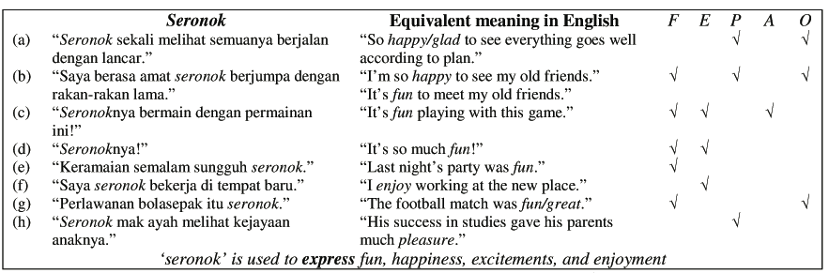
F: fun, E: enjoyment, P: pleasure, A: amusement, O: others
Table 1: Seronok alongside the equivalent English sentences and associated emotions
—–
In Part 2, we’ll continue unpacking how different languages and cultural expressions—like the Malay word riang—help us uncover subtle emotional nuances that are crucial for inclusive and enjoyable technology design.