Previously, we explored how English and Malay cultures express “fun” through the word seronok. In this post, we dive deeper into another important word—riang—and its role in emotional expression and design.
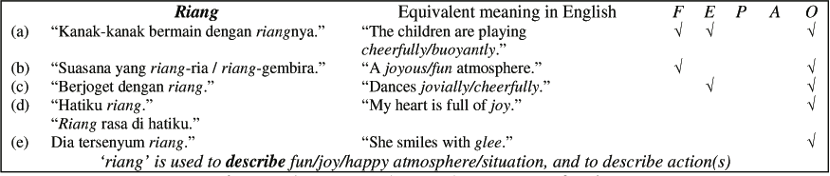
F: fun, E: enjoyment, P: pleasure, A: amusement, O: others
Table 2: Riang alongside the equivalent English sentences and associated emotions
Note that although there is a lot of overlap between, for example, soronok and fun, there are also differences (e.g. in English one would not say that it is ‘fun’ that something is going to plan). We can think of the words as delineating areas of a conceptual emotion landscape (see Fig. 1), where the languages take different ‘cuts’ through the landscape. The points of intersection and difference can help us to understand the fundamental attributes of the emotions, rather than the attributes of a particular experience (virtual crackers) uncovered in Dix [7]. Although we cannot explore this in full here, we can start to look at a few issues the approach uncovers.
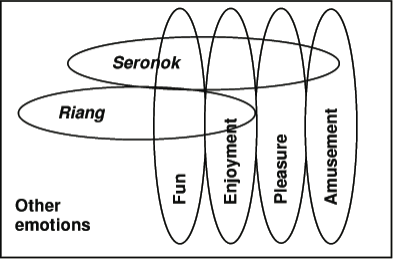
Figure 1: The emotion landscape (schematic only: the words soronok and riang overlap in meaning as do the English words with one another)
One clear point from the emotional landscape is that relative to fun, and its related words, there are certain emotions of seronok and riang which do not encompass in any of the four English words. Of the two Malay words, seronok, is the word that comes closest to fun, as the word is used to describe or express fun, pleasure and enjoyment. This word is also used to express or to show happiness, gladness and excitement, which apparently are not what fun is about.
Although riang, from the sentences given above, shows no close correspondence to the word fun, riang however is commonly used to describe a happy atmosphere, setting or situation or one’s expression of happiness. Another interesting remark when constructing examples for the word riang is the fact that it ordinarily addresses children rather than adults. It is uncommon to hear the word riang describing the happy behaviour shown by an adult. To some extent this also reflects childlike or childish connotations of the word fun in English, hence the reason why examples (a) and (h) (from Table 1) do not sound like ‘fun’.
It is also interesting to see how seronok and riang correspond to amusement. There is a direct translation of ‘amusement’ in Malay, the word hiburan. For example, ‘amusement park’ is translated directly into Malay as taman hiburan. Nonetheless, when a suffix is added to the word seronok it is changed to menyeronokkan which also means entertaining or amusing.
DISCUSSION
We have seen that emotions play such a large part in defining the application of each word. In the Malay culture, the word seronok is expressed when one expresses the fun that he/she is experiencing, enjoyment, happiness, and even excitement. From the investigation, in contrast to the Malay word, the word fun alone cannot describe one’s emotion when experiencing fun. Imagine you are enjoying a ride at a theme park. To describe your ‘emotion’ in English you either say, “This ride is fantastic!”, or, “I’m having so much fun!” But when it comes from a Malay, the answer would be no more than one word, which is, Seronok! The word seronok per se is able to express one’s emotion, a word answer is sufficient to describe the whole emotion one is experiencing.
It is fascinating indeed to see that there is more than just a mere translation at work. Seeing what fun really means from two different horizons gives us insight into the way each culture perceives and applies ‘fun’. Although in the beginning, it seemed as if seronok suits perfectly as fun’s description, it turns out that the Malay word is not just used to express the experience of fun, but also to express excitement, happiness and enjoyment. Furthermore, seronok is different from fun in a way that seronok itself can be used to express emotions.
The Malay culture is different to the English in many ways. East vs. West says it all. When we look deeper, the reason why the single word seronok has the ability to express emotion may be due to the way the Malay culture expresses itself. Unlike the English, the Malay culture expresses many things with ‘feelings’, rather than ‘thinking’. For instance, in English culture, one normally expresses things by saying, “I think…”, but in Malay culture, one says, “Saya rasa...” which translates to “I feel…” Possibly the ability to show emotions of fun in the Malay and English languages is all down to how each culture expresses itself (or visa versa). Perhaps Wittgenstein’s phenomenological view of language is due to an English obsession with external appearance!
Malay ‘feel’ shows fun as emotions
English ‘think’ shows fun as emotions
CONCLUSION
Starting with a focus on experience in usability and ‘funology’ has inspired us to examine how two different cultures, English and Malay, as expressed in the words they use, perceive fun and in what way they show or express fun. We identified contexts in which the words seronok and riang appear in Malay conversation and how they compare with the English word ‘fun’ and related terms. These examples of sentences and situations allow us to explore the emotional landscape and uncover subtle differences and nuances of ‘fun’ experiences.
At one level the closest word in Malay to fun is seronok, but the differences highlight the individual ways in which culture shows or expresses their emotions. Whereas the Malay word seronok is more about feelings the English word fun is about experiences. It is open to discussion (and coffee room argument!) whether this betrays a more fundamental difference between Malay expressing itself in feeling as compared with English in thought or appearance.
This study certainly provides us insights that tell us that fun experiences cannot be accepted as something that is the same for everyone. It is part of our broader investigations into how technology in domestic settings of different cultures could affect the way users want the technology to be integrated into their homes. We believe that as an analytic technique, the use of multiple languages can be a touchstone and probe to uncover subtle differences between cultures and also to help us build richer vocabularies of the felt experience.
REFERENCES
[1] Atkinson M. and Kydd C. (1997) Individual characteristics associated with World Wide Web use: an empirical study of playfulness and motivation, ACM SIGMIS Database, Volume 28 Issue 2, April 1997.
[2] Blythe M.A. and Hassenzahl M. (2003a) “The Semantics of Fun: Differentiating Enjoyable Experiences” in Blythe et al. (2003b), pp. 91-100.
[3] Blythe M.A., Overbeeke K., Monk A.F. and Wright P.C. (eds.) (2003) Funology, Human-Computer Interaction Series, Volume 3, Kluwer Academic Publishers, Netherlands.
[4] Cambridge Dictionaries Online (2007) URL http://dictionary.cambridge.org, Accessed 2007.
[5] Del Galdo, E. and Nielsen, J., (eds.) (1996) International User Interfaces, John Wiley and Sons, New York.
[6] Desmet P.M.A., Hekkert, P., and Jacobs, J.J. (2000) “When a car makes you smile: Development and application of an instrument to measure product emotions” in S.J. Hoch and R.J. Meyer (eds.), Advances in Consumer Research, 27, 111-117.
[7] Dix, A. (2003) “Deconstructing Experience – pulling crackers apart”, in Blythe et al. (2003b), pp. 165-178.
[8] Dix, A., Finlay, J., Abowd, G.D. and Beale, R., (2003), Human–Computer Interaction, Prentice Hall.
[9] Diederiks E.M.A. (2003) Full Technical Papers: Buddies in a box: animated characters in consumer electronics, Proceedings of the 8th international conference on Intelligent User Interfaces.
[10] Fogg, B. (2003) Persuasive Technology, Morgan Kaufmann.
[11] Kranz, M., Jain, A., Klinker, L., Stöger, C., Blank, D., Mösenlechner, L. and Schmidt, A. (2006), Sketch-A-Move – Design Inspired Technology for Children (Video), UbiComp 06.
[12] Neal L., Perez R. and Miller D. (2004) Special interest groups: eLearning and fun, Extended abstracts of the 2004 conference on Human factors and computing systems, CHI 2004, 24-29 April, Vienna, Austria.
[13] Preece, J., Rogers, Y. & Sharp, H. (2002) Interaction Design: Beyond Human-Computer Interaction. New York, NY: John Wiley & Sons.
[14] Schmidt, A., Holleis, P. and Kranz. M., (2004) Sensor-Virrig – A Balance Cushion as Controller, Workshop “Playing with Sensors” in conjunction with UbiComp 2004, Nottingham, UK.
[15] Vodvarsky, E., Holleis, P., Kranz, M. and Schmidt, A. (2007), Mobile Platforms For Playful Learning and Interaction, IADIS International Conference on Mobile Learning 2007, Lisbon, Portugal.
[16] Vordener P., Hartmann T. and Klimmit C. (2003) Explaining the enjoyment of playing video games: the role of competition, Proceedings of the second international conference on Entertainment Computing