
COURSE INFORMATION
| Course synopsis: | This course introduces students to the fundamentals of lightning protection and grounding system. Emphasis will be on the lightning protection system (LPS) design as per standards requirements based on lightning and grounding fundamentals. The course also exposes students to step by step design of an LSP for a given structure. In addition, the course covers the field work on soil resistivity and ground electrode resistance measurements. At the end of the course student should be able to critically design an LPS and a substation grounding system including using application software and tools. |
| Course coordinator | Dr Zuraimy Adzis P06 zuraimy@utm.my |
| Lecturer | Prof. Dr. Zulkurnain Abdul Malek F54-1-135 (UTM JB) +6012-7167607 zulkurnain@utm.my people.utm.my/zulkurnain |
| School/Faculty: | Electrical Engineering/Engineering |
| Program name: | Masters of Engineering (Electrical Power) |
| Course code: | MKEK 1643 |
| Course name: | Lightning Protection and Grounding System |
| Credit hours: | 3 |
| Pre/co requisite: | Nil |
Mapping of the Course Learning Outcomes (CLO) to the Programme Learning Outcomes (PLO), Teaching & Learning (T&L) methods and Assessment methods:
| No. | Course_Learning_Outcomes (CLO) | PLO (Code) | Taxon./ Generic Skills | T&L methods | Assessment methods |
| CLO1 | Attain specialized and latest knowledge on lightning and its potential hazards on man and man-made systems, and the principles of lightning protection | PLO1 (KW) | C3 | Lecture, active learning | T, F |
| CLO2 | Demonstrate proficiency in selected analytical methods and simulations to perform LPS design studies | PLO2 | C5 | Lecture, active learning | T, F |
| CLO3 | Solve lightning protection system critically and synthesize relevant knowledge through design and development | PLO3 | C6 | Project-based learning | PRR, Pr |
| CLO4 | Plan and perform assigned project responsibly, professionally and ethically | PLO4 | EM3 | Project-based learning | PRR, Pr |
- EM3 – Observing Ethical practices and responsible to the society
Details on Innovative T&L practices:
| Active learning | Conducted through in-class activities |
| Project-based learning | Conducted through design assignments. Students in a group of 2 are given 1 design project that require solutions involving the design calculations and verification using CDEGS/DEHN Risk Tool. Compliance to the design specifications need to be given in the form of written reports. |
Weekly Schedule:
Lectures are scheduled on Tuesdays 10-1a am and Thursdays 11am-1pm
Overview:
| 16/3-1/5/26 | First half of Sem 2 (7 weeks) |
| 4/5-10/5/26 | Mid-Sem Break |
| 11/5-26/6/26 | Second half of Sem 2 (7 weeks) |
| 29/6-5/7/25 | Revision week |
| 6/7-19/7/25 | Final exam |
| Week_Dates_Hrs W1 (ONLINE LECTURES) 16 Mar – 20 Mar 1 hours Chp 0 2hours Chp 1 | VIRTUAL CLASSROOM: https://utm.webex.com/meet/zulkurnain Conditions: 1. All students’ cameras MUST BE ON throughout the lecture duration otherwise ATTENDANCE NOT COUNTED 2. All microphones must be MUTED except when asking/answering questions Course Information Introduction to MEEP1643 Tue (17/3): Introduction and Overview of the Course (1 hr) Thurs (19/3): (2 hrs) Chapter 1. Lightning Phenomenon and Its Detection (updated) Introduction, Thunderstorm Formation, Lightning Flash, Lightning Parameters, Striking Distance, Lightning Detection, Lightning Related Damages, Lightning Protection |
| W2 (ONLINE LECTURES) 23 Mar – 27 Mar 3 hrs Chp 1 | Chapter 1 cont. |
| IEC62305 Standards Part 1 Part 2 Part 3 Part 4 | |
| W3 30 Mar – 3 Apr 3 hrs Chp 2 | Chapter 2a. Risk Management Introduction to LPS Standard, Risk Management -Need and economic justification for LPS, Risk Assessment, Exercises DEHN Risk Tool Guide |
|
W4
|
Chapter 3. LPS Design |
|
How to 3D-SShield | |
|
W5 14 Apr 16 Apr
| Chapter 3 cont. |
|
W6 21 Apr 23 Apr | Chapter 3 cont. |
|
W7 28 Apr30 Apr | Chaper 3 cont. Chapter 4 Internal Protection System Design and installation of SPM,Earthing and bonding, Magnetic shielding and line routing, Coordinated SPD system, Isolating interfaces, SPM management |
|
| Mid-Semester Break |
|
14 May 16 May 11.50am-12.35pm (replacing 24 Apr) | TEST 1 Chps 1&2 (2 May 202) Chapter 4 cont. |
|
W9 21 May | Chapter 5 Earthing Chapter 5 Earthing (Additional Notes) Fundamentals of Earthing, Earthing system and soil structure, Resistance of Earthing Systems, Impulse Impedance, Earthing system design, Standard Requirements for LPS, Earthing Measurements |
|
W10 28 May | Chapter 5 cont. |
|
W11 4 Jun | Chapter 5 cont. Submit Field Work Report (Due June 202) Presentation Schedule June 202: 2.00pm Grp 1 2.12pm Grp 2 2.24pm Grp 3 All slides will be already uploaded to my laptop. You just need to come out at the front and present them within 10 minute duration ONLY.. |
|
W12 11 Jun | Chapter 6. Lightning Surges in Power System Mechanisms of overvoltages in power systems due to lightning strikes, Surge propagation fundamentals, Computation of tower voltage, Lightning surge arresters, Surge arrester application in a substation and its protection performance |
|
W13 16 Jun 18 Jun 1 hour Test 2 2 hours Chp 6 | TEST 2 Chps 3-5 ( 30 May) Chapter 6 cont. |
|
W14 25 Jun
| Chapter 6 cont. |
| Course Summary and Revision Thursday (Chp S) (Field Measurements at IVAT Laboratory) | |
| Starting Jul | Final Exam |
Transferable skills (generic skills learned in course of study which can be useful and utilised in other settings):
- Team working
- Ethics and Professionalism
Student learning time (SLT) details:
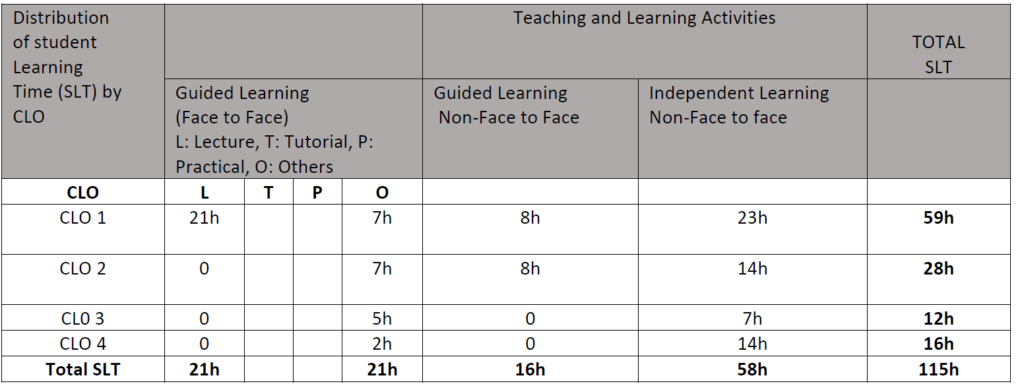

Assessment Samples
- Sample Test 1
- Sample Test 2
- Sample Final Exam Paper
Special requirement to deliver the course (e.g: software, nursery, computer lab, simulation room):
- Access to computers with DEHN Tool/CDEGS
Learning resources:
Main references
- IEC 62305 Part 1-4, Protection Against Lightning
- IEEE Guide for Safety in AC Substation Grounding, ANSI/IEEE Std 80-1986
Additional references
- Electrical Insulation in Power Systems. N.H. Malik, A.A. Al-Arainy, M.I. Qureshi (1997). CRC Press.
- High Voltage Engineering, M.S. Naidu and V. Kamaraju (2004), McGraw-Hill
- The Lightning Flash, edited by Venon Cooray (2003), London (IEE Power & Energy Series 34)
- High Voltage Engineering: Theory and Practice, M. Khalifa (1990), Marcel Dekker.
Online
Academic honesty and plagiarism:
Assignments are individual tasks and NOT group activities (UNLESS EXPLICITLY INDICATED AS GROUP ACTIVITIES)
Copying of work (texts, simulation results etc.) from other students/groups or from other sources is not allowed. Brief quotations are allowed and then only if indicated as such. Existing texts should be reformulated with your own words used to explain what you have read. It is not acceptable to retype existing texts and just acknowledge the source as a reference. Be warned: students who submit copied work will obtain a mark of zero for the assignment and disciplinary steps may be taken by the Faculty. It is also unacceptable to do somebody else’s work, to lend your work to them or to make your work available to them to copy.
Disclaimer:
All teaching and learning materials associated with this course are for personal use only. The materials are intended for educational purposes only. Reproduction of the materials in any form for any purposes other than what it is intended for is prohibited.
While every effort has been made to ensure the accuracy of the information supplied herein, Universiti Teknologi Malaysia cannot be held responsible for any errors or omissions.
