Thermal Insulative Coating (TIC) vs Heat Resistive Paint

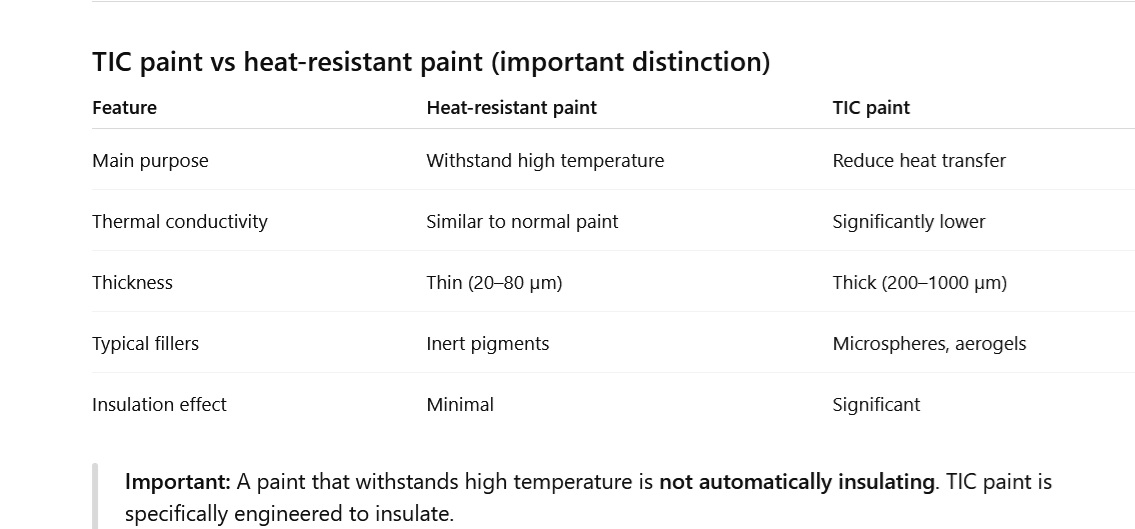
Thermal insulation coating (TIC) paint is designed to reduce heat transfer and lower surface temperature by using low-thermal-conductivity fillers and is applied as a thick, high-build layer. In contrast, heat-resistive paint is formulated to withstand high temperatures without degradation but is typically thin and provides little or no thermal insulation.
Recent development in heat insulating research

Conventional heat insulating materials like expanded polystyrene, polyurethane foams or mineral wool are low cost and lightweight but high flammability. Other non-flammable insulating materials like fiberglass, rockwool and glass wool are heavy and bulky. Silica-aerogel surpass other materials due to its high thermal stability, non-flammable and lightweight properties.

Heat insulation materials

Aerogel : new lightweight composite materials

Lightweight-thermal insulation composites were prepared using unsaturated polyester resin and silica aerogel. Preservation of pores in the aerogel was achieved by modification of the silica aerogel into closed pores, core-shell structure. Well-preserved aerogel pores in the UPR composites result in low density as well as the increase of thermal insulation with an increase of vol% of filler. Lowest thermal conductivity of 0.20 W/mK was achieved for composite containing 70 vol% of core-shell silica aerogel, which is about 55% reduction of the thermal conductivity of UPR (0.45 W/mK). The data from TGA show that decomposition proceeds in three steps for neat UPR as well as UPR composites, but the solid residue above 450 °C was considerably higher for filled composites. Addition of CSA has increased the thermal stability of the UPR by lowering the mass loss rate due to the formation of thermal stable char.


Details:

Halim, Z.A.A., Yajid, M.A.M., Idris, M.H., Hamdan, H. (2018) Physiochemical and thermal properties of silica Aerogel–Poly vinyl alcohol / Core–Shell structure prepared using fluidized bed coating process for thermal insulation applications. Materials Chemistry and Physics. Volume 215, Pages 269-276.

Halim, Z.A.A., Yajid, M.A.M., Idris, M.H., Hamdan, H. (2018) Effects of Rice Husk Derived Amorphous Silica on the Thermal-Mechanical Properties of Unsaturated Polyester Composites. Journal of Macromolecular Science, Part B: Physics. Volume 57, Issue 6, Pages 479-496.

Abdul Halim, Z.A., Mat Yajid, M.A., Idris, M.H., Hamdan, H. (2018) Dispersion of polymeric-coated–silica aerogel particles in unsaturated polyester composites: Effects on thermal-mechanical properties. Journal of Dispersion Science and Technology, Volume 39, Issue 8, Pages 1093-1101

Abdul Halim, Z.A., Mat Yajid, M.A., Idris, M.H., Hamdan, H. (2017) Effects of silica aerogel particle sizes on the thermal–mechanical properties of silica aerogel – unsaturated polyester composites. Plastics, Rubber and Composites. Volume 46, No. 4, Pages 184-192


Research Interest

Research Interests: Advanced Electron Microscopy, Nanomaterials, Reactive coatings for electronics, Hard coatings, Coatings for Aerospace Applications, Engineering Materials

welcome

Ir Ts Dr Muhamad Azizi Mat Yajid
Associate Professor
B.Eng (Hon’s) Materials Engineering, USM
MSc. Nanoscale Science & Technology, The University of Leeds, UK
PhD in Engineering Materials, The University of Sheffield, UKDepartment of Materials, Manufacturing and Industrial Engineering
Faculty of Mechanical Engineering
Universiti Teknologi Malaysia (UTM)
81310 Skudai, Johor
Malaysia
Tel.  : +607-5534649
Mobile: +6012-9015829
Fax.  : +607-5566159
e-mail: azizi_my@mail.fkm.utm.my

           azizi@utm.my
Research Interests: Advanced Electron Microscopy, Nanomaterials, Reactive coatings for electronics, Hard coatings, Coatings for Aerospace Applications, Engineering Materials
UTM Open Day