6th ICSSA 2026

Dear researchers, 

The Faculty of Artificial Intelligence, Universiti Teknologi Malaysia (UTM), in collaboration with the IEEE Malaysia Section – Instrumentation and Measurement Society (IMS), proudly presents the 6th International Conference on Smart Sensors and Applications (ICSSA 2026).

Conference details:
Date: 22–23 September 2026
Venue: Putrajaya, Malaysia

Under the theme “Driving Innovation Beyond Boundaries for Tomorrow’s World”, the conference welcomes original research papers and practical innovations that address emerging challenges and opportunities in sensing technologies and smart systems.

Conference Topics:
* Sensor Technology
* Smart Technology and Sustainable Systems
* Medical, Healthcare and Bio-Inspired Applications
* Next-Generation Communication Networks
* Advanced Informatics in Computational Applications

Important Dates:
Paper Submission Deadline : 7 April 2026

First Extension : 7 April 2026

Second Extension : 10 June 2026

Notification of Acceptance : 26 June 2026

Early Bird Registration : 20 July 2026

Normal Registration Deadline : 20 August 2026

Camera-Ready Submission : 20 August 2026

Publication:
Accepted papers will be submitted for possible inclusion in IEEE Xplore, subject to meeting the scope and quality requirements of IEEE.

Paper Submission:

Submit your manuscript via EDAS
https://edas.info/N34584

Website: fai.utm.my/icssa2026
Email: icssa.utm@gmail.com

Rail camera system for Plant Disease Detection using Computer Vision

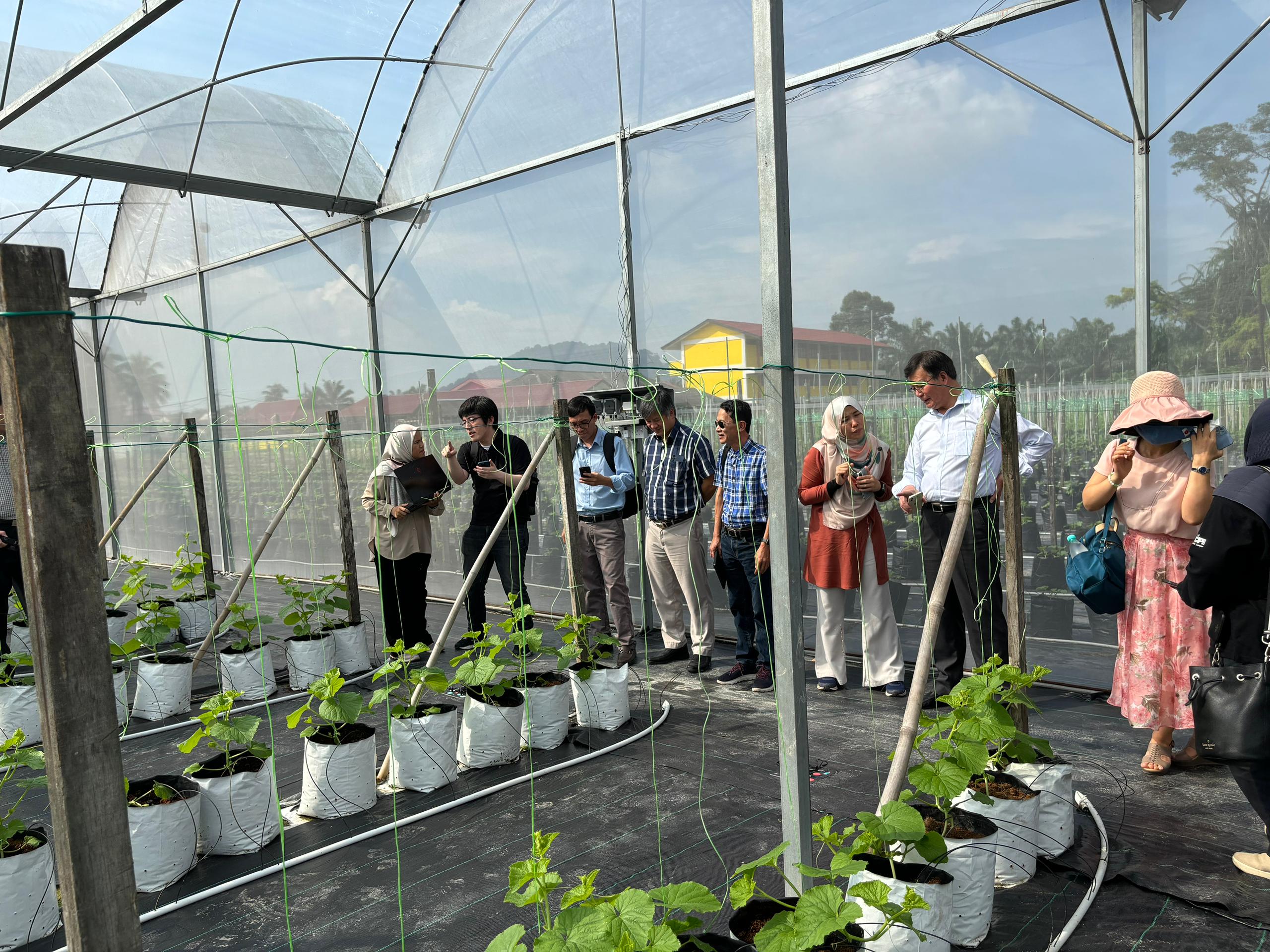
Banting, Selangor, 21 April 2026 – An ongoing smart agriculture project is currently being deployed at KMK Agro Global Sdn. Bhd., introducing a rail-mounted camera system powered by computer vision to support rock melon farming in a greenhouse environment.

Funded by the Innovation and Commercialisation Centre (ICC), Universiti Teknologi Malaysia (UTM), the project—known as the GreenPulse IoT-Enhanced Smart Camera System—aims to integrate artificial intelligence and IoT technologies for automated fertigation and early-stage plant disease monitoring.

At its current stage, the installation is partially completed, with key components such as the rail camera mechanism and imaging system already in place. The system is designed to move along greenhouse rows, capturing plant images at scheduled intervals to build a consistent visual dataset for analysis.

These images will be processed using edge computing technology powered by the NVIDIA Jetson Orin Nano platform. Through AI-based image analysis, the system is expected to detect early symptoms of plant diseases and identify nutrient deficiencies, enabling timely alerts and faster intervention by farmers.

While the system is still under development and testing, the project team is actively working on optimising hardware integration, improving data capture consistency, and enhancing AI model performance for more accurate predictions.

The collaboration with KMK Agro Global Sdn. Bhd. provides a valuable real-world testbed, allowing continuous refinement of the system based on actual farm conditions. In addition, the project supports knowledge transfer activities, equipping farmers with exposure to emerging smart farming technologies.

Once fully completed, the system is expected to improve operational efficiency, reduce manual monitoring efforts, and enhance crop productivity, particularly for high-value crops such as rock melon.

This initiative reflects UTM’s commitment, through ICC funding, to advancing applied research and bridging the gap between academic innovation and industry implementation in smart agriculture.

TTT INFINEON PSoC 6 WITH INDUSTRIES

Universiti Teknologi Malaysia (UTM), through the Faculty of Artificial Intelligence (FAI), organised a two-day Train-the-Trainer (TTT) Infineon PSoC® 6 Board Programme on 13 and 15 April 2026. The programme involved academic participants together with industry researchers from MIMOS Berhad and Mindmatics Sdn Bhd. It aimed to improve skills and strengthen collaboration in embedded systems and Internet of Things (IoT) technologies.

The programme was supported by Infineon Technologies under a Memorandum of Understanding (MoU). This collaboration also introduced the UTM–Infineon Innovation Launchpad (UIIL), which will support future activities in innovation, talent development, and research in embedded and AI technologies. FURTHER READING >> NEWS

AI SHOWCASE @UTM – PLANT DISEASE DETECTION

Details news > news@Awani

UTM Expands Global Research Links in Intelligent Wireless Systems

Universiti Teknologi Malaysia (UTM), through the Faculty of Artificial Intelligence (FAI) UTM Kuala Lumpur, hosted a focused academic engagement programme from 13 to 16 January 2026. The programme was organised by the Ubiquitous Broadband Access Network (U-BAN) Research Group, in collaboration with the FAI Research & Innovation Office. Over four days, the activities gathered UTM staff, researchers, and students to strengthen knowledge exchange, widen research networks, and create new opportunities for future joint research with international partners.

A key highlight was a technical talk titled “Goal-Oriented Wireless Sensor Networks”, held on 14 January 2026 (Wednesday). The session was delivered by Prof. Dr. Tadashi Matsumoto, an IEEE Life Fellow and Professor Emeritus of the Japan Advanced Institute of Science and Technology (JAIST), Japan, and the University of Oulu, Finland. In his presentation, Prof. Matsumoto discussed how goal-oriented design can enhance the efficiency and reliability of wireless sensor networks by aligning network decisions with application objectives, enabling smarter use of resources and more meaningful performance outcomes.

The talk was open to all staff, researchers, and students. Participants engaged actively through questions and discussion, reflecting a strong interest in translating the concepts into practical sensing, monitoring, and communication solutions.

Beyond the seminar, the 13–16 January programme featured several closed discussions among Prof. Matsumoto, U-BAN members, and FAI researchers. These sessions explored potential research collaboration in the coming future, including AI-assisted sensor networking, energy-efficient sensing and communication, and emerging IoT and 6G-related applications. The group also discussed practical pathways for collaboration, including joint publications, collaborative grant proposals, student mobility, and co-supervision arrangements to sustain long-term engagement.

FAI and U-BAN extend appreciation to Prof. Dr. Tadashi Matsumoto and all participants, and look forward to translating the outcomes of this academic week into impactful collaborative research partnerships.

UTM Students Gain Industry Exposure at PETRONAS Drone Centre

KUALA LUMPUR , Jan 23 – Faculty of Artificial Intelligence (FAI), Universiti Teknologi Malaysia (UTM) recently conducted an academic visit to the PETRONAS Drone Centre (PDCC), KLCC, as part of the course Internet of Things (IoT) for Disruptive Technology. The visit involved a focused delegation of postgraduate learners comprising six Engineering Doctorate (EngDoc) students and five Master’s students from the Master of Science in Systems Engineering (MSSE) and Master of Science in Sustainable Infrastructure (MSSI) programmes. The session was designed to bridge classroom learning with real-world industrial practices, particularly in the fast-evolving domains of drone operations, digital inspection, and data-driven decision-making.

At PDCC, participants were introduced to operational workflows and safety practices that support the reliable deployment of drones in complex environments. The engagement began with safety moments and opening remarks, followed by an industry briefing on permitting and regulatory requirements, highlighting how compliance and governance shape drone operations in high-value facilities. Students also explored how drones enable “new ways of method” for asset inspection and operational excellence, including aerial inspection, thermography inspection, confined space inspection, and digitisation with 3D modelling. The briefing further showcased advanced applications such as optical gas imaging, gas quantification, ultrasonic testing, and project monitoring, demonstrating how IoT sensing and analytics can strengthen safety, efficiency, and maintenance planning.

A dedicated Q&A session allowed students to discuss practical challenges, technology readiness, and the skills needed to support drone-enabled digital transformation. The visit concluded with a Skybridge tour, providing a memorable close to an industry immersion that broadened student perspectives and strengthened potential avenues for university–industry collaboration in disruptive IoT ecosystems.

The academic exposure at PDCC is expected to create strong value for both students and the academic programme. For students, the visit sharpened their understanding of how IoT concepts translate into regulated, safety-critical operations, while also highlighting the importance of standards, risk management, data integrity, and professional communication in real deployments. For the Master’s and EngDoc programmes, the insights gained can be directly infused into course delivery through richer case studies, industry-relevant problem statements, and potential capstone or applied research topics aligned with drone analytics, inspection automation, and digital twin development. Overall, this engagement strengthens UTM’s industry-linked learning ecosystem and supports the development of graduates who are more job-ready, agile, and capable of contributing to the innovation of disruptive technologies.

ASEAN IVO @Dalat Vietnam

The Agricultural IoT Based on Edge Computing project—under ASEAN-IVO in collaboration with NICT—has successfully concluded its final meeting in Da Lat City, Vietnam. Participating institutions from Vietnam, Malaysia, Thailand, and Japan convened to review outcomes, share experiences, and discuss the path forward.

The initiative aimed to tackle challenges in agriculture through an IoT framework that leverages edge computing. Key goals included developing real-time, low-latency data processing at farm sites; ensuring system security; and integrating advanced sensing, AI/ML innovations, and automation in farming systems. Among the work packages were smart fertigation & watering systems, plant disease predictors, pollinating systems, and drone-assisted monitoring.

Field demonstrations, such as visits to farms deploying sensor networks and automated systems, helped validate concepts in real settings. The project emphasized capacity building and cross-border cooperation, enabling the sharing of research methods, data, and lessons learnt among ASEAN countries.

Looking ahead, partners intend to build on the technical advances: improving disease-prediction models, strengthening privacy/security in IoT deployments, and expanding these solutions across diverse agricultural environments.

Further reading>> video compilation UTM newshub 

SOFTT 2025 @LOMBOK

The IEEE 7th Symposium on Future Telecommunication Technologies (SOFTT 2025) became a significant platform for reinforcing the collaboration between the Faculty of Artificial Intelligence (FAI), Universiti Teknologi Malaysia (UTM), and Telkom University, Indonesia. Held at the Aruna Senggigi Hotel in Lombok, the symposium brought together academics and researchers from both institutions to share progress on joint projects under the Matching Grant Programme, an initiative anchored in the Memorandum of Understanding (MoU) signed between UTM and Telkom University.

During SOFTT 2025, UTM was represented by five delegates from the U-BAN Research Group. The progress update meeting and project symposium emphasized the ongoing Matching Grant collaboration between UTM and Telkom University, which is dedicated to advancing research in 6G technologies. The discussions highlighted significant progress in areas such as digital village connectivity, energy-efficient communication networks, and secure next-generation systems, reflecting the strong commitment of both institutions to jointly shape the future of telecommunication.

Further reading>> newshub UTM

FAI UTM Strengthens Sustainability Agenda with Sungai Bunus Urban Garden Community

In conjunction with the World Earth Day celebration, the Faculty of Artificial Intelligence (FAI), Universiti Teknologi Malaysia (UTM), in collaboration with Institut Sultan Iskandar (ISI), organised a community engagement programme at Kebun Bandar Sungai Bunus. The initiative involved staff, students, and the local community in a gotong-royong (communal work) activity aimed at promoting sustainability awareness and environmental responsibility.

The highlight of the event was the installation of a solar-powered automatic irrigation system developed using project funds, supporting UTM’s mission of promoting green innovation in urban agriculture. This system enhances water efficiency and reduces energy reliance, aligning with multiple Sustainable Development Goals (SDGs), including SDG 7 (Affordable and Clean Energy), SDG 11 (Sustainable Cities and Communities), and SDG 13 (Climate Action).

This programme not only empowered the local community through environmental education and hands-on involvement but also served as a model for replicable green technology initiatives in other urban gardens. FAI UTM remains committed to integrating sustainability efforts with real-world community impact.

Further reading >> SG BUNUS

NEWS: FAI UTM and RISDA Collaboration

The Faculty of Artificial Intelligence (FAI), Universiti Teknologi Malaysia (UTM), conducted a site visit to the Smallholders Development Institute (IKPK) under the Rubber Industry Smallholders Development Authority (RISDA) in Pahang to explore potential collaboration in establishing an Artificial Intelligence (AI) Training Centre at RISDA Pahang. The visit aimed to discuss consultancy opportunities through which FAI UTM could support RISDA in upgrading its existing facilities into a fully equipped AI training centre that meets current technological needs and specifications.

During the discussion session, both parties examined the requirements for upgrading infrastructure and developing more modern and comprehensive facilities to support AI-driven training, research, and innovation in the agricultural sector in detail. FAI UTM also presented detailed proposals on the technical specifications and design of the training centre to ensure that it could serve as a national reference hub for the development and application of AI in agriculture.

Further reading >> RISDA

UTM Open Day