Introduction to Behaviorism
- Definition: Learning as a relatively permanent change in observable behavior as a result of experience.
- The “Black Box” Metaphor: Behaviorists argued that because we cannot objectively observe a thought or a feeling, we should treat the mind as a “black box.” A black box is a system where you can see the input (what goes in) and the output (what comes out), but the internal workings are invisible or irrelevant to the observer. We don’t need to know what’s happening inside to understand, predict, or change behavior. This is why behaviorists prioritize measurable actions over internal mental processes.
- Key Assumptions:
- Learning processes are similar across species and the role of the environment.
- Science requires data that multiple people can observe and verify.
- For example:
- If I say I am “motivated,” you have no way to measure that directly. However, if I finish 10 math problems in 5 minutes, we have a measurable, objective fact. Behaviorists believed that by focusing only on what could be seen, they were making psychology a “hard science” like physics or chemistry.
- A teacher who believes in behaviorist perspective will explain that students study because, in the past, studying was followed by a high grade (Positive Reinforcement).
Behavioral theories: Classical Conditioning and Operant Conditioning
I. Classical Conditioning (S-R Learning)
Focuses on involuntary, emotional, or physiological responses.
- Two key figures:
- 1) Ivan Pavlov
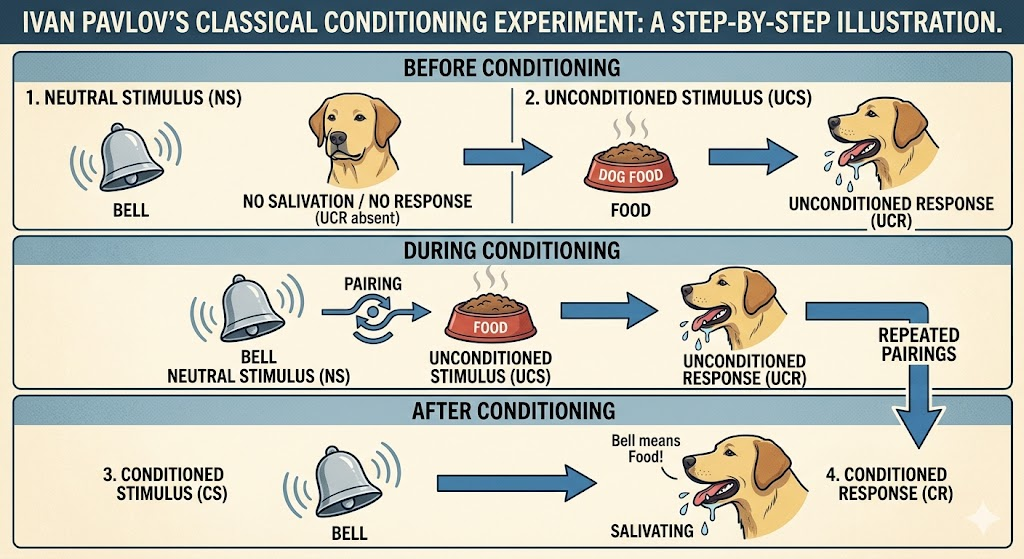
- The Pavlovian Foundation: Ivan Pavlov’s accidental discovery with dogs (he mechanics of classical conditioning with dogs)
- 1) Ivan Pavlov
- 2) John B Watson
- Father of Behaviorism: The man who brought classical conditioning into the human world. He is often called the “Father of Behaviorism” because he applied the mechanics of classical conditioning with children.
- Watson wanted to prove that “nurture” (the environment) was more powerful than “nature” (instinct). He set out to condition a phobia into an 11-month-old infant known as Albert.
- Before Conditioning: Albert showed no fear of a white rat (Neutral Stimulus). He only showed a natural fear of loud noises (Unconditioned Stimulus).
- The Conditioning: Every time Albert reached for the white rat, Watson would strike a steel bar with a hammer behind the boy’s head.
- The Result: After only seven pairings, Albert would burst into tears and crawl away at the mere sight of the rat, even without the loud noise.
- Key Components of classical conditioning:
- Unconditioned Stimulus (UCS) & Response (UCR): Natural, unlearned triggers (e.g., food leading to drool OR loud noise leading to fear).
- Neutral Stimulus (NS): A trigger that initially means nothing (e.g., a bell OR a white rat).
- Conditioned Stimulus (CS) & Response (CR): The learned association (e.g., bell leading to drool OR a white rat leading to fear).
- Core Concepts:
- Acquisition or Shaping: The “pairing” phase.
- Extinction: What happens when the CS is presented without the UCS.
- It is the process by which a learned response is weakened and eventually disappears. It occurs when the “rules” of the environment change, and the expected outcome no longer follows the trigger.
- Generalization (This is John B Watson’s contribution): It is a phenomenon in learning where a subject responds to a new stimulus in the same way they respond to a known conditioned stimulus, simply because the two are similar.
- Example: Watson found that Albert didn’t just fear the white rat; he became terrified of anything white and furry such as a rabbit, a dog, a sealskin coat, a teddy bear and even a Santa Claus mask with a white beard. Fears are learned, not necessarily innate. Once a fear is learned, it can “bleed over” into similar objects or situations.
- Discrimination: It occurs when a specific stimulus is consistently followed by an Unconditioned Stimulus (UCS), while a similar stimulus is consistently not followed by it.
- Example: Imagine a dog is conditioned to salivate to a specific bell tone (1000 Hz) (The Stimulus). You ring a slightly different bell by lowering the tone (900 Hz) (The Variation). If the 1000 Hz bell is always followed by food, the dog salivates. If the 900 Hz bell is never followed by food, the dog eventually learns to ignore it (The Learning Process). The dog has “discriminated” between the two tones. 1000Hz = food, 900Hz = no food (The Result)
- Spontaneous recovery: It is a phenomenon where a previously extinguished response suddenly reappears after a period of rest.
- It proves that extinction is not “unlearning” or erasing a memory; rather, it is the brain learning to suppress a behavior. The original association is still tucked away in the “black box,” waiting for a chance to resurface.
II. Operant Conditioning (R-S Learning)
Focuses on voluntary behaviors shaped by consequences.
- Thorndike’s Law of Effect: Behaviors followed by pleasant outcomes are strengthened.
- B.F. Skinner’s Contributions: The Skinner Box and the shift from “respondent” to “operant” behavior.
- Premack’s Principle (by David Premack): Premack’s core idea was that high-probability behaviors (things we want to do) can be used to reinforce low-probability behaviors (things we don’t want to do). Example: You have to eat your vegetables before you can have dessert.
- The Mechanics of Consequences:
- Reinforcement (Increasing Behavior):
- Positive reinforcement: Adding a reward to increase desirable behavior (e.g. a token for submitting homework)
- Negative reinforcement: Removing an unpleasant stimulus to increase desirable behavior (e.g., the seatbelt chime stopping).
- Positive reinforcement: Adding a reward to increase desirable behavior (e.g. a token for submitting homework)
- Punishment (Decreasing Behavior):
- Presentation (Positive punishment or also known as Type I punishment) (e.g. give a fine for late registration)
- Removal (Negative or also known as Type II punishment) (e.g. taking away a privilege of using family car when coming back after curfew hours)
- Presentation (Positive punishment or also known as Type I punishment) (e.g. give a fine for late registration)
- Reinforcement (Increasing Behavior):
- Schedules of Reinforcement:
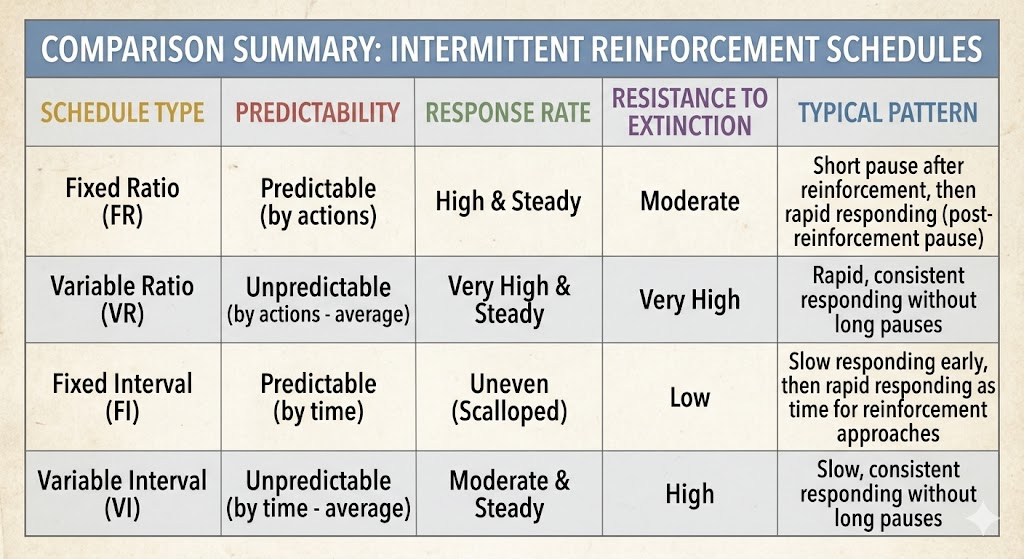
- Continuous vs. Intermittent (Fixed Ratio, Variable Ratio, Fixed Interval, Variable Interval).
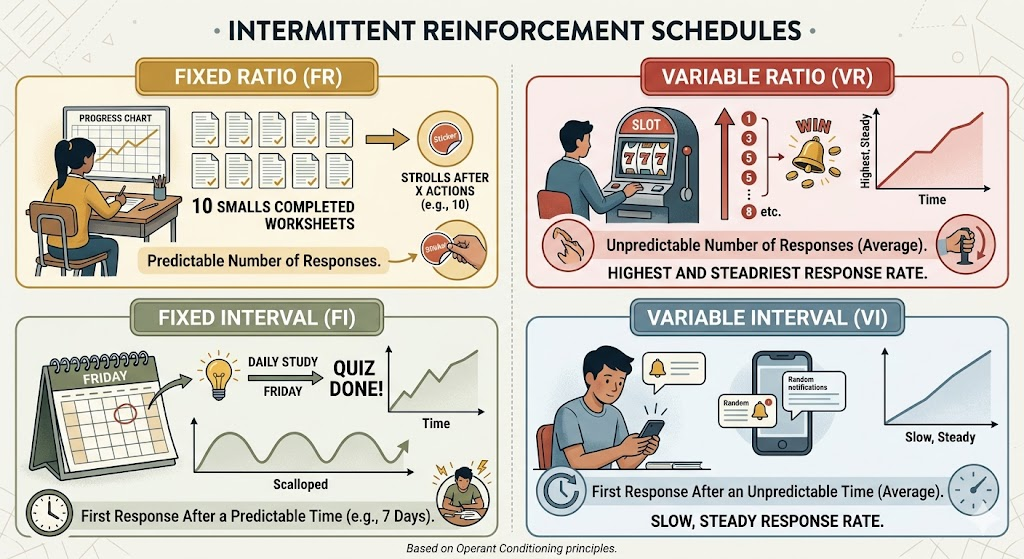
Note: Why gambling (Variable Ratio) is so addictive.
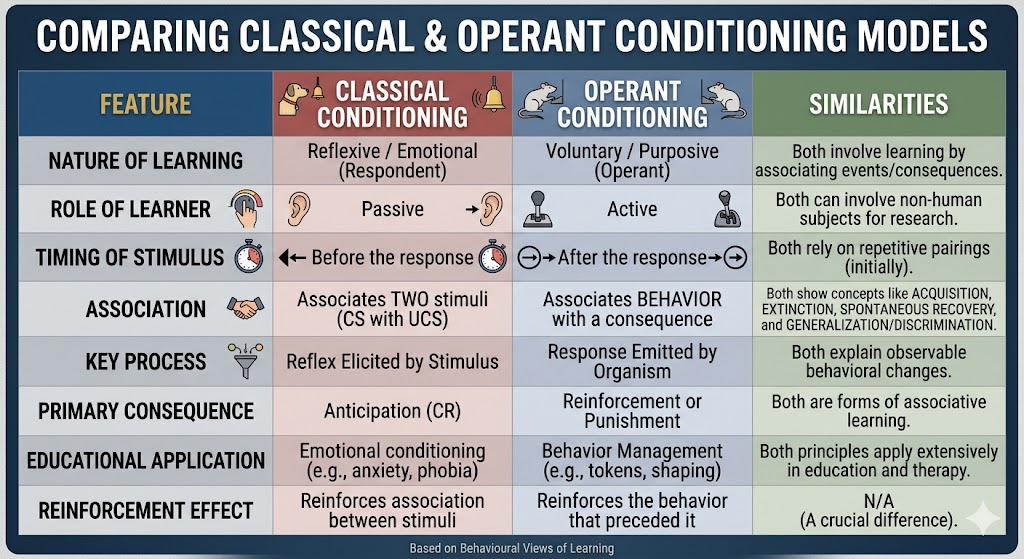
Educational Application:
- We can understand how “math anxiety” or school phobia is often classically conditioned.
- Learning can occur with different effects either discrimination or generalization. While discrimination is about being “picky,” generalization is about being “broad.”
- Context Matters: A behavior might be extinguished in one setting (at school) but still occur in another (at home)
- As a teacher, if you notice that a student loves drawing but dislikes math, you can apply operant conditioning (taking Premack’s principle into consideration) such as by giving instruction “Once you finish these five math problems, you can spend ten minutes working on your drawing.” (The Application). In this regard, drawing (the high-probability behavior) reinforces math (the low-probability behavior) (The Result).