Carol Gilligan’s Ethics of Care vs. Ethics of Justice

Carol Gilligan’s theory emerged as a direct critique of Lawrence Kohlberg’s stages of moral development. While working as Kohlberg’s research assistant, Gilligan noticed that women often scored lower on his scale, typically landing at Stage 3 (focusing on interpersonal relationships) rather than Stage 4 or 5 (focusing on abstract justice).

She argued that Kohlberg’s model wasn’t showing that women were “less moral,” but rather that his model was biased toward a “Justice Perspective” (common in men) and ignored the “Care Perspective” (common in women).

Gilligan suggested that there are two distinct ways of looking at moral problems:

  • Ethics of Justice: Focused on individual rights, logic, and universal rules. Morality is about “not interfering with others’ rights.” (Kohlberg’s focus).
  • Ethics of Care: Focused on interpersonal relationships, compassion, and responsibility. Morality is about “not turning away from someone in need.” (Gilligan’s focus).

Gilligan’s Three Stages of Moral Development

Similar to Kohlberg, Gilligan proposed three levels, but hers focus on how the “logic of care” evolves from self-interest to a universal concern for all.
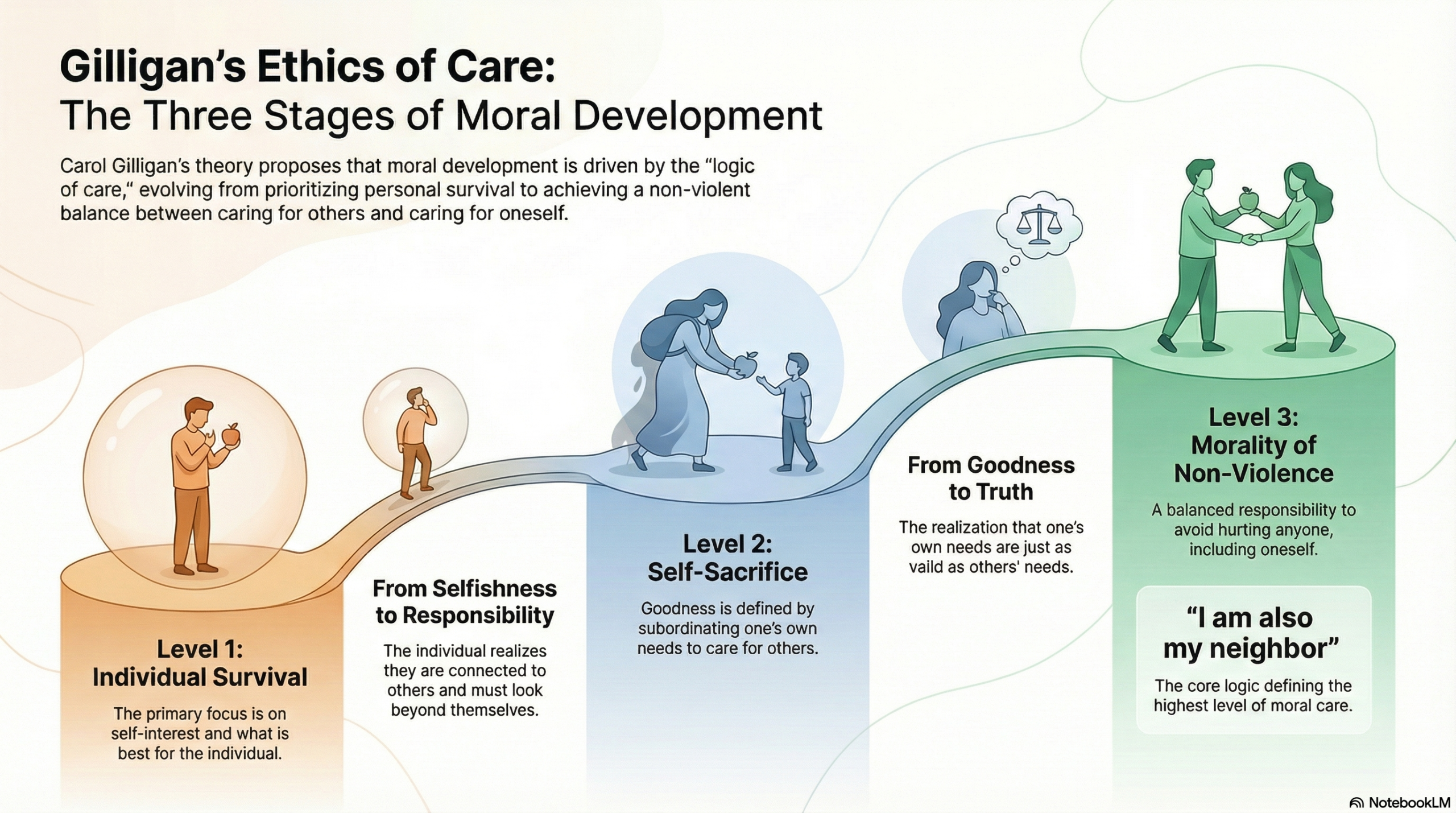
Level 1: Orientation to Individual Survival

At this stage, the woman’s primary focus is on herself and what is best for her own survival.

  • The Transition: From Selfishness to Responsibility. The individual begins to realize that they are connected to others and that “doing the right thing” involves more than just looking out for oneself.

Level 2: Goodness as Self-Sacrifice

In this stage, “goodness” is defined as caring for others. The woman adopts societal values where she subordinates her own needs to the needs of others (parents, children, partners). She feels that being a “good person” means being self-sacrificing.

  • The Transition: From Goodness to Truth. The individual realizes that self-sacrifice is not the same as care. They begin to see that their own needs are just as valid as the needs of others.

Level 3: The Morality of Non-Violence

This is the highest level, where the individual achieves a balance between caring for others and caring for oneself. Morality is defined by a desire to avoid hurt to anyone, including oneself.

  • The Logic: “I have a responsibility to care for my neighbor, but I am also my neighbor.”
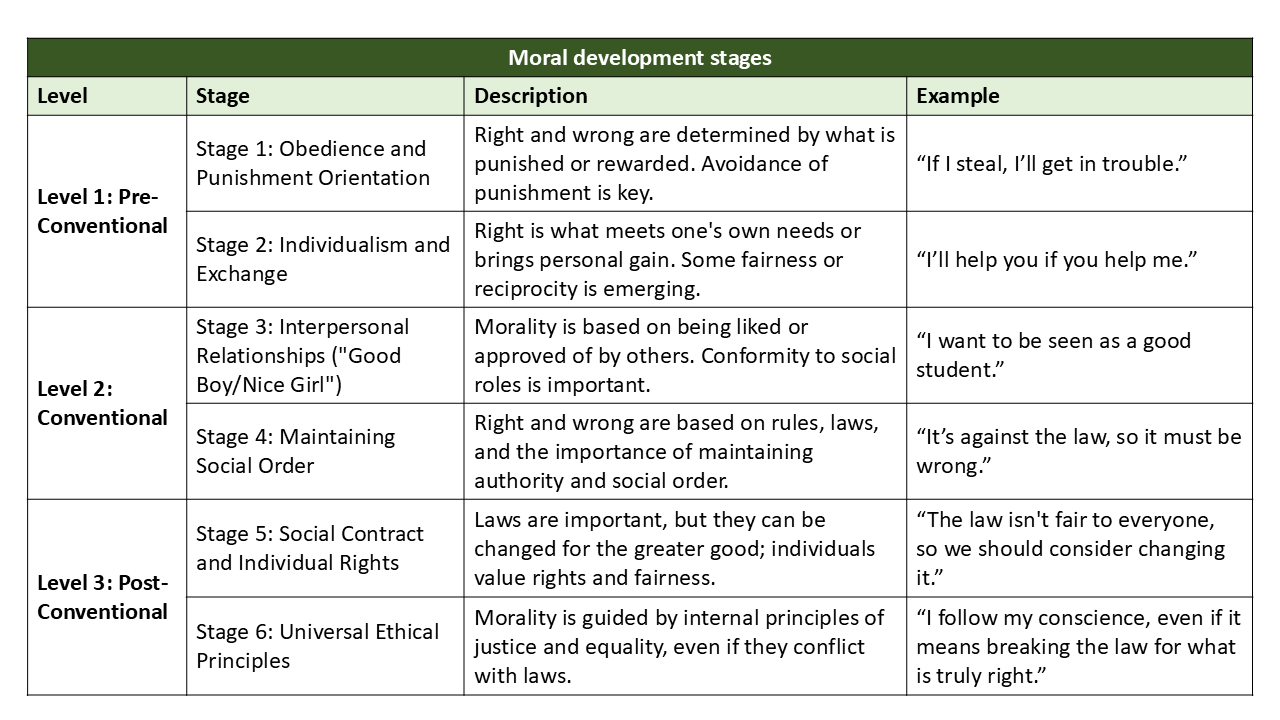
Lawrence Kolhberg’s moral development

Level 1: Pre-Conventional Morality

At this level (common in children), morality is externally controlled. Rules are imposed by authority figures, and “right” or “wrong” is judged by the direct consequences.

Stage 1: Obedience and Punishment Orientation

The focus is on direct consequences. An action is perceived as wrong because the person is punished for it.

  • Logic: “I shouldn’t do it because I don’t want to get in trouble.”

Stage 2: Individualism and Exchange

Children recognize that there is not just one right view handed down by authorities. Different individuals have different viewpoints. “Right” is what meets one’s own interests or involves a fair trade.

  • Logic: “What’s in it for me?” or “I’ll help you if you help me.”

Level 2: Conventional Morality

At this level (typical of adolescents and adults), morality is tied to personal and societal relationships. Individuals continue to accept the rules of authority figures, but now because they believe it is necessary to maintain positive relationships and societal order.

Stage 3: Good Interpersonal Relationships

Often called the “good boy/nice girl” orientation. The individual is good in order to be seen as being a good person by others. The focus is on living up to social expectations and roles.

  • Logic: “I want people to like me and think I’m a good person.”

Stage 4: Maintaining the Social Order

The individual becomes aware of the wider rules of society, so judgments concern obeying the law, respecting authority, and performing one’s duties so that social order is maintained.

  • Logic: “If everyone broke the law, society would fall apart. I must follow the rules.”

Level 3: Post-Conventional Morality

At this level, individuals move beyond the perspectives of their own society. Morality is defined in terms of abstract principles and values. People now believe that some laws are unjust and should be changed.

Stage 5: Social Contract and Individual Rights

The individual becomes aware that while rules/laws might exist for the good of the greatest number, there are times when they will work against the interest of particular individuals. Issues are not always clear-cut.

  • Logic: “The law should be changed if it doesn’t protect the rights of the people.”

Stage 6: Universal Ethical Principles

People at this stage have developed their own set of moral guidelines which may or may not fit the law. The principles apply to everyone (e.g., human rights, justice, and equality). The person will be prepared to act to defend these principles even if it means going against the rest of society in the process and having to pay the consequences of disapproval and/or imprisonment.

  • Logic: “I will do what is right because it is inherently right, regardless of what the law says.”

James Marcia’s Identity Status

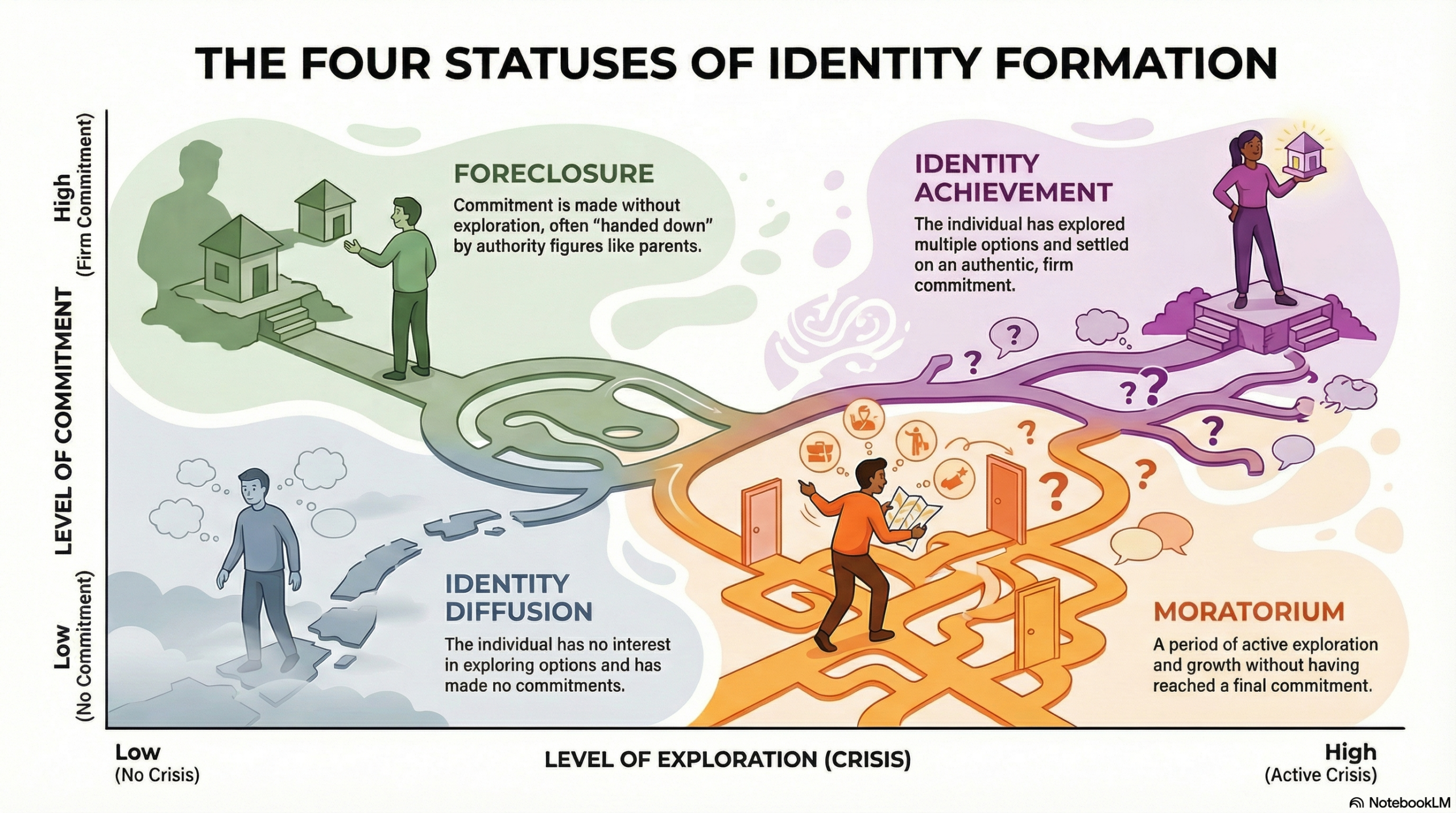
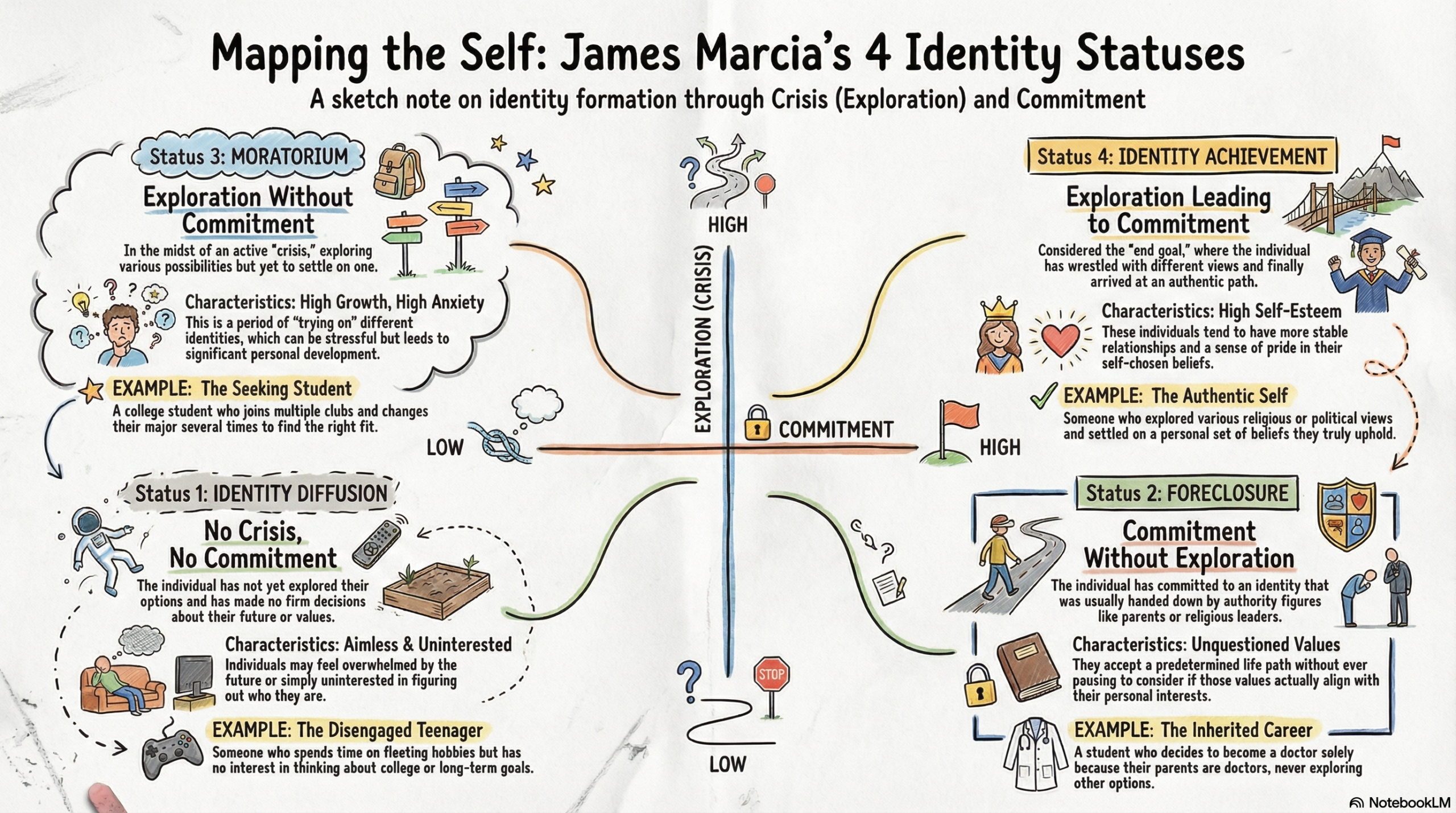
James Marcia extended Erik Erikson’s Identity vs. Role Confusion stage by explaining how identity develops by proposing that identity formation is not a single event, but a process driven by two key factors: Exploration (Crisis) and Commitment.

Instead of stages, Marcia proposed four identity statuses based on two dimensions:

  • Exploration (crisis) → actively questioning choices (e.g., career, beliefs)
  • Commitment → making decisions and sticking to them

The Four Identity Statuses

1. Identity Diffusion

In this status, the individual has not yet experienced a crisis and has made no commitments.

  • Characteristics: They may seem aimless, uninterested, or overwhelmed by the idea of the future. They aren’t trying to figure out who they are, nor do they care to at the moment.
  • Example: A teenager who has no interest in thinking about college or a career and spends most of their time on fleeting hobbies without deep engagement.

2. Foreclosure

Here, the individual has made a commitment but has not explored other options.

  • Characteristics: Their identity is often “handed down” by authority figures (usually parents or religion). They accept these values without questioning them.
  • Example: A student who decides to become a doctor simply because their parents are doctors, without ever considering if they actually like medicine.

3. Moratorium

The individual is currently in the midst of a crisis, actively exploring, but has not yet made a commitment.

  • Characteristics: This is often a period of high anxiety but also high growth. They are “trying on” different versions of themselves—new styles, political views, or career paths.
  • Example: A college student who changes their major three times and joins various clubs to see where they fit best.

4. Identity Achievement

This is the “end goal” where the individual has gone through a crisis and made a firm commitment.

  • Characteristics: They have explored various possibilities and settled on a path that feels authentic to them. They tend to have higher self-esteem and more stable relationships.
  • Example: Someone who explored different religious and political views, wrestled with the contradictions, and finally arrived at a set of personal beliefs they are proud to uphold.

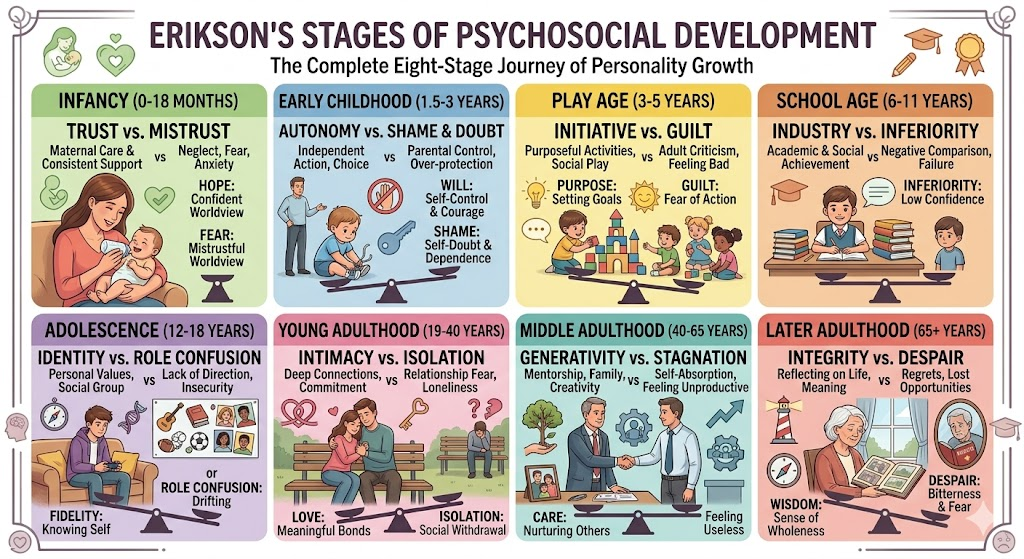
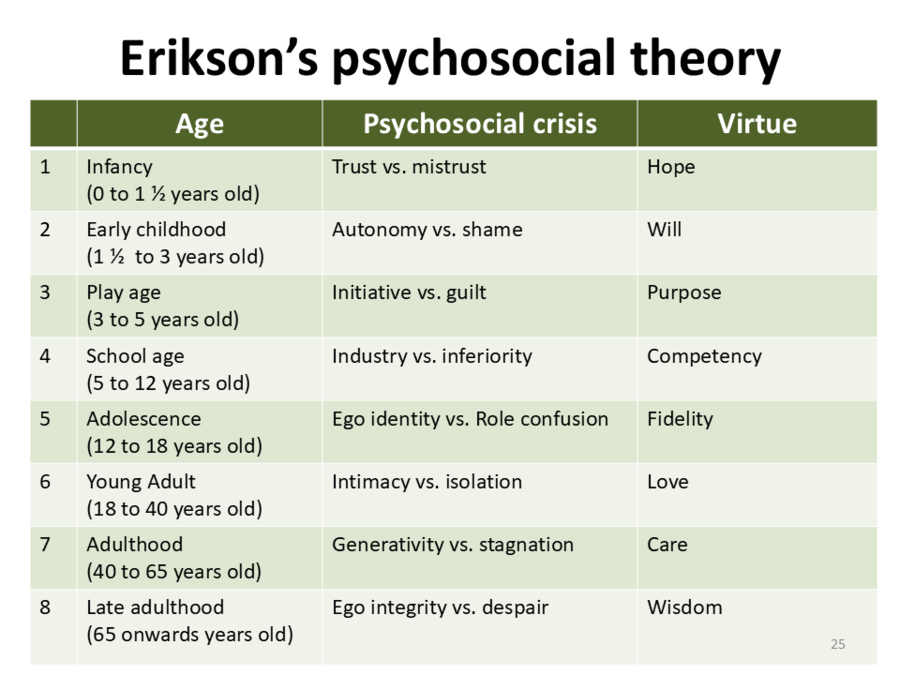
Erikson: Psychosocial Stages

Erikson viewed development as a series of crises that must be resolved. Each stage centers on a social struggle that impacts personality.

Stage 1: Trust vs. Mistrust (Infancy – 0 to 1.5 years old): Is the world a safe place?

Core issue: Can I trust the world?
Key factor: Consistent caregiving

  • Positive outcome: Trust, sense of safety
  • Negative outcome: Fear, suspicion
  • Phase where it serves as the foundation of attachment and emotional security

Stage 2: Autonomy vs. Shame/Doubt (Toddlerhood – 1.5 to 3 years old): Can I do things myself?

Core issue: Can I do things on my own?
Key factor: Encouragement vs. overcontrol

  • Positive: Independence, confidence
  • Negative: Shame, self-doubt
  • This phase is linked to early self-control and decision-making

Stage 3: Initiative vs. Guilt (Preschool – 3 to 5 or 6 years old): Am I good or bad at planning tasks?

Core issue: Is it okay to take initiative?
Key factor: Support for exploration

Key factor: Support for exploration

  • Positive: Initiative, leadership
  • Negative: Guilt, fear of trying
  • This phase is important for development of creativity and goal-directed behavior

Stage 4: Industry vs. Inferiority (School Age – 7 to 12 years old ): How do I compare to my peers?

Core issue: Am I competent?
Key factor: School and achievement

  • Positive: Competence, productivity
  • Negative: Inferiority, low confidence
  • This phase has a strong connection to academic self-efficacy

Stage 5: Identity vs. Role Confusion (Adolescence – 13 to 17 years old): Who am I?

Core issue: Who am I?
Key factor: Exploration of roles, values

  • Positive: Strong identity
  • Negative: Confusion, instability
  • This is a central stage in personality development and life direction

Stage 6: Intimacy vs. Isolation (Young adulthood – 19 – 40 years old)

Core issue: Can I form meaningful relationships?
Key factor: Emotional openness

  • Positive: Intimacy, strong relationships
  • Negative: Loneliness, isolation

Stage 7: Generativity vs. Stagnation (Middle adulthood – 40 to 65 years old)

Core issue: Am I contributing to society?
Key factor: Productivity, care for others

  • Positive: Generativity (giving back)
  • Negative: Stagnation, lack of purpose

Stage 8: Integrity vs. Despair (Late adulthood – 65 years old onwards)

Core issue: Was my life meaningful?
Key factor: Life reflection

  • Positive: Wisdom, fulfillment
  • Negative: Regret, despair

Diana Baumrind: Parenting Styles

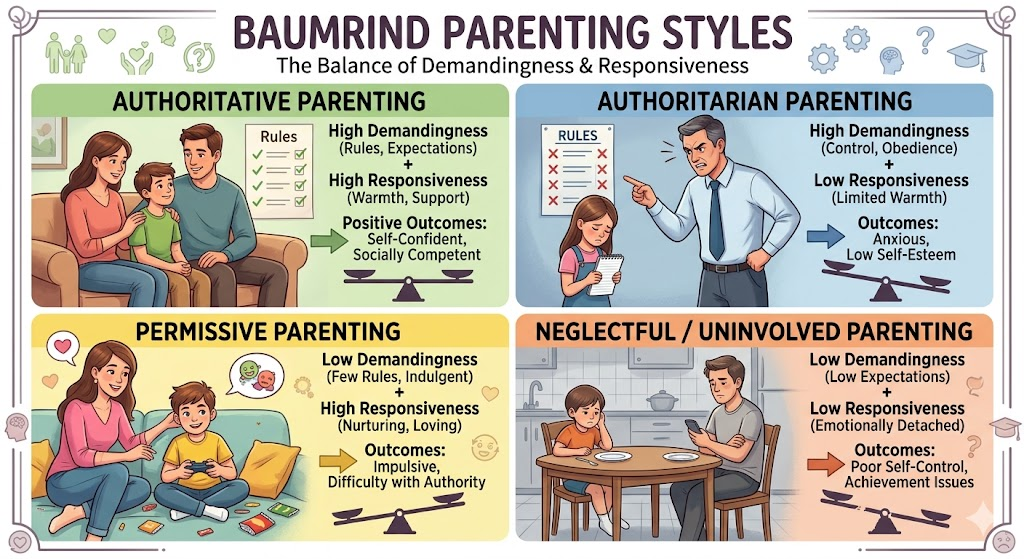
Diana Baumrind identified how the balance of responsiveness (warmth) and demandingness (control) shapes a child’s social competence. There are four types of parenting styles.

1. Authoritative Parenting (High Warmth, High Control)

Characteristics:

  • Warm, responsive, and supportive
  • Clear rules and expectations
  • Encourages independence and reasoning
  • Uses explanation rather than punishment
  • Considered the most effective style in many cultural contexts.

Example:
A parent explains why homework is important and sets a routine, while still listening to the child’s concerns.

Outcomes (research-consistent):

  • High self-esteem
  • Good social skills
  • Better academic performance
  • Strong self-regulation

2. Authoritarian Parenting (Low Warmth, High Control)

Characteristics:

  • Strict rules, high expectations
  • Low emotional warmth
  • Emphasis on obedience and discipline
  • “Because I said so” approach

Example:
A child is punished for breaking a rule without explanation or discussion.

Outcomes:

  • Obedient but less happy
  • Lower self-esteem
  • Higher anxiety or aggression
  • Poorer social skills

3. Permissive Parenting (High Warmth, Low Control)

Characteristics:

  • Very loving and indulgent
  • Few rules or boundaries
  • Avoids discipline
  • Acts more like a “friend” than authority

Example:
A child can decide bedtime, screen time, and routines without limits.

Outcomes:

  • Poor self-discipline
  • Impulsivity
  • Difficulty following rules
  • Lower academic achievement

4. Neglectful / Uninvolved Parenting (Low Warmth, Low Control)

Characteristics:

  • Lack of responsiveness and guidance
  • Minimal involvement in child’s life
  • Basic needs may be met, but emotional needs neglected

Example:
Parents are physically present but emotionally unavailable and uninvolved.

Outcomes:

  • Low self-esteem
  • Poor academic performance
  • Attachment issues
  • Higher risk behaviors

Urie Bronfenbrenner: Ecological Systems Theory

Bronfenbrenner doesn’t focus on “stages” but rather on the layers of environment that influence a child. He argues that you cannot understand a person’s development without looking at the systems they inhabit.

  • Microsystem: The immediate environment (family, school, peers).
  • Mesosystem: Connections between microsystems (e.g., how a parent’s relationship with a teacher affects the child).
  • Exosystem: Indirect environments (e.g., a parent’s workplace stress affecting the home life).
  • Macrosystem: The broader culture, laws, and social values.
  • Chronosystem: The dimension of time (e.g., the timing of a divorce or a historical event).

Socioemotional Development

Definition

  • Socioemotional development refers to the process through which individuals learn to understand, express, and manage emotions, and develop social relationships and identity across the lifespan.
  • It combines social development (how we relate to others) and emotional development (how we understand and manage feelings).

Socioemotional development encompasses how individuals move from understanding themselves and others to managing emotions and navigating social worlds. There are various theoretical lenses that can help us understand how individuals develop based on internal psychological elements that interact with external circumstances.

  1. Urie Bronfenbrenner’s ecological system
  2. Diana Baumrind’s parenting styles
  3. Erik Erikson’s psychosocial development stages
  4. James Marcia’ Identity Statuses
  5. Lawrence Kolhberg’s moral development
  6. Carol Gilligan’s Ethics of Care vs. Ethics of Justice (related to moral development)

Language Development

Definition of Language

  • A form of communication (spoken, written or signed) that is based on a system of symbols.
  • Consists of words used by a community (vocabulary) and the rules for varying and combining them (grammar and syntax)
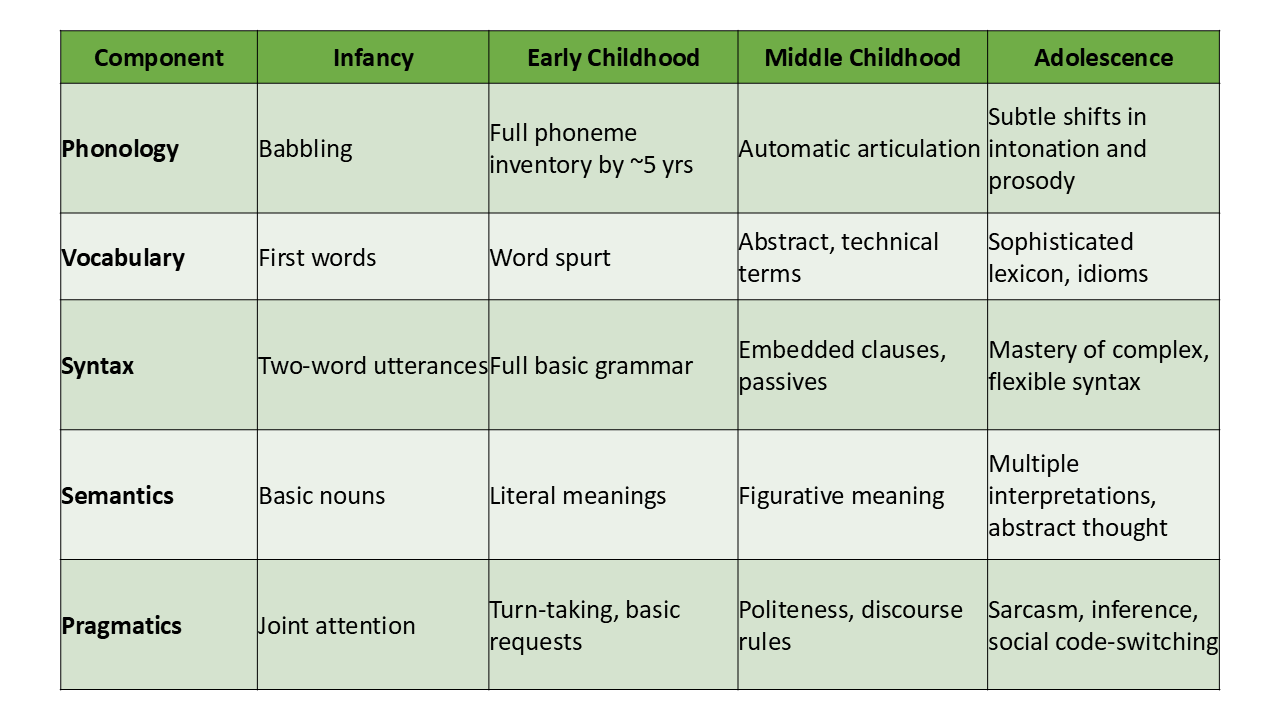
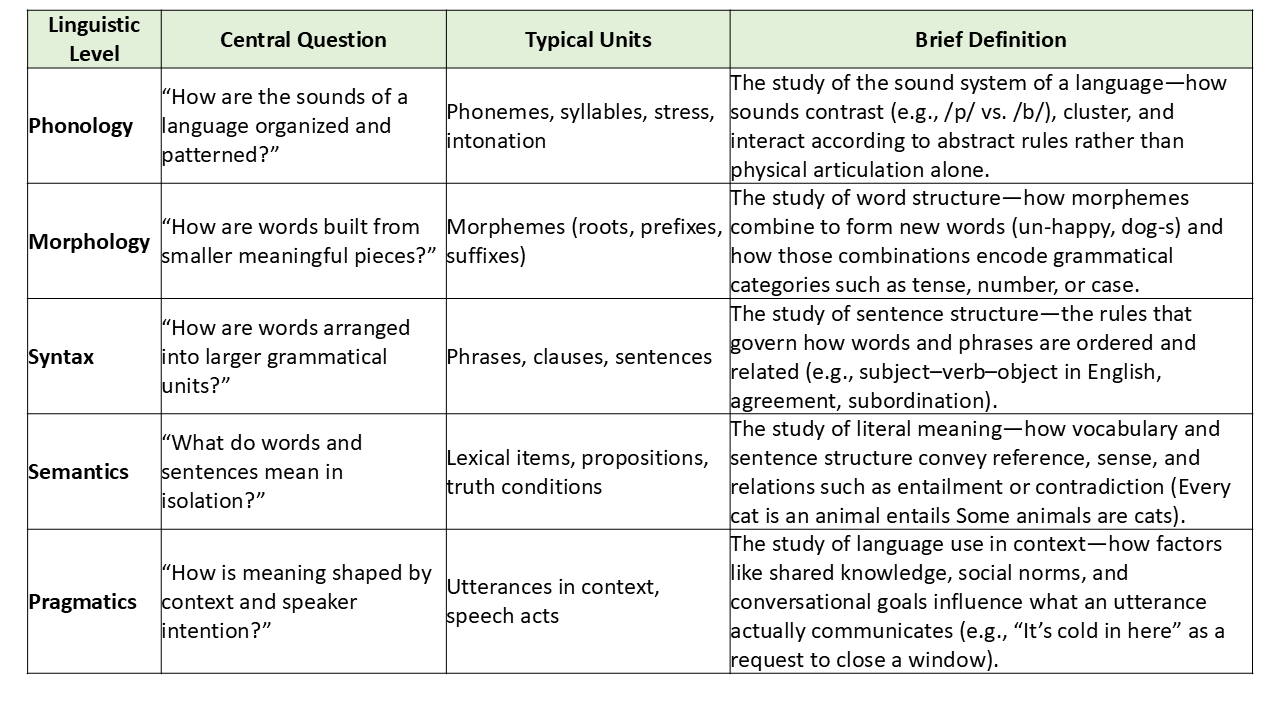
  • Involves five (5) systems of rules: phonology, morphology, syntax, semantics and pragmatics.

Theories related to Language Development (Basic)

1. Nativist Theory (Noam Chomsky)

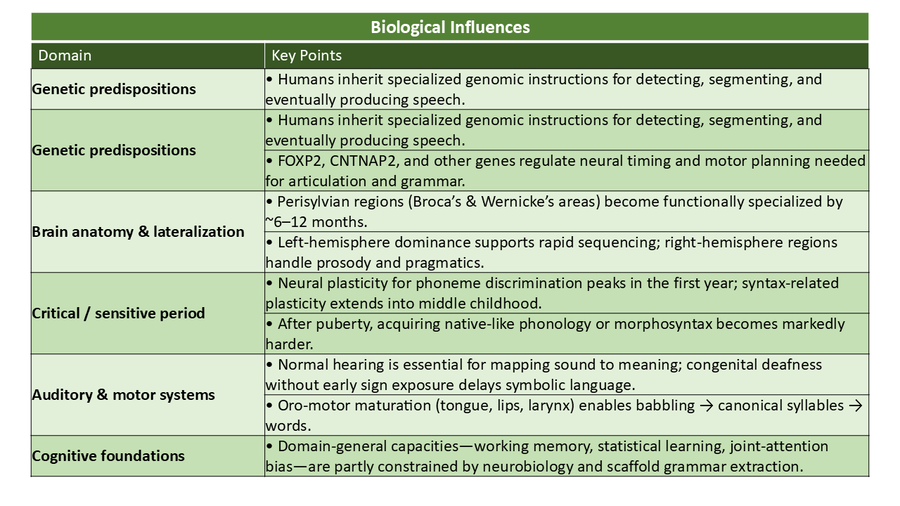
The Nativist perspective argues that humans are biologically programmed to gain knowledge. Chomsky famously challenged the idea that language is learned through mere imitation, noting that children often produce sentences they have never heard before.

Core Concepts:

  • Language Acquisition Device (LAD): An innate biological “module” or mental processor that allows children to understand the rules of whatever language they are exposed to.
  • Universal Grammar (UG): The theory that all human languages share a common underlying structural basis. Children aren’t learning grammar from scratch; they are “plugging in” the specific rules of their native tongue to a pre-existing template.
  • The Critical Period: Nativists argue there is a specific biological window (usually ending around puberty) during which language must be acquired for a person to reach full fluency.

2. Interactionist Theory

Interactionism serves as a bridge between biological and behavioral theories. It suggests that while biological preparation is important, language only develops through meaningful social interaction with others.

Core Concepts:

  • Language Acquisition Support System (LASS): Proposed by Jerome Bruner as a counterpoint to the Language Acquisition Device (LAD). It emphasizes the importance of a child’s social network (parents, teachers, peers) in providing the necessary framework for learning.
  • Social Context: Children learn language because they have a powerful desire to communicate and socialize. The environment provides the “input” that triggers and shapes linguistic growth.
  • Zone of Proximal Development (ZPD): Often associated with Lev Vygotsky, this concept suggests that children learn best when interacting with a “More Knowledgeable Other” (MKO) who provides scaffolding as temporary support that is removed as the child becomes more proficient.

Cara penulisan Penutup (RPH)

Menulis bahagian Penutup dalam Rancangan Pengajaran Harian (RPH) adalah sangat penting bagi memastikan murid keluar dari bilik darjah dengan pemahaman yang jelas dan motivasi yang tinggi. Berikut adalah panduan dan contoh bagaimana menggabungkan aspek Kognitif dan Sosial secara efektif:


1. Aspek Kognitif (Rumusan Kandungan)

Tujuannya adalah untuk mengukuhkan semula apa yang telah dipelajari dan menilai sama ada objektif pembelajaran tercapai.

  • Rumusan Guru: Guru merangkumkan isi-isi penting.
  • Sumbang Saran Murid: Murid memberikan semula poin-poin utama yang mereka ingat.
  • Peta I-Think: Menggunakan peta minda secara spontan di papan putih.
  • Soal Jawab: Guru bertanyakan soalan rawak (Cold Call) untuk menguji kefahaman.

2. Aspek Sosial (Peneguhan Positif/Negatif)

Tujuannya adalah untuk memberi maklum balas terhadap tingkah laku, usaha, dan kerjasama murid sepanjang sesi PdP.

  • Peneguhan Positif: Pujian, tepukan, atau pemberian bintang/mata bagi murid yang aktif dan berdisiplin.
  • Peneguhan Negatif: Teguran membina atau peringatan tentang disiplin (contoh: mengingatkan murid yang tidak menyiapkan tugasan supaya menyiapkannya sebagai kerja rumah).
  • Motivasi: Kata-kata semangat untuk sesi akan datang.

Contoh penulisan Penutup

Guru merangkumkan isi penting. Guru bertanyakan soalan imbuhan seperti: “Mengapa bangunan pencakar langit mempunyai tapak yang sangat luas?” untuk menguji kefahaman mendalam. Murid merumuskan bahawa faktor luas tapak dan ketinggian mempengaruhi kestabilan sesuatu binaan (Aspek kognitif). Guru memberi pujian kepada murid yang berjaya menjawab soalan imbuhan dan juga memberi pujian kepada kumpulan membina model paling stabil dan menunjukkan semangat kerja berpasukan yang tinggi. (Aspek sosial).

Dari contoh di atas, apabila guru memberikan pujian kepada kumpulan (aktiviti di Fasa Peneguhan Konsep), ianya memberikan pengiktirafan kepada murid dan juga mengaitkan murid dengan fasa yang telah dilaksanakan sebelum ini. Dengan membuat perkaitan ini, ianya dapat mengukuhkan ingatan murid dengan adanya tambahan perkaitan pengalaman dari satu fasa dengan fasa lain.

Cara penulisan Penilaian (Pentaksiran Formatif)

Fasa Penilaian (Pentaksiran Formatif) adalah fasa selepas fasa Peneguhan Konsep. Untuk menjadikan penulisan Penilaian (Pentaksiran Formatif) dalam RPH lebih profesional, sebaiknya menyentuh aspek berikut:

a. Aktiviti: Apa yang murid buat?

b. Tujuan: Apa yang ingin dinilai? (Objektif pembelajaran)

c. Tindakan Susulan: Apa yang guru buat selepas mendapat jawapan murid? (Inilah intipati pentaksiran formatif).

Penulisan Penilaian (Pentaksiran Formatif) yang umum seperti ” Kuiz bertulis (5 soalan)” adalah tidak memadai bagi menerangkan fasa Penilaian (Pentaksiran Formatif). Contoh lain: “Murid menjawab soalan kuiz Quizziz melalui platform padlet. Guru menilai tahap penguasaan murid.” mempunyai maklumat tambahan tentang apa yang guru lakukan tetapi masih boleh diperbaiki. Ianya tidak mempunyai penjelasan tindakan susulan guru selepas melaksanakan penilaian tahap penguasaan murid.

Contoh penulisan Penilaian (Pentaksiran Formatif)

Murid menjawab 5 soalan kuiz bertulis (Lampiran 1) dalam tempoh 5 minit (Apa yang murid buat). Guru menyemak jawapan murid secara rawak untuk mengenal pasti tahap penguasaan objektif pembelajaran (Tujuan). Murid yang salah diberikan bimbingan (remedi), manakala yang betul diberikan latihan pengayaan (Tindakan Susulan).

UTM Open Day