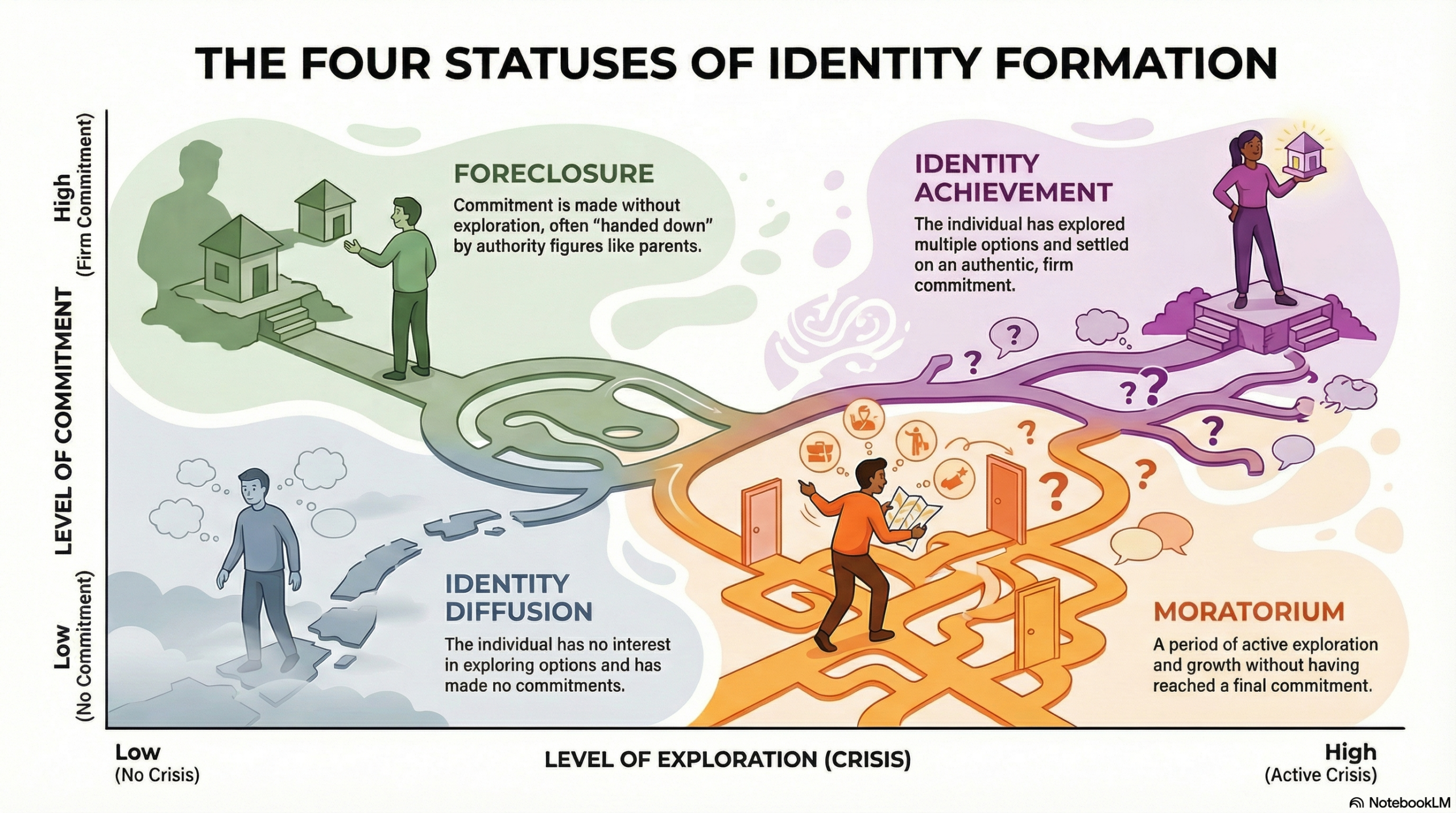
James Marcia extended Erik Erikson’s Identity vs. Role Confusion stage by explaining how identity develops by proposing that identity formation is not a single event, but a process driven by two key factors: Exploration (Crisis) and Commitment.
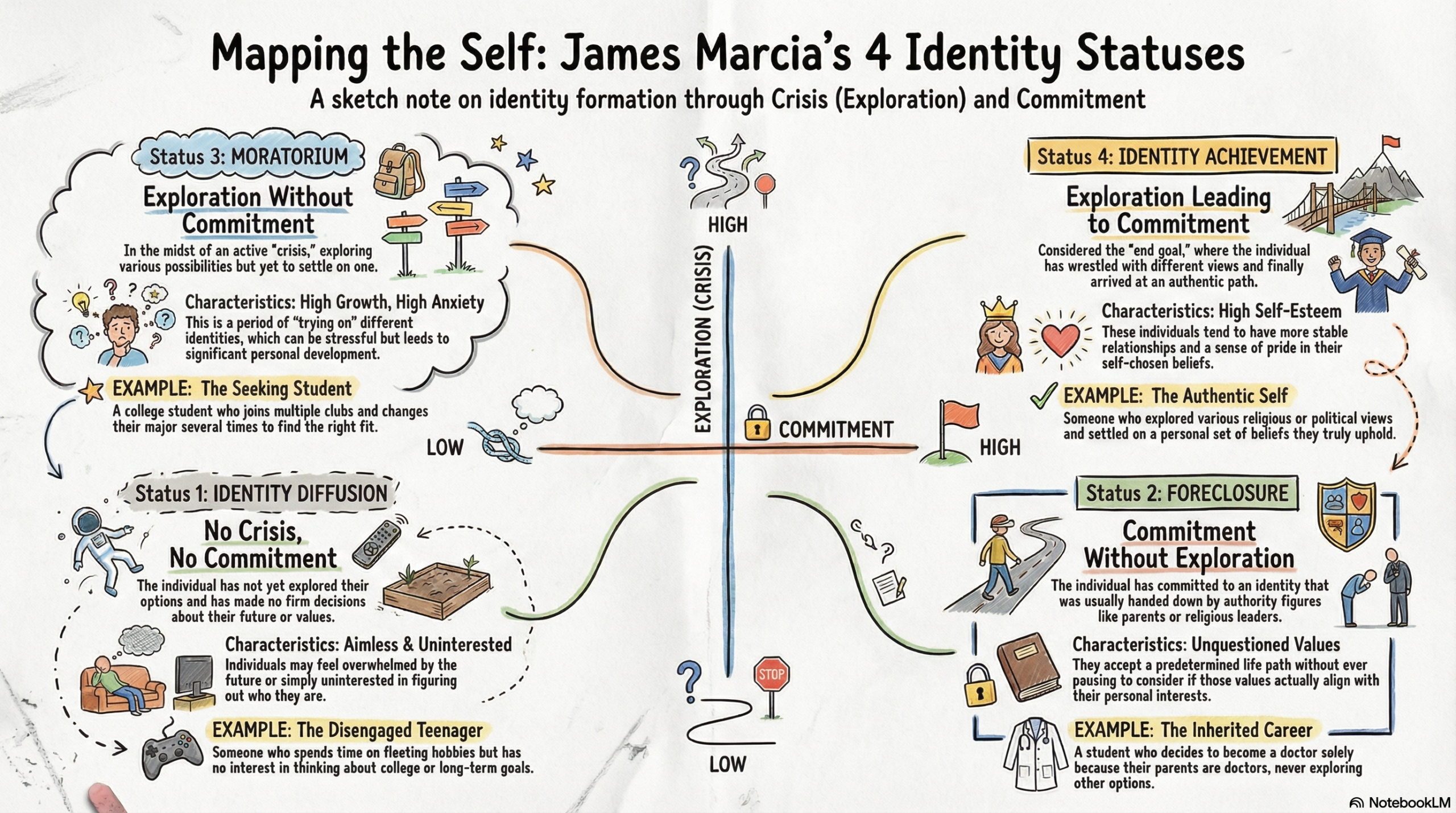
Instead of stages, Marcia proposed four identity statuses based on two dimensions:
- Exploration (crisis) → actively questioning choices (e.g., career, beliefs)
- Commitment → making decisions and sticking to them
The Four Identity Statuses
1. Identity Diffusion
In this status, the individual has not yet experienced a crisis and has made no commitments.
- Characteristics: They may seem aimless, uninterested, or overwhelmed by the idea of the future. They aren’t trying to figure out who they are, nor do they care to at the moment.
- Example: A teenager who has no interest in thinking about college or a career and spends most of their time on fleeting hobbies without deep engagement.
2. Foreclosure
Here, the individual has made a commitment but has not explored other options.
- Characteristics: Their identity is often “handed down” by authority figures (usually parents or religion). They accept these values without questioning them.
- Example: A student who decides to become a doctor simply because their parents are doctors, without ever considering if they actually like medicine.
3. Moratorium
The individual is currently in the midst of a crisis, actively exploring, but has not yet made a commitment.
- Characteristics: This is often a period of high anxiety but also high growth. They are “trying on” different versions of themselves—new styles, political views, or career paths.
- Example: A college student who changes their major three times and joins various clubs to see where they fit best.
4. Identity Achievement
This is the “end goal” where the individual has gone through a crisis and made a firm commitment.
- Characteristics: They have explored various possibilities and settled on a path that feels authentic to them. They tend to have higher self-esteem and more stable relationships.
- Example: Someone who explored different religious and political views, wrestled with the contradictions, and finally arrived at a set of personal beliefs they are proud to uphold.