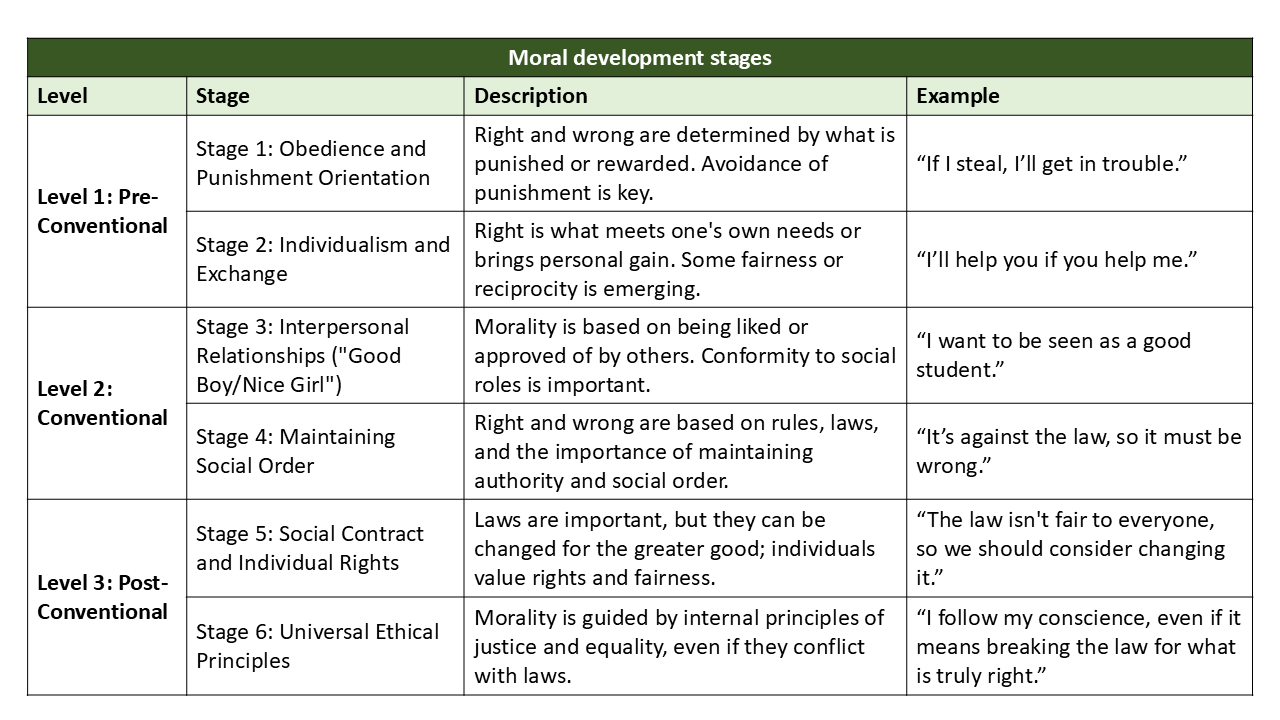
Level 1: Pre-Conventional Morality
At this level (common in children), morality is externally controlled. Rules are imposed by authority figures, and “right” or “wrong” is judged by the direct consequences.
Stage 1: Obedience and Punishment Orientation
The focus is on direct consequences. An action is perceived as wrong because the person is punished for it.
- Logic: “I shouldn’t do it because I don’t want to get in trouble.”
Stage 2: Individualism and Exchange
Children recognize that there is not just one right view handed down by authorities. Different individuals have different viewpoints. “Right” is what meets one’s own interests or involves a fair trade.
- Logic: “What’s in it for me?” or “I’ll help you if you help me.”
Level 2: Conventional Morality
At this level (typical of adolescents and adults), morality is tied to personal and societal relationships. Individuals continue to accept the rules of authority figures, but now because they believe it is necessary to maintain positive relationships and societal order.
Stage 3: Good Interpersonal Relationships
Often called the “good boy/nice girl” orientation. The individual is good in order to be seen as being a good person by others. The focus is on living up to social expectations and roles.
- Logic: “I want people to like me and think I’m a good person.”
Stage 4: Maintaining the Social Order
The individual becomes aware of the wider rules of society, so judgments concern obeying the law, respecting authority, and performing one’s duties so that social order is maintained.
- Logic: “If everyone broke the law, society would fall apart. I must follow the rules.”
Level 3: Post-Conventional Morality
At this level, individuals move beyond the perspectives of their own society. Morality is defined in terms of abstract principles and values. People now believe that some laws are unjust and should be changed.
Stage 5: Social Contract and Individual Rights
The individual becomes aware that while rules/laws might exist for the good of the greatest number, there are times when they will work against the interest of particular individuals. Issues are not always clear-cut.
- Logic: “The law should be changed if it doesn’t protect the rights of the people.”
Stage 6: Universal Ethical Principles
People at this stage have developed their own set of moral guidelines which may or may not fit the law. The principles apply to everyone (e.g., human rights, justice, and equality). The person will be prepared to act to defend these principles even if it means going against the rest of society in the process and having to pay the consequences of disapproval and/or imprisonment.
- Logic: “I will do what is right because it is inherently right, regardless of what the law says.”