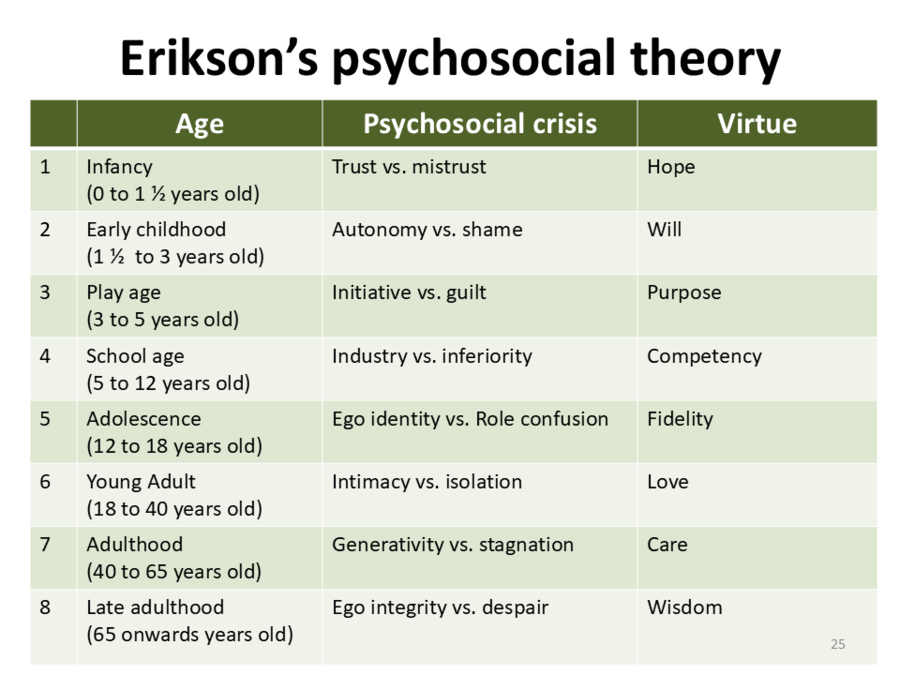
Erikson viewed development as a series of crises that must be resolved. Each stage centers on a social struggle that impacts personality.
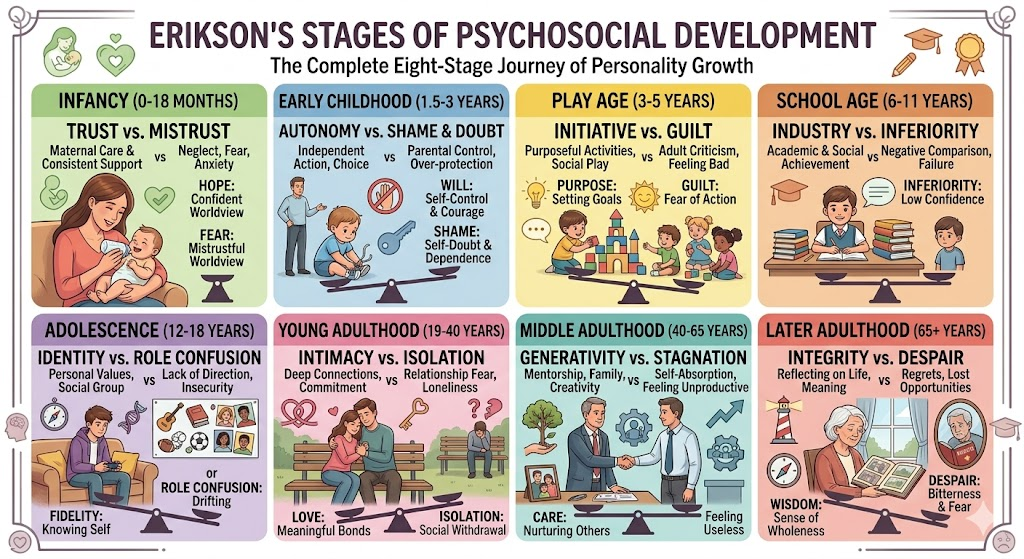
Stage 1: Trust vs. Mistrust (Infancy – 0 to 1.5 years old): Is the world a safe place?
Core issue: Can I trust the world?
Key factor: Consistent caregiving
- Positive outcome: Trust, sense of safety
- Negative outcome: Fear, suspicion
- Phase where it serves as the foundation of attachment and emotional security
Stage 2: Autonomy vs. Shame/Doubt (Toddlerhood – 1.5 to 3 years old): Can I do things myself?
Core issue: Can I do things on my own?
Key factor: Encouragement vs. overcontrol
- Positive: Independence, confidence
- Negative: Shame, self-doubt
- This phase is linked to early self-control and decision-making
Stage 3: Initiative vs. Guilt (Preschool – 3 to 5 or 6 years old): Am I good or bad at planning tasks?
Core issue: Is it okay to take initiative?
Key factor: Support for exploration
Key factor: Support for exploration
- Positive: Initiative, leadership
- Negative: Guilt, fear of trying
- This phase is important for development of creativity and goal-directed behavior
Stage 4: Industry vs. Inferiority (School Age – 7 to 12 years old ): How do I compare to my peers?
Core issue: Am I competent?
Key factor: School and achievement
- Positive: Competence, productivity
- Negative: Inferiority, low confidence
- This phase has a strong connection to academic self-efficacy
Stage 5: Identity vs. Role Confusion (Adolescence – 13 to 17 years old): Who am I?
Core issue: Who am I?
Key factor: Exploration of roles, values
- Positive: Strong identity
- Negative: Confusion, instability
- This is a central stage in personality development and life direction
Stage 6: Intimacy vs. Isolation (Young adulthood – 19 – 40 years old)
Core issue: Can I form meaningful relationships?
Key factor: Emotional openness
- Positive: Intimacy, strong relationships
- Negative: Loneliness, isolation
Stage 7: Generativity vs. Stagnation (Middle adulthood – 40 to 65 years old)
Core issue: Am I contributing to society?
Key factor: Productivity, care for others
- Positive: Generativity (giving back)
- Negative: Stagnation, lack of purpose
Stage 8: Integrity vs. Despair (Late adulthood – 65 years old onwards)
Core issue: Was my life meaningful?
Key factor: Life reflection
- Positive: Wisdom, fulfillment
- Negative: Regret, despair