Part 4 – MyDigital EDUCATOR@MOHE program: First internal evaluation
Having a passionate mentor is like having a gyutou knife. It is a dream to have one but it can cause serious injury too with its sharpness. A learner who is like me who needs extra time and lots of efforts to master learning new things can be a nightmare for any passionate mentor. My mentor had decided to have a quick evaluation before we submitted our materials (deadline is on 30th July 2022). Even though he is not feeling well yesterday, but he made a point to have one-to-one session with us. I was the third person to be evaluated. So after seeing the first two people getting their feedback, I know how serious my mentor is.
When it was my turn, I showed him the downloadable checklist first before I showed him my lesson plan and materials in MOHE moodle. He gave constructive feedbacks which I would use to implement. One of the feedbacks is I should omit the links to the materials in the checklist. His justification is students will use the links in the checklist without accessing moodle. My thought is still in the MCO mode in which I used to give such checklist to students who had difficulty to access elearning. This module is not for such students. I overlook this aspect.
The second feedback that he gave is I should use embed display setting for the materials. I tried it several times to no avail. This is one good example of a struggle that I have to overcome. I will try to watch again the related videos to learn about this. A quick solution would be to bug one of my friends to teach me (she gave a talk before about elearning stuff and she knows elearning better than me).
Another thing that he suggested is to have an opening or welcoming video with a short instruction. I am thinking to use Genially with the voice recorded mode. I need to learn to do that. I have tried once but I am not satisfied with the recorded video. My laptop is a bit slow when converting video to MP4 so using an online video recorded video is an option that I have to consider as the only option now.
I lamented to one of the seniors. He advised me “Just do the things within your ability. If you have to learn something new, learn at your own pace. If somebody pressure you to do something that beyond your ability, just ignore it. Just ignore it until it is no longer relevant. But if you must do it and do not have any other choice, just deal with it“. With a chuckle he said “Masa tu la nak pening kepala“.
I try to convince myself that this is just a phase. Indeed. But I am starting to feel helpless. This is not good. Knowing the severity of learned helplessness, I need to do something to avoid myself falling into that situation.
Note: What is learned helplessness? It is a term coined by Martin Seligman and Steven Maier to describe a condition that occurs when we face uncontrollable situation continuously (repeatedly) and despite our best efforts to find solution, we face failures or negative outcomes. This will lead us to stop trying to change the circumstances or the situations even when we have the ability to do so. In this case, our judgment about our ability is being clouded by the negative assessment of our efforts based on the negative outcomes of the uncontrollable situations.
Citra karisma 2022
My 1st tuition class this year (2022)
I was involved in the tuition classes as an enrichment program that the school organized since 2018. Back in 2018, I had a little choice to say No as I was a part of the teaching staff. But I was entrusted to teach the low achievers who knew they were labeled as such based on their performance. I had a blast with them even though it was challenging to boost their self-esteem and improve their performance at the same time. I continued to teach tuition classes in 2019 but in 2020 and 2021, due to the COVID-19 pandemic and whatsnot, the tuition classes had to stop for a while.
I was contacted by Ita last Monday (4 July 2022) if I was available to join their enrichment program again this year. I immediately said Yes even though I know that I will be a bit preoccupied with examination thingy and stuff this month. So, I looked up my old notes that I used when I taught English in 2018 and tried to find information about the current SPM format. Well, they have changed the SPM format for English paper (Writing). No more 350 words. Now, the word counts are between 200 to 250 words for continuous writing. Well, I learn something new with the new formatting. There is also a revised rubric to evaluate Part 3: Continuous writing. Having a former student who is also an invigilator cum examiner of the Paper 2 is a blessing. I contacted my former student and asked about the latest things to update myself.
She laughed at me when I said that I was nervous as I was entrusted to teach the high achievers this time around. She said: “I bet you will love it! Teaching such students is a challenge in itself, but rewarding. Just try it” I came a few minutes late as I stopped at Pekan Tiram to photocopy some materials. Cikgu dan kedai fotostat berpisah tiada. Indeed.
The shop owner and I had a small talk and he remarked “Lama dah tak nampak cikgu datang kedai fotostat“. I just smiled but he could see me smiling as I was wearing my face mask. Alhamdulillah I wore the face mask at that time, so I could hide my uneasiness after hearing him saying that.
I had a quick background check with Ita about the students. Knowing that some of them are from B40 families, I predict that they might not have foolscap paper. I brought some papers which I took from old examination booklets. So, I can give it to anyone who does not bring or have any foolscap paper.
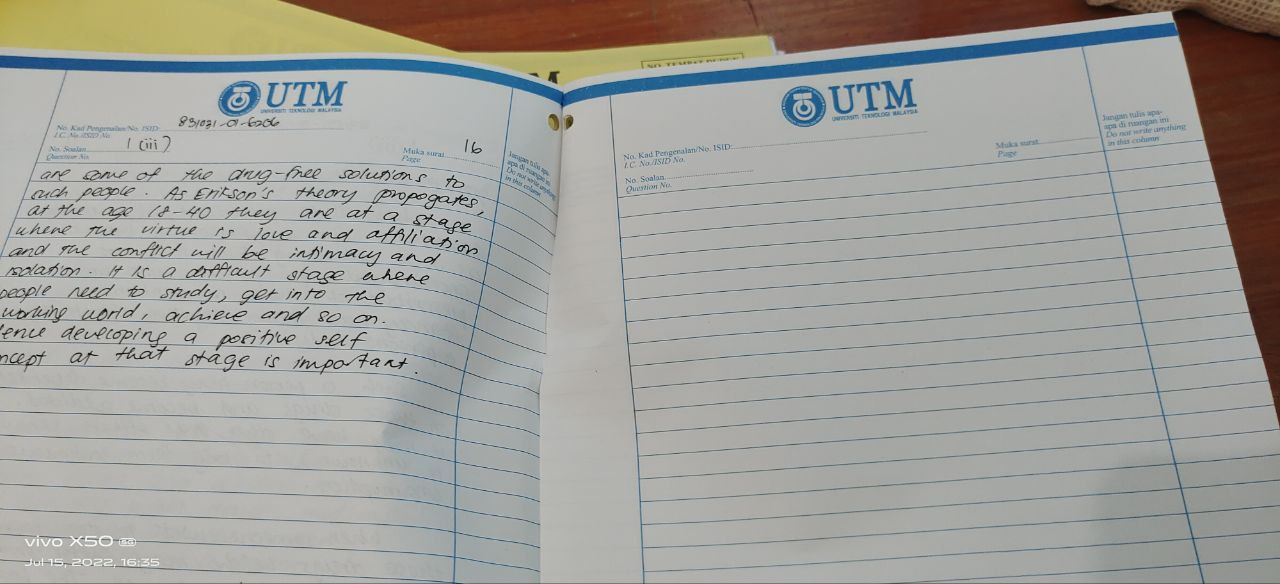
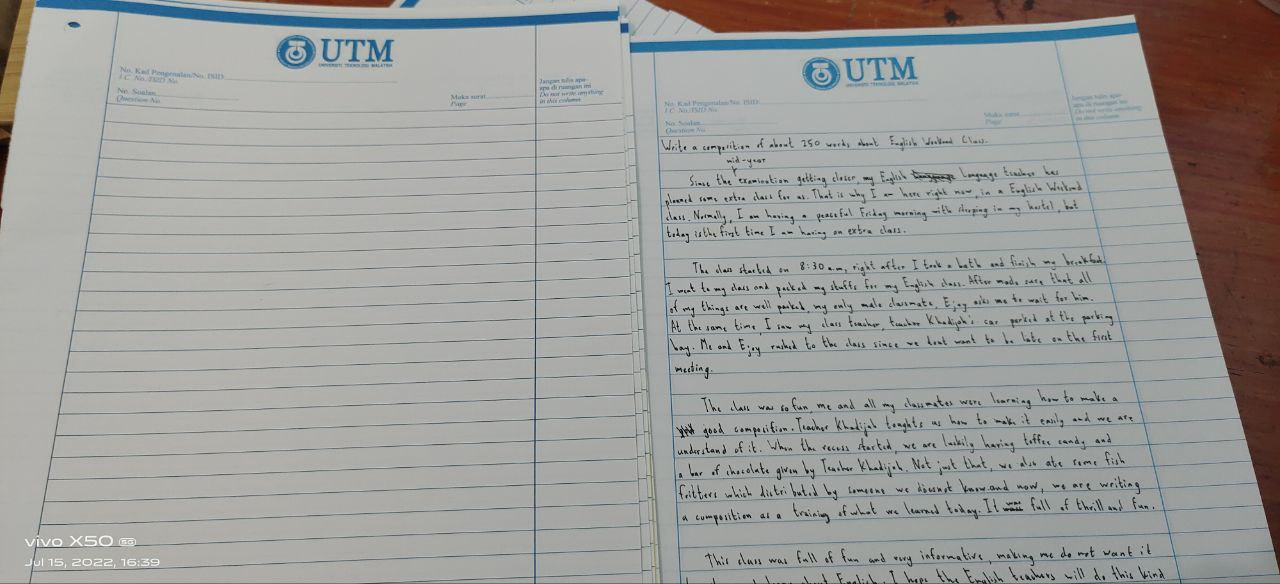
There are a couple of students who brought their own foolscap paper but upon seeing that I have the left-over papers from the examination booklet with UTM logo, they requested me to give them too. One of the students tried to sniff the paper. “This is not a perfumed paper.” I told the student while rolling my eyes. With a cheeky smile, he said “Saja nak bau. Mana tau ada bau UTM”. Huh?
UTM does not have that budget to have perfumed examination booklet (tongue in cheek remark!). Our students are not that lucky to have such paper. Nevertheless, the paper from the examination booklet is thicker than the foolscap paper that they have.
While collecting the papers from them, one of the students said to me “Teacher, pelajar di UTM guna kertas ni ke ketika peperiksaan?” Well, with that question, I had to tell them the truth by saying “Well, I took this from the examination booklet. These are the unused pages in the booklet. I shredded the used pages and threw it away. I kept these as foolscap paper” . While nodding her head, she replied back by saying, “Saya suka lah guna kertas ni. Saya rasa bersemangat nak tulis karangan dengan baik” Errmm… should I believe that or what?
Padlet bukan bahan econtent untuk kategori collaboration tools
Saya baru ada sedikit masa terluang untuk menyemak TESDCP tahun lepas (2021). Saya mendapati bahawa hasil perbincangan pelajar saya yang menggunakan nota (Prezi) yang diletakkan dalam Padlet tidak dikira sebagai bahan e-content (tiada markah diberikan). Dalam Padlet tersebut ada soalan berbentuk terbuka yang memerlukan pelajar menjawab secara naratif atau esei pendek.
Kesimpulannya, Padlet tidak lagi diterima sebagai bahan econtent. Ini adalah bercanggah dengan nota yang diberikan oleh Dr Nurbiha.
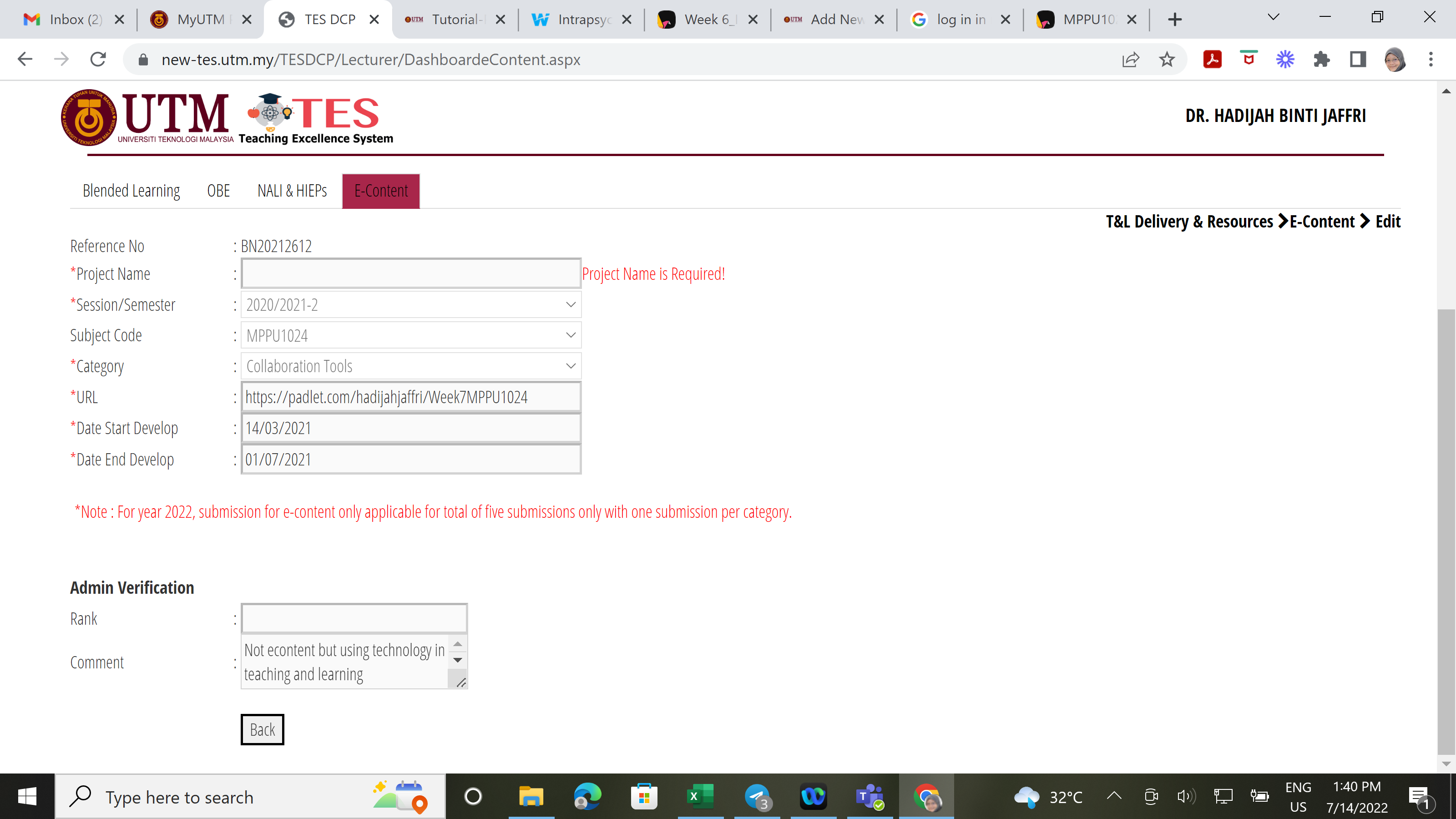
Ini adalah nota dari sesi taklimat yang diberikan oleh Dr Nurbiha (mungkin nota lama)
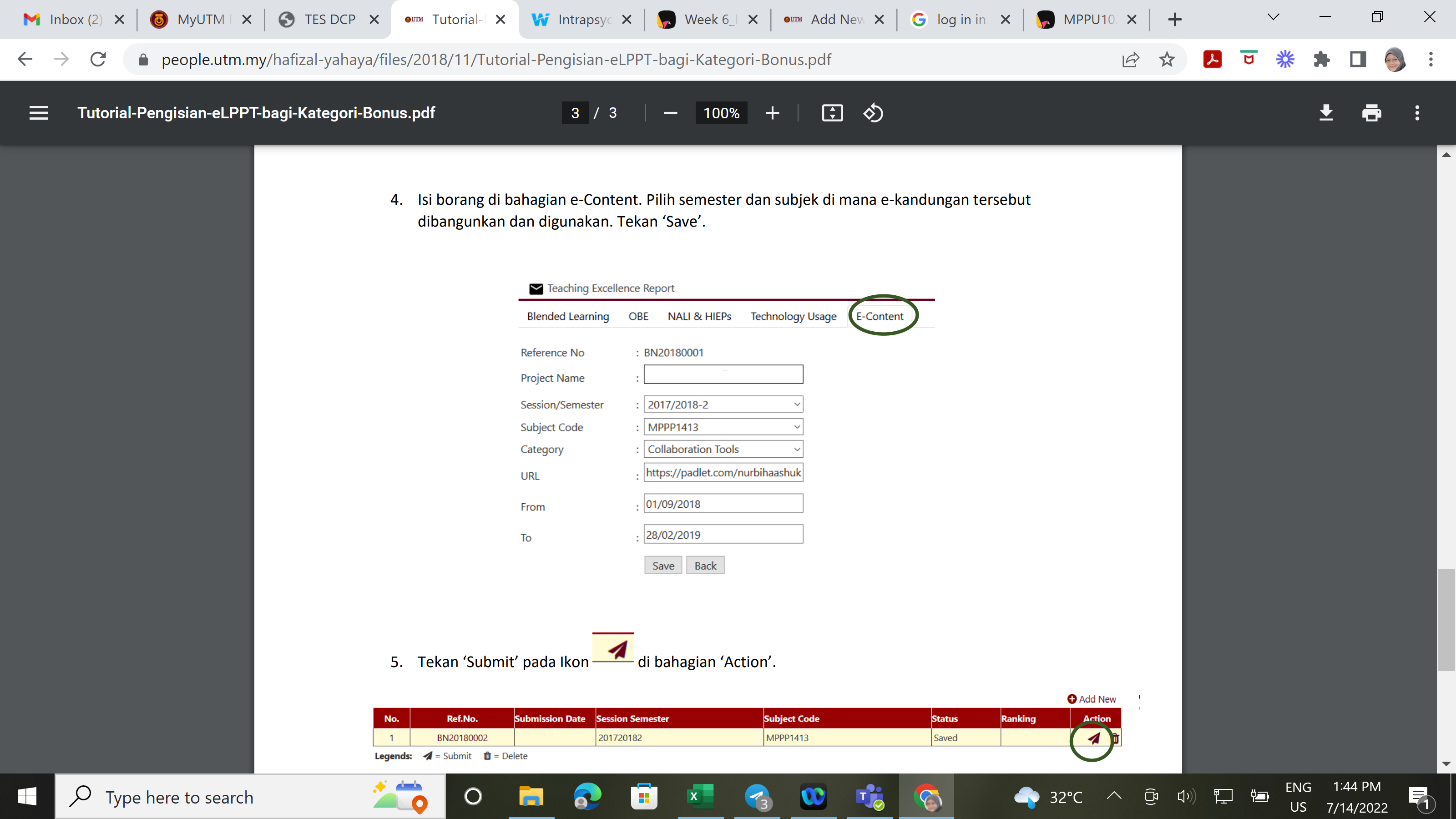
Apa yang saya faham ialah Padlet adalah alat seperti Youtube, Powtoon, Trello, Quizziz, Kahoot, Socrative dan sebagainya yang mana ianya digunakan dalam membina bahan pengajaran. Sebagai contoh, Powtoon, Genially, Moovly, Canva dan sebagainya adalah alat yang boleh digunakan untuk membangun, dan membina bahan pengajaran berbentuk video (sila betulkan saya sekiranya ialah ada salah konsep [misconception]).
Bagi Genially, pembina tidak perlu memuat turun video dalam bentuk MP4 dan memuat naik video ke YouTube. Bagi Powtoon, pembina bahan perlu memuat turun video dalam bentuk MP4 dan memuat naik video tersebut ke YouTube. Yang berbeza ialah apabila menggunakan Genially (versi berbayar dan dilanggan), kita diberi pautan URL yang boleh dikongsi dengan pelajar dan sekiranya pengguna awam ingin menggunakan bahan tersebut mereka boleh mendapatkan dan menggunakan bahan tersebut (cuma agak sukar sekiranya pengguna awam kurang biasa dengan Geniallymeskipun pautan tersebut adalah umum (public).
Untuk pelantar yang membolehkan pelajar berbincang dalam talian sama ada secara segerak atau tidak segerak, kita boleh menggunakan pelantar seperti Padlet, Jamboard, Wakelet, Trello dan sebagainya. Ianya lebih bersifat agak terbuka kerana ianya boleh digunakan oleh pelajar untuk menulis jawapan, pandangan atau memberi komen tertentu yang boleh dikongsi dengan rakan yang lain. Bagi keadaan bersemuka, selalunya kita menggunakan kertas mahjung untuk pelajar menulis sesuatu. Pelantar seperti Padlet dan Wakelet mempunyai ruang untuk pelajar memberikan komen terhadap pandangan atau jawapan rakan. Sekiranya ianya hanya dianggap sebagai teknologi dan bukan bahan econtent, saya agak keliru kerana ianya menjadi bahan econtent dengan apa yang ditulis dalam pelantar tersebut.
Ianya seolah sekiranya bahan pengajaran video dimuat naik di YouTube tidak diterima sebagai bahan econtent kerana menggunakan teknologi iaitu YouTube dalam pengajaran. YouTube adalah alat seperti Padlet.
Sesungguhnya saya keliru kerana dalam sesi taklimat yang diberikan oleh Dr Nihra, beliau ada menunjukkan contoh Trello yang digunakan untuk perbincangan pelajar. Beliau ada mengatakan bahawa itu menunjukkan bahan econtent yang memberikan peluang kepada pelajar untuk berinteraksi dengan rakan. Padlet saya mempunyai nota kelas, arahan dan juga ruangan untuk pelajar berinteraksi dengan bahan (nota) dan rakan. Mereka boleh berinteraksi dengan rakan melalui ruangan komen atau mereka boleh membina ruangan komen baru.
Jadi dimanakah silapnya saya sehingga Padlet tidak dikira sebagai bahan econtent? I rest my case. Adakah mungkin kerana saya silap memilih kebenaran untuk paparan sama ada umum atau peribadi? Kena melihat semula aspek ini.
Dimanakah tempat pengisian E-content tahun 2022 yang terkini?
Jangan kalut. Jangan panik.
Langkah-langkah:
- Pastikan anda telah log masuk (log in) di UTMPortal
- Di bawah “Academic” pilih “TESDCP“
- Di paparan utama TESDCP, pilih “T&L Delivery and Resources“
- Di bawah paparan yang ada muka anda yang _____ (isi tempat kosong), terdapat empat (4) pilihan: Blended learning, OBE, NALI & HIEPS, E-content.
- Pilih E content.
- Seterusnya, anda boleh masukkan maklumat yang diperlukan seperti biasa.
Part 3 – MyDigital EDUCATOR@MOHE program: Rubric!
One of the things that our mentor reminds is always refer to the given rubrics. There are three rubrics. One of the rubric is to evaluate our assessments that we assign in our module. So, as I scrutinized the rubric, I was shocked. One of the criteria is “Apply relevant rubric to measure learner’s knowledge and achievement”. My initial thought was “If I use MCQ and True/False questions, the answer scheme is straight forward so I do not need to prepare any rubric. So, what does this criteria mean?” As I looked at the descriptors of the performance levels, I notice the highest mark is given for “Use, modify, integrate and validate the rubric to measure”. What rubric that I have to create now?
So, I asked my mentor. He is very prompt in assisting me. In the end, after a quick discussion through WhatsApp, I understand that I have to create an open-ended question assignment with its rubric. So, out of three assessments, one has to be open-ended question. Then I remember that my mentor showed an example from his module in which he uses an activity worksheet. That gives me an idea about doing a similar thing: An activity worksheet in which the instruction given demands students to answer several questions.
I search existing worksheets that I have but in the end I need to craft it from scratch. So, I look at some examples of rubrics (my own collection) and from there I modify to suit with the new activity worksheet. There. Do I fit into the descriptor for the highest mark? Well, I do it the best I could so I will leave it to the rest. It is up to the evaluator to assess the materials. I just hope that whatever I do will make sense to others and if this module is offered, it might benefit anyone who uses it.
Part 2 – MyDigital EDUCATOR@MOHE program: When you have a passionate mentor
We are assigned with a mentor for MyDigitalEducator program. Our group is blessed to have a mentor who is passionate in teaching. Well, he holds an admin post at this unit which responsible with things related to teaching and learning. Thus, it does resonate with his actions.
One of the things that he did was had a briefing with all mentees. After that, he checked the title that we sent for the module that we have to develop. There were some of us who give generic titles. He reminded those individuals to change the title. He also reminded us to inform him if we have any technical problem or directly inform the webmaster from UUM. Alhamdulillah the PIC from UUM is very helpful especially in rectifying technical problems that we might have.
Other than briefing, our mentor also set a date for progress reporting via WebEx after Eid Adha. Sigh…. I was planning to take a long break but apparently I cannot do so as I have to complete 50% of the module by that time. Technically, I have less than 2 weeks to do so. One might be wondering, if I have lack of time to complete the module, why do I have time to create this post, right? This is a way for me to “capture” the moment that I am having at this time. So, I can reflect at it later on and see what are the things that can be improved.
In a way, this is the way I do my CQI for my teaching.
IUCEL 2022
We had no grant, no product nor any commercialisation value for this project. Nope. But what we have is something that we want to share with others about our teaching practice. This is our little experiment. So, Dr Doria Abdullah and I brainstormed last year about the things that we want to do for our class. It was a new session (session 202122) so I want to try out something new for my class. Dr Doria has used comics in her class for few semesters. I like the idea and I want to try out for my class but since I only taught one course which I did not pair with others, I could only experiment this idea in this course. It is a bit tedious to discuss and involve others whom I do not have any experience collaborating with.
Dr Doria was my former student and she likes the idea of some of the things that I did when I was teaching her (I have forgotten what I did back then – it was more than 10 years ago). To cut the story short, we had data from our little experiment. It is might be not enough for publication yet as it might need few cycles of data collection to have solid and sufficient data. So, as a start, we share our findings in IUCEL 2022.
Alhamdulillah, we got Silver medal. Well, our intention is not for the medal but we want to share and get feedbacks from others which we can use to improve our teaching. So our project is nothing fancy. It involved just the two of us because the process happened in our classes (Dr Doria used her undergraduate class and I used my postgraduate class). My students were informed about this.
Last year, I submitted my own project which I conducted alone for my class (the data collection took place three semesters). Somebody asked me why I did such project alone. Well, Alhamdulillah Allah Gives me someone to collaborate with. Even though, Dr Doria is a junior but she has lots of ideas that I find interesting to replicate in my own class. I hope our collaboration will not stop here.
