Author Archives: haslina

Fatal Tesla Self-Driving Car Crash Reminds Us That Robots Aren’t Perfect

Tesla-Model-S-Elon-Musk-2011

This article is obtained from http://spectrum.ieee.org/cars-that-think/transportation/self-driving/fatal-tesla-autopilot-crash-reminds-us-that-robots-arent-perfect?utm_campaign=TechAlert_07-21-16&utm_medium=Email&utm_source=TechAlert&bt_alias=eyJ1c2VySWQiOiAiOWUzYzU2NzUtMDNhYS00YzBjLWIxMTItMWUxMjlkMjZhNjE0In0%3D

null
Photo: Bloomberg/Getty Images

On 7 May, a Tesla Model S was involved in a fatal accident in Florida. At the time of the accident, the vehicle was driving itself, using its Autopilot system. The system didn’t stop for a tractor-trailer attempting to turn across a divided highway, and the Tesla collided with the trailer. In a statement, Tesla Motors said this is the “first known fatality in just over 130 million miles [210 million km] where Autopilot was activated” and suggested that this ratio makes the Autopilot safer than an average vehicle. Early this year, Tesla CEO Elon Musk told reporters that the Autopilot system in the Model S was “probably better than a person right now.”

The U.S. National Highway Transportation Safety Administration (NHTSA) has opened a preliminary evaluation into the performance of Autopilot, to determine whether the system worked as it was expected to. For now, we’ll take a closer look at what happened in Florida, how the accident may could have been prevented, and what this could mean for self-driving cars.

According to an official report of the accident, the crash occurred on a divided highway with a median strip. A tractor-trailer truck in the westbound lane made a left turn onto a side road, making a perpendicular crossing in front of oncoming traffic in the eastbound lane. The driver of the truck didn’t see the Tesla, nor did the self-driving Tesla and its human occupant notice the trailer.  The Tesla collided with the truck without the human or the Autopilot system ever applying the brakes. The Tesla passed under the center of the trailer at windshield height and came to rest at the side of the road after hitting a fence and a pole.
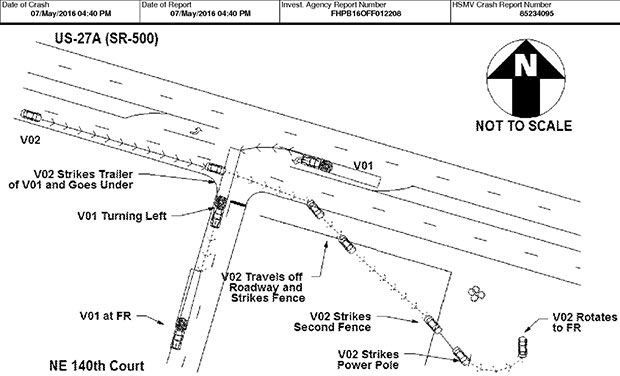
img
Image: Florida Highway Patrol

Tesla’s statement and a tweet from Elon Musk provide some insight as to why the Autopilot system failed to stop for the trailer. The autopilot relies on cameras and radar to detect and avoid obstacles, and the cameras weren’t able to effectively differentiate “the white side of the tractor trailer against a brightly lit sky.” The radar should not have had any problems detecting the trailer, but according to Musk, “radar tunes out what looks like an overhead road sign to avoid false braking events.”

We don’t know all the details of how the Tesla S’s radar works, but the fact that the radar could likely see underneath the trailer (between its front and rear wheels), coupled with a position that was perpendicular to the road (and mostly stationary) could easily lead to a situation where a computer could reasonably assume that it was looking at an overhead road sign. And most of the time, the computer would be correct.

Tesla’s statement also emphasized that, despite being called “Autopilot,” the system is assistive only and is not intended to assume complete control over the vehicle:

It is important to note that Tesla disables Autopilot by default and requires explicit acknowledgement that the system is new technology and still in a public beta phase before it can be enabled. When drivers activate Autopilot, the acknowledgment box explains, among other things, that Autopilot “is an assist feature that requires you to keep your hands on the steering wheel at all times,” and that “you need to maintain control and responsibility for your vehicle” while using it. Additionally, every time that Autopilot is engaged, the car reminds the driver to “Always keep your hands on the wheel. Be prepared to take over at any time.” The system also makes frequent checks to ensure that the driver’s hands remain on the wheel and provides visual and audible alerts if hands-on is not detected. It then gradually slows down the car until hands-on is detected again.

I don’t believe that it’s Tesla’s intention to blame the driver in this situation, but the issue (and this has been an issue from the beginning) is that it’s not entirely clear whether drivers are supposed to feel like they can rely on the Autopilot or not. I would guess Tesla’s position on this would be that most of the time, yes, you can rely on it, but because Tesla has no idea when you won’tbe able to rely on it, you can’t really rely on it. In other words, the Autopilot works very well under ideal conditions. You shouldn’t use it when conditions are not ideal, but the problem with driving is that conditions can very occasionally turn from ideal to not ideal almost instantly, and the Autopilot can’t predict when this will happen. Again, this is a fundamental issue with any car that has an “assistive” autopilot that asks for a human to remain in the loop, and is why companies like Google have made their explicit goal to remove human drivers from the loop entirely.

The fact that this kind of accident has happened once means that there is a reasonable chance that it, or something very much like it, could happen again. Tesla will need to address this, of course, although this particular situation also suggests ways in which vehicle safety in general could be enhanced.

Here are a few ways in which this accident scenario could be addressed, both by Tesla itself, and by lawmakers more generally:

A Tesla Software Fix: It’s possible that Tesla’s Autopilot software could be changed to more reliably differentiate between trailers and overhead road signs, if it turns out that that was the issue. There may be a bug in the software, or it could be calibrated too heavily in favor of minimizing false braking events.

A Tesla Hardware Fix: There are some common lighting conditions in which cameras do very poorly (wet roads, reflective surfaces, or low sun angles), and the resolution of radar is relatively low. Almost every other self-driving car with a goal of sophisticated autonomy uses LIDAR to fill this kind of sensor gap, since LIDAR provides high resolution data out to a distance of several hundred meters with much higher resiliency to ambient lighting effects. Elon Musk doesn’t believe that LIDAR is necessary for autonomous cars, however:

For full autonomy you’d really want to have a more comprehensive sensor suite and computer systems that are fail proof.

That said, I don’t think you need LIDAR. I think you can do this all with passive optical and then with maybe one forward RADAR… if you are driving fast into rain or snow or dust. I think that completely solves it without the use of LIDAR. I’m not a big fan of LIDAR, I don’t think it makes sense in this context.

Musk may be right, but again, almost every other self-driving car uses LIDAR. Virtually every other company trying to make autonomy work has agreed that the kind of data that LIDAR can provide is necessary and unique, and it does seem like it might have prevented this particular accident, and could prevent accidents like it.

Vehicle-to-Vehicle Communication: The NHTSA is currently studying vehicle-to-vehicle (V2V) communication technology, which would allow vehicles “to communicate important safety and mobility information to one another that can help save lives, prevent injuries, ease traffic congestion, and improve the environment.” If (or hopefully when) vehicles are able to tell all other vehicles around them exactly where they are and where they’re going, accidents like these will become much less frequent.

Side Guards on Trailers: The U.S. has relatively weak safety regulations regarding trailer impact safety systems. Trailers are required to have rear underride guards, but compared with other countries (like Canada), the strength requirements are low. The U.S. does not require side underride guards. Europe does, but they’re designed to protect pedestrians and bicyclists, not passenger vehicles. An IIHS analysis of fatal crashes involving passenger cars and trucks found that “88 percent involving the side of the large truck… produced underride,” where the vehicle passes under the truck. This bypasses almost all front-impact safety systems on the passenger vehicle, and as Tesla points out, “had the Model S impacted the front or rear of the trailer, even at high speed, its advanced crash safety system would likely have prevented serious injury as it has in numerous other similar incidents.”


If Tesla comes up with a software fix, which seems like the most likely scenario, all other Tesla Autopilot systems will immediately benefit from improved safety. This is one of the major advantages of autonomous cars in general: accidents are inevitable, but unlike with humans, each kind of accident only has to happen once. Once a software fix has been deployed, no Tesla autopilot will make this same mistake ever again. Similar mistakes are possible, but as Tesla says, “as more real-world miles accumulate and the software logic accounts for increasingly rare events, the probability of injury will keep decreasing.”

The near infinite variability of driving on real-world roads full of unpredictable humans means that it’s unrealistic to think that the probability of injury while driving, even if your car is fully autonomous, will ever reach zero. But the point is that autonomous cars, and cars with assistive autonomy, are already much safer than cars driven by humans without the aid of technology. This is Tesla’s first Autopilot-related fatality in 130 million miles [210 million km]: humans in the U.S. experience a driving fatality on average every 90 million miles [145 million km], and in the rest of the world, it’s every 60 million miles [100 million km]. It’s already far safer to have these systems working for us, and they’re only going to get better at what they do.

Pembukaan Permohonan Skim Geran Penulisan Kes (CWGS) 2016

Assalamualaikum & Salam Sejahtera.
 
Ybhg. Dato’/ Prof./ Dr./ Tuan/ Puan, 
 
2.  Sukacita dimaklumkan bahawa permohonan geran bagi menjalankan program penilisan kes di bawah Skim Geran Penulisan Kes (CWGS) 2016 telah dibuka secara atas talian kepada kumpulan penyelidik di institusi pendidikan tinggi (IPT) bermula 1 Julai 2016 hingga 15 Ogos 2016. 
 
3.  Untuk makluman, permohonan Skim CWGS 2016 yang dikemukakan hendaklah memenuhi syarat – syarat yang ditetapkan berdasarkan kepada Garis Panduan CWGS 2016 yang boleh dirujuk di laman web :- cwgs.utm.my. Siling bagi setiap permohonan geran adalah RM20,000.00. 
 
4.  Sebarang pertanyaan lanjut boleh hubungi Pn Suraya binti Ibrahim di talian 07-5533133 atau emel :- isuraya@utm.my. Kerjasama pihak Tuan/Puan amatlah dihargai dan didahului dengan ucapan terima kasih.
 
Sekian, 
 

—

Prof. Madya Dr. Shukor Abd Razak

Timbalan Pengarah Pengurusan Projek
Pusat Pengurusan Penyelidikan
Universiti Teknologi Malaysia
Tel:(6)07-5537803
Fax:(6)075566177
http://www.rmc.utm.my – RMC Portal

Gangguan Capaian ke eLearning@UTM

Assalamualaikum dan Salam Sejahtera,

Perkara diatas adalah dirujuk.

Untuk makluman, pihak CICT masih lagi belum selesai proses pemasangan elearning Semester pendek bagi Sesi 2015/2016. Sehubungan dengan itu, semua pensyarah dan pelajar UTM masih belum dapat membuat sebarang capaian ke server elearning sehingga  5:00 petang (21 Ogos 2016 – Khamis)

Segala kesulitan amatlah dikesali.

Harap Maklum
Norah Md Noor, Dr
Lecturer / IT Manager UTMLead
CENTER FOR TEACHING & LEARNING

UTMLead

UNIVERSITI TEKNOLOGI MALAYSIA
81310 Johor Bahru, Johor, Malaysia

Penutupan Sementara Urusan di Pejabat Pendaftar UTMKL : Majlis Sambutan Hariraya Aidilfitri 1437H

YBhg Prof/Dato’/Datin /Dr./Saudara

Dengan segala hormatnya adalah saya merujuk kepada perkara di atas.


Majlis Sambutan Hari Raya Aidilfitri 1437H peringkat Pejabat Pendaftar UTM   Kuala Lumpur  akan diadakan seperti pada ketentuan berikut :

Tarikh      :  21 Julai 2016 (Khamis)

Masa       : 9.00 pg – 1.00 tghri

Tempat    : Tasik Angkat PPKL, KSJ

Sehubungan itu segala urusan di kedua-dua pejabat (Pejabat Am & Unit Keselamatan) adalah ditangguhkan buat sementara dan akan beroperasi semula pada sebelah petangnya.

Semoga berada di dalam makluman, atas segala kerjasama diucapkan ribuan terima kasih.

FRGS PHASE 1/2016 – MYGRANTS REVISION, AGREEMENT & RADIS REGISTRATION

Dear Researchers,

Assalamualaikum and Good Day.

Congratulation to all researchers who succeeded in FRGS Phase 1/2016. To speed up the grant activation process, please take the following necessary actions:

Task 1  – Due date:  26th July 2016

Please revise/amend your proposal in MyGrants system as per MOHE panel’s comment. The start date of the project is 1st August, 2016. Please revise budget, milestone and Gantt chart accordingly. Once you are have completed with the revision, change the Status to Complete and click Save to submit the revised proposal for RMC actions.


Task 2 – Due date:  26th July 2016

Once complete with MyGrants revision/amendment, Project Leader needs to submit TWO (2) hardcopies of FRGS Agreements to RMC. Only need to fill up information in page 3, 7 & 8 and print the completed agreement in A4 size paper (please print on both sides).

Task 3 – Due date: 31st July 2016

Once complete with Task 1 and Task 2, Project Leader needs to register the approved FRGS Grant in RADIS System. Make sure to upload the completed FRGS agreement and FRGS result (attached in this email) in your RADIS registration. Manual on how to complete FRGS registration in RADIS is also attached in this email.

For further enquiries, please contact Proposal & Record Unit as below:-

  1. Raja Rozita Raja Rahmat (ext:37822 email: eitaeusof@utm.my)
  2. Suziana Tahir (ext:37824 email: ziana@utm.my)
  3. Mohamad Amirul Nizam Abu Mansor (ext: 37824 email: m.amirulnizam@utm.my)
  4. Lilissuriati Mohamed Tahir (ext:37822 email: lilissuriati@utm.my)


Regards,
—

Prof. Madya Dr. Shukor Abd Razak

Timbalan Pengarah Pengurusan Projek

Pusat Pengurusan Penyelidikan

Universiti Teknologi Malaysia

Tel:(6)07-5537803

Fax:(6)075566177

http://www.rmc.utm.my – RMC Portal

http://www.rmconline.utm.my – RMC Helpdesk

https://radis.utm.my – Research and Development Information System

EXTENDED DEADLINE: 2016 IEEE EMBS CONFERENCE IN BIOMEDICAL ENGINEERING & SCIENCES (IECBES 2016) – IEEE Xplorer & Scopus indexed

Call for Papers | 2016 IEEE EMBS CONFERENCE IN BIOMEDICAL ENGINEERING & SCIENCES

A REGIONAL CONFERENCE OF THE IEEE EMBS

4-8 December 2016
Kuala Lumpur, Malaysia

http://www.iecbes.org
——————————————————————

IECBES 2016 welcomes original submissions on the following topics of interest (but not limited to): Biomedical Signal and Image Processing | Biomedical Instrumentation and Devices | Biosensors/Micro/Nano/Wearable Technologies | Biomedical Imaging | Cardiovascular and Respiratory Systems | Neural Engineering | Biomedical Modelling and Simulation | Biomedical and Medical Robots | Cellular/Molecular/Tissue Engineering | Biomaterial | Biomimetic | Bioinformatics | Healthcare Information System | eHealth/mHealth/Telemedicine | Rehabilitation Engineering | Biomedical Engineering Education

SELECTED PAPERS will be submitted to Cogent Engineering Journal in early 2017. 

FEATURING…

KEYNOTE SPEAKERs: Ahmad Fadzil Mohamad Hani | Allan Hanbury | Beverly Steffert | Elisabeth Worthey | Nigel H. Lovell | Toshiyo Tamura | Yuan Ting Zhang

PANELISTs for FORUM_Connecting EMB with Medical Physicians: Challenges towards Better Healthcare and Life Quality: Ahmad Sobri Muda | Mohammed Faruque Reza | Teo Soo Hwang | Wong Chee Piau | Felix Yap Boon Bin

WORKSHOPs: Neurofeedback for Adhd, Autism & Developmental Coordination Disorder | Big Data in Healthcare

SPECIAL SESSION: IEEE Humanitarian Technology Activities

AWARDs: Young Scientist Best Paper Award for all Tracks | Professional Best Paper Award for all Tracks | WIE Best Paper Award | HTA Paper Award |

HUMANITARIAN WORKSHOP: Your registration fee contributes to underserved teens from orphanages to attend “Biomedical Engineers Meeting Humanity: An Education and Career Sharing with Underserved High School Children”

NETWORKINGs: Conference Dinner | Cultural Performance | Elephant Sanctuary

SPONSORS & SUPPORT: IEEE EMBS, IEEE WIE, IEEE HTA


Important Dates
===============
* Submission of Full Paper: July 15, 2016 15 August 2016
* Notification of Acceptance: September 15, 2016
* Camera Ready/ Paper Submission: October 15, 2016
* Conference Date: December 4-8, 2016

Paper Submission Guidelines
====================
All papers will be peer-reviewed and accepted papers of IECBES 2016 will be submitted to IEEE Xplore. The conference will only accept paper(s) that adhered to IEEE format. To download a copy of the template, kindly click here.


The Organizing Committee of IECBES2016

iecbes@myembs.org

ICECS 2016: Paper Submission Deadline *Extended*

The 23rd IEEE International Conference on Electronics, Circuits and Systems (ICECS) will be held in Monte Carlo, Monaco on December 11-14, 2016. The conference is technically sponsored by IEEE CAS society in Region 8 of IEEE (Europe, Middle East, and Africa). Papers are on the topics of design methodologies, techniques and experimental results in emerging electronics, circuits and systems. IEEE ICECS 2016 will include tutorials, regular sessions (lecture and poster) and special sessions.

Papers are solicited in, but not limited to, the following topics:
  • VLSI Systems, NoC, SoC, CAD, and Layout
  • Analog and Mixed Signals Circuits
  • Signal Processing
  • MEMS/NEMS
  • Communication and RF Circuits and Systems
  • Green and Power Electronics
  • Low-Power Technologies and Harvesting Energy
  • Neural Networks and Fuzzy Systems
  • Control Systems, Mechatronics and Robotics
  • Image Processing and Multimedia Systems
  • Linear and Non-linear Circuits and Systems
  • Embedded and Systems Architectures
  • Bioengineering Circuits and Systems
  • Emerging Technologies

The best papers will be invited for publication in an extended version in IEEE TCAS-I. This year’s conference will devote a special interest to Bio-Nano devices and circuits; the best papers in this category will be selected for publication in the J. of BioNanoScience.


Conference proceedings will be indexed and published on IEEE Xplore.


Proposal Submission

General information and the submission procedure can be found on the conference site.

Important Dates
Deadline for paper submission: 25th of July, 2016
Tutorial submission deadline: 27th of May, 2016
Special session submission deadline: 27th of May, 2016
Notification of acceptance: 30th of September, 2016
Deadline for submission of final paper: 20th of October, 2016


A special Young Professional (YP) day will be organized with posters, demos and a panel discussion (http://icecs.isep.fr/yp_session.html). Information about submitting proposals for YP posters and demos can be found on the conference website.

Henna delays fingerprint-secured graduations in India

30_1_2014_20_20_48_t3tsra0mn4ts1hu6ccngvlafv7_wa3b7kc77l

See more at: http://www.planetbiometrics.com/article-details/i/4716/desc/henna-delays-fingerprint-secured-graduations-in-india/#sthash.3GbIo1wv.dpuf


Students hoping to graduate from an educational course in India have had to wait to confirm final results as henna applied to their fingers disrupted a biometric authentication tool. The biometric device rejected the thumb impressions of “scores” of female candidates who applied “Mehendi” traditional henna makeup during the Eid festival in the city of Hyderabad, reported Sisat. With only couple of days are left for completion of the verification process which escalated students’ anxiety, girls were seen trying to erase the mehendi with the help of detergent and even hydrogen peroxide. An official said that clear instructions on the matter were provided during the time of application, but the girls didn’t take it seriously. He said that light coloured henna were able to match using the, but the dark colours were not recognised. Students were asked not to panic as they have until later this week to provide verification details. – See more at: http://www.planetbiometrics.com/article-details/i/4716/desc/henna-delays-fingerprint-secured-graduations-in-india/#sthash.3GbIo1wv.dpuf

PENGHANTARAN LAPORAN PEMANTAUAN DANA PENYELIDIKAN FRGS, PRGS, ERGS, TRGS, LRGS, NRGS, FRGS TOP-DOWN DAN RAGS BIL.2/2016

Assalamua’laikum w.b.t dan salam sejahtera,
Dimaklumkan pihak Kementerian Pendidikan Tinggi akan menjalankan proses pemantauan Bil. 2/2016 terhadap prestasi projek-projek penyelidikan yang telah diperakukan di bawah skim FRGS, PRGS, ERGS, LRGS, NRGS, FRGS Top-Down dan RAGS. Laporan prestasi dan kewangan projek penyelidikan perlu di hantar secara atas talian menggunakan portal MyGRANTS dengan melayari laman web https://mygrants.gov.my bagi geran-geran berikut:

1. Skim Geran Penyelidikan Fundamental (FRGS) Fasa 1/2013 sehingga Fasa 1/2015
2. Skim Geran Penyelidikan Prototaip (PRGS) Fasa 1/2013 sehingga Fasa 1/2015
3. Skim Geran Penyelidikan Eksploratori (ERGS) Fasa 1/2013
4. Skim Geran penyelidikan Trans-Disiplinari (TRGS) Fasa 1/2013 sehingga Fasa 1/2015
5. Dana Pembudayaan Penyelidikan (RAGS) tahun 2013 sehingga 2014

Bagi geran LRGS, NRGS dan FRGS Top-Down penyelidik dipohon untuk mengisi borang secara manual dan menghantar borang laporan prestasi dan kewangan projek/program penyelidikan yang lengkap sebagaimana berikut:

1. Skim Geran Penyelidikan Jangka Panjang (LRGS) Fasa 1/2011 sehingga Fasa 2/2014
2. Skim Geran Penyelidikan Nic (NRGS) Tahun 2013
3. Skim Geran penyelidikan Fundamental Top-Down (FRGS Top-Down) Tahun 2013 sehingga 2014
Setiap laporan projek/program penyelidikan perlu dikemukakan borang-borang pemantauan mengikut geran penyelidikan masing-masing yang terdiri daripada Borang – P1 (R) iaitu:
1. Laporan Prestasi Projek/Program (Progress Report)
2. Bagi projek yang telah tamat diisi pada Borang P3 (R)

Penyelidik juga diminta untuk melengkapkan laporan kemajuan (Progress Report) dan akhir (End Report) dalam sistem RADIS. Semua laporan pemantauan perlu diselesaikan sebelum atau pada 7 Ogos 2016 bagi membolehkan pihak RMC majukan kepada KPT mengikut tarikh yang ditetapkan.

Kegagalan mengemukakan laporan pemantauan mengikut tarikh yang ditetapkan boleh menyebabkan permohonan geran KPT dari ketua-ketua projek terbabit tidak akan diproses.
Berikut merupakan pautan bagi  senarai geran yang terlibat dalam proses pemantauan tersebut serta Borang-P1(R) dan Borang-P3(R) serta User Manual Monitoring – Researcher. Penyelidik yang masih belum menghantar laporan kemajuan/akhir diminta untuk menghantar laporan yang diperlukan mengikut tempoh yang telah ditetapkan.

ERGS : https://drive.google.com/open?id=0By7vxb2Y2MtzbU5fR09RU2IxOTA

FRGS : https://drive.google.com/open?id=0By7vxb2Y2MtzbTkzRkZBUXVhaFU

FRGS TOP DOWN :  https://drive.google.com/open?id=0By7vxb2Y2MtzdmkzRUlsY0NWQW8

LRGS : https://drive.google.com/open?id=0By7vxb2Y2MtzSmpNUW9iU2NhTm8

PRGS : https://drive.google.com/open?id=0By7vxb2Y2MtzOXZZSXRULWM2QWc

TRGS : https://drive.google.com/open?id=0By7vxb2Y2MtzZGM3X1czd3o1ZU0

user manual mygrants : https://drive.google.com/open?id=0By7vxb2Y2MtzbF8xajVHTC1IaFE

Sebarang pertanyaan berhubung penggunaan sistem MyGRANTS sila hubungi:
1. Urusetia FRGS – 03-88706974/frgsbpki@gmail.com
2. Urusetia PRGS – 03-88706974/prgsbpki@gmail.com
3. Urusetia ERGS/TRGS/RAGS – 03-88706973/6972 rndbpki@gmail.com
4. Urusetia LRGS – 03-88706974/ 6972 lrgsbpki@gmail.com
5. Urusetia NRGS – 03-88706974/ 6972 nrgsbpki@gmail.com
6. Helpdesk MyGRANTS – 012-6200825 (Qayyuum)/010-2252532 (Jason)/ helpdesk@mygrants.gov.my

Sebarang pertanyaan berhubung pemantauan di peringkat RMC UTM sila hubungi:
1. En. Amirul Shahrin – 37883
2. Pn. Nur Illani – 37873
3. Cik Azizah – 37830

Sekian, terima kasih.

—

Prof. Madya Dr. Shukor Abd Razak

Timbalan Pengarah Pengurusan Projek
Pusat Pengurusan Penyelidikan
Universiti Teknologi Malaysia
Tel:(6)07-5537803
Fax:(6)075566177
http://www.rmc.utm.my – RMC Portal
https://radis.utm.my – Research and Development Information System

3rd WEEK OF THE MONTH AS ENGLISH WEEK IN UTM

Salam Sejahtera & Salam 1Malaysia

Dear Datuk/Professor/Dr./Mr./Mrs.,


3rd WEEK OF THE MONTH AS ENGLISH WEEK IN UTM

We would like to announce that UTM is implementing the following programmes to enhance the use of English among the staff.

All staff of UTM are required to use English regularly in UTM to develop their confidence to communicate with foreigners. This is to provide daily training for UTM staffs besides the formal training programmes offered by Human Capital Department (Registrar Office).


The implementation will be effective every 3rd week of every month starting from 17th – 23rd July 2016. Heads of Departments are to ensure that the program is successfully carried out at the department level involving all staff.


Your cooperation in ensuring the success of the program is highly appreciated.

Thank you.


“Berkhidmat untuk Negara Kerana Allah”

THANKING & REGARDS

DEVELOPMENT SECTION

HUMAN RESOURCES DIVISION

REGISTRAR OFFICE

UNIVERSITI TEKNOLOGI MALAYSIA

81310 UTM JOHOR BAHRU, JOHOR

Office:07 – 553 0361/1116/37949 | Fax: 07-5585821

Primary Email: hcd@utm.my | Site: http:registrar.utm.my/en/hcd/