Puppy love? Monkey love?

I had a quick chat with Ita yesterday.  I asked her about what’s new and what’s not about school.  She told me about some teenage angst among the form 5 students.  Yup.  Among the students who she mentioned was in my class.  When they caught the form four student last April due to “energy booster” stuff, I wrote to all my former form 4 students a letter.  

I am a bit busy off lately.  I don’t think I would have enough time to write each and every one of them a letter.  But I will meet some of them this Friday for our tuition class in sha Allah.  So, I would have a pep talk with them.  There are various issues that teachers are worried about.  Among the issues are coupling, same gender close relationship, a minor brawl (this one is due to minor misunderstanding between a senior and a junior relating to defending one’s girlfriend) and lack of motivation in their study.  Some of the issues are part and parcel of life.  As teenagers, they are exploring their identity and thus they need to learn to negotiate with others.  It is not easy to do that.  They need guidance and lots of patience from other adults.  

But the thing is, when it comes to opposite gender relationship, for some teachers, it is too early for them to explore in that area.  For me, it is ok as long as they know the boundary that they have to abide according to Islam.  A normal note from one to another is common.  To meet or hang out at the mall is normal (of course this is not right if you don’t observe “the” guideline).  Some of them might say that their parents met when they were at school.  They were high school sweet hearts.  So sweet right?  Yeah right.  Now, their children are following their parents footsteps.  Of course, this makes thing a bit challenging for the teachers because on one hand. the parents are ok with that and on the other hand, the teachers don’t want it to become a culture at school.

Some people can balance their act when it comes to studying and coupling.  But if you have string of Cs and Ds, it clearly indicates that you need to focus on one aspect more than trying to focus on both.  But again, it is choice.  At the end of the day, the students need to decide and be accountable towards their decision.  
What did I normally do during relief class?

It was quite common for me to have relief class during Latihan Ikhtisas.  Sometimes, I had few relief classes almost every day.  At first, I didn’t know what to do during relief class other than “following” the normal practice i.e. let the students do their own work.  But after some time, I decided to do some activities (with rewards). 

Among the activities that I would do was spelling bee and trivia (quiz about general knowledge) but for form 3 and form 5 students, I would normally ask the teachers if they had handouts that they want me to use when I had their relief class and we would have discussion after that.  In a way that, I would end up teaching the students.   I did these few times and later on the principal and the GPK knew about it and thus, I would end up taking ALL relief classes for English regardless of the forms.  For examination classes i.e. form 3 and form 5, I would normally assign to do revision exercise with them for grammar, writing, literature and such.  

Normally, what I did was if I knew in advance that I would be given a relief class, sometimes I would book the computer room and did activities using Quizziz such as online trivia.  Of course, some students were hesitated but I normally would reward those who got the right answer etc. with chocolates.  The funny thing was sometimes when the students knew that they would get a relief teacher on certain time, they would ask me if I would be the relief teacher because they wanted to “play English game”.  Yeah right!  The power of positive reinforcement.  Indeed.   

My quizziz collection: Suitable for secondary school students

I have been using Quizziz since 2016.  But when I went for my Latihan Ikhtisas, I still continued using Quizziz for my form 1 and form 4 students.  Here are some of the Quizziz that I made that anyone can get access to any time, any where provided they have internet connection [Note: I make it public so that there is no password or code needed to get access to it]

Form 4 

Living Photograph (Poem)

Charge of the Light Brigade (Poem)

Leaving (Short Story)

Form 1

Sad I Ams

Grammar 

Nouns

Present Perfect Simple Tense

Simple Past Tense

Present Continuous Tense

Simple Present Tense

Past Perfect Tense

Past Progressive/Continuous Tense

Modal verbs

Prepositions

Adverbs

Adjectives

Pronouns


Multiple intelligence: What is that?

Any intelligence theory is complicated and could easily be misunderstood because there are many layers of intelligence.   Some might think that if a student prefers to use audio style of learning (i.e. listening to lecture, talk, engaging in discussion etc.), he/she is an auditory learner.  Well, it is easy to accept such assumption because it gives a quick way to understand one’s preference in learning.  But, as human being, we are complex beings and thus, there are so many aspects and factors that affect our learning.  

When Howard Gardner proposed his theory of Multiple Intelligence, he wrote many articles about it but off lately, other researchers have found findings that contradict Gardner’s idea.  Gardner acknowledges that he might overlook some parts of human learning.  As teachers, we have to take time to know our students.  Knowing their intelligence level or learning preference is not enough.  Compassion is one of the key elements to be emphatic teachers.  

la Résistance

Oittt

Takde yang pdf ke

Yang ni tak reti nak guna la

That’s the message that I received from one of my senior colleagues who seems to baffle a bit when I gave him Prezi link.  

I am a novice Prezi user.  But, in line with the implementation of Future Ready Educators practice in UTM, I have no choice other than “transforming” my notes to Prezi.  It is my baby step.  Prezi can be converted into PDF but it does not look nice.  I don’t like it.   So, I would rather give the link so the users can have interactive slides.  They can skip any subtopic or can look at any subtopic that they want with ease.  Powerpoint has similar feature yet it is does not have any direct link like Prezi.

I guess, since the E-content is new, people are struggling to adjust to it.  Like the OBE.  I still remember back in 2011, when I attended the course on OBE, I was motivated to “practice” preparing the Course Assessment Report (CAR) by using OBE.  But, I vividly remember my former HoD said to me when he saw that I was sending the *OBE version report, “Hadijah, just because you attended the OBE workshop, it does not mean that you should use OBE to prepare your report.  You have to do it manually.  I won’t accept this OBE version report“.

I was heartbroken (a bit).  But, here I am facing such challenges again.  I just need to be persistent in this.  I need to adjust to the new requirement as FREE (Future Ready Educators) ASAP.  I am not getting any young so I might need extra time to adjust myself with the new trend.  I will try my best to learn the rope and never give up easily In Sha Allah.  May Allah ease my journey as FREE

[*Note: Who can tell that a year after that incident, it was made compulsory for ALL Of us to use OBE for our CAR.  By this time, I have got use to OBE and I don’t have much problem to navigate the system 😀 ]

E-content: Future Ready Educators

One of the things that I notice after I came back from my Latihan Ikhtisas is the implementation of TES and TESDCP.  Well, it is all related to the changes that happened when I was not in UTM last year.   Some of my colleagues are lamenting about it.  Some of them are really looking forward to retire early.   

Me?  I feel that whether I like it or not, it is something that I have to do.  So, I just bear with it the best I could.  That’s what I am doing now.  In searching and researching a sense of purpose, I look back on what I have done so far.  A long chat with my friend enlightens me.  

So, I think for now, I will take one thing at a time.  Small steady step.  No rush.  

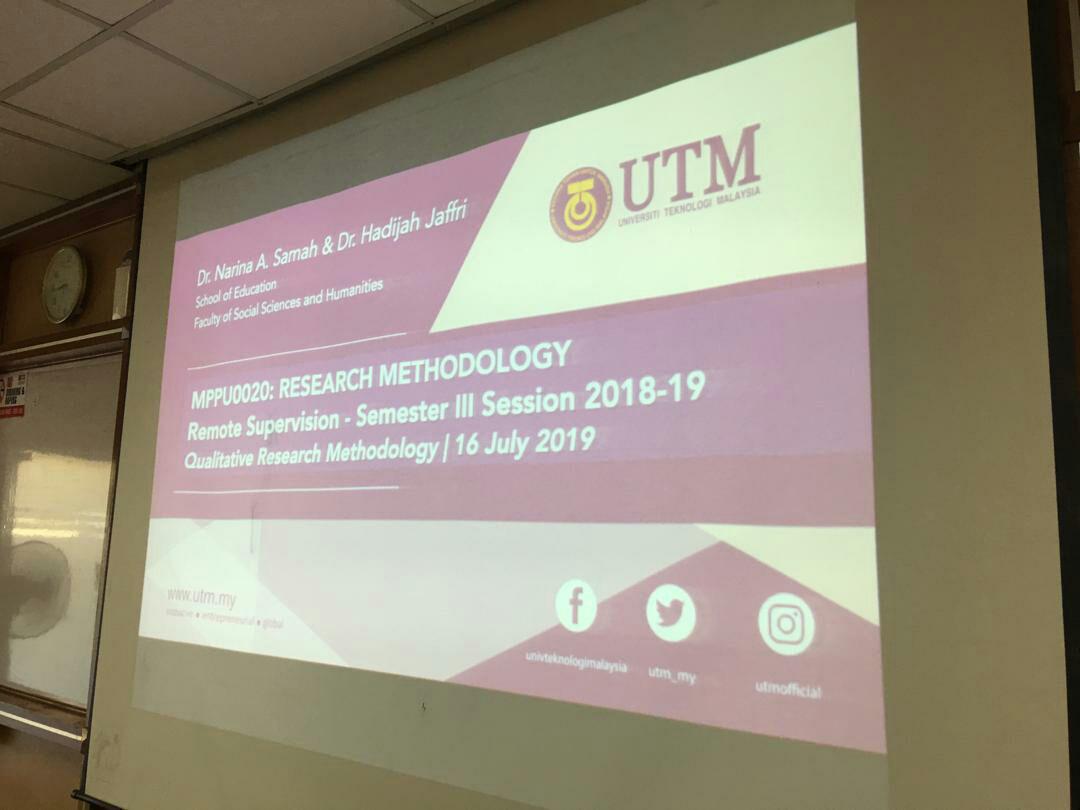
When I was assigned to handle a session on Research Methodology for Remote Supervision PhD students, I told my partner that we should use Prezi for our notes.  Due to time constraint, I only managed to prepare mine, and not able to convert her slides into Prezi.  One of my senior colleagues aka The Coordinator asked us to give him the notes because he wants to document it, my partner and I decided to give the Prezi link instead.  😀 

HERE is the link on Introduction to Qualitative Research Design.  

Remote Supervision UTM 2019

Remote Supervision in UTM is not a new thing.  But, I just involve in this programme this semester.  Well, I have to replace someone so, technically I am not the first choice though as facilitator.  😀 

I learn a lot from the students attending this course (especially the session that I shared with Dr Narina).  They are articulated, matured and active.  Well, not all though.  Some came a bit late.  Few did not turn up at all for the afternoon session.  It’s ok.  They might have emergency that they have to attend (perhaps).  

But, nevertheless, we put our slide in PreziThis is our first attempt to use Learning Management System.  We have to link this in our E-content (TES) as a part of the required tasks as Future Ready Educators (FREE).  We are struggling, but we are doing our best to be the best FREE (according to our strengths and ability) In sha Allah

Remote Supervision: UHPP0010 RESEARCH METHODOLOGY

This is my first time involved in this course, Remote Supervision and I was told that I could include this in my TES – Professional Activities [Nonconventional T&l]. 

Even though I am vaguely understand the meaning of Remote Supervision, yet I am not sure about how it is done.  So, don’t ask me about it though.  Since this is my first time, I plan to use Prezi.  Our Prezi note is HERE.

I also plan to do some activity using Quizziz later on.  HERE is the link.  

What are the characteristics of qualitative researchers?

I constructed this short vignette few years ago and use it as an activity worksheet when I discuss the introduction part of qualitative research.  

A short vignette from a qualitative researcher

As a researcher in education, I am interested to know about teaching and learning practice and the people involve in it (the teaching and learning practice).  The question of how and why a scenario in teaching and learning practice happens in certain way always intrigue me to explore more.  Using qualitative research as a methodology to explore educational issues, one of the ways to collect the data is through listening to my participants’ narrations by meeting them face to face.  I want to know more about my participants’ experiences, thoughts or views from their own narrations.  I want to be where the data is and for this manner, I become the tool to collect the data as compared to using a survey as an instrument where my samples can leave their responses.  However, it is quite a challenge to know someone’s life in details unless I explore it from the narrator’s views.  As an example, I have a student who belongs to a well-known notorious gang when I was exploring gangsterism in Malaysian schools.  From this student’s story, I understand more the intricacies of being a member of a gang from the perspective of a member.  Such data could not be measured and gained through a survey questionnaire.  Even though there are theories which can provide some explanations about gangsterism and being a member of a gang yet, it is hard to be dismissed the fact that the decision to be a member of a gang is not straight forward one.  The decision of one member from the another might be similar, yet different.  Such uniqueness intrigues me to explore it from qualitative perspective.  Like any other participants, I usually meet the student in places where he/she feel comfortable to share his/her experiences, thoughts and feelings.  I was invited to his/her school and home.  In this regards, I also able to gain data from observing him/her in natural setting.  Apart from talking to him/her, I can see how he/she behaves in such settings.  Sometimes, he/she shows some pictures or documents.  By meeting the participant personally, I have the opportunity to ask him/her about the pictures and documents and its significance in his/her lives.   In this regards, I need to be flexible in gathering my data which can be time consuming.  This is because the data can be gathered not only through interview which is most likely to be assumed as the main method to collect data in qualitative research.  With rich data at hand, I often feel overwhelmed in terms of how to start my analysis.  Should I use more than one analysis for the different sets of data or should I stick to one analysis regardless of the data that I have gathered?  As a researcher, while looking at the data, I often reflect on the similarities and differences of my participants’ experiences, thoughts or views from my own.  Even though I have to be reflective, however, I cannot be too overly subjective in interpreting my participants’ experiences, thoughts or views with my own.  After all, I acknowledge the complexity of one’s own experiences, thoughts and views.   In this regards, it is not easy to interpret and later on to present the data accordingly because I need to stay true to myself as a researcher while ensuring my participants’ narrations are as authentic as the way they mean it without disregarding my own personal constructs as a researcher.  I know that even though there is no firm guideline on how I should conduct my research, yet as a researcher, I am subjected upon others’ judgment and review while maintaining the transferability of my study.  Ah, what an enchanted journey as a qualitative researcher!


UTM Open Day