
Dunning-Kruger Effect: What is that?
A senior colleague and I were discussing about an issue relating how people overestimate their ability level. Meaning, sometimes we might find people who think they know a lot but in reality, they do not know much and they do not even realize it. Ironic, isn’t it? But this is the reality. Incompetent people think that they are amazing, genius (and the list goes on)
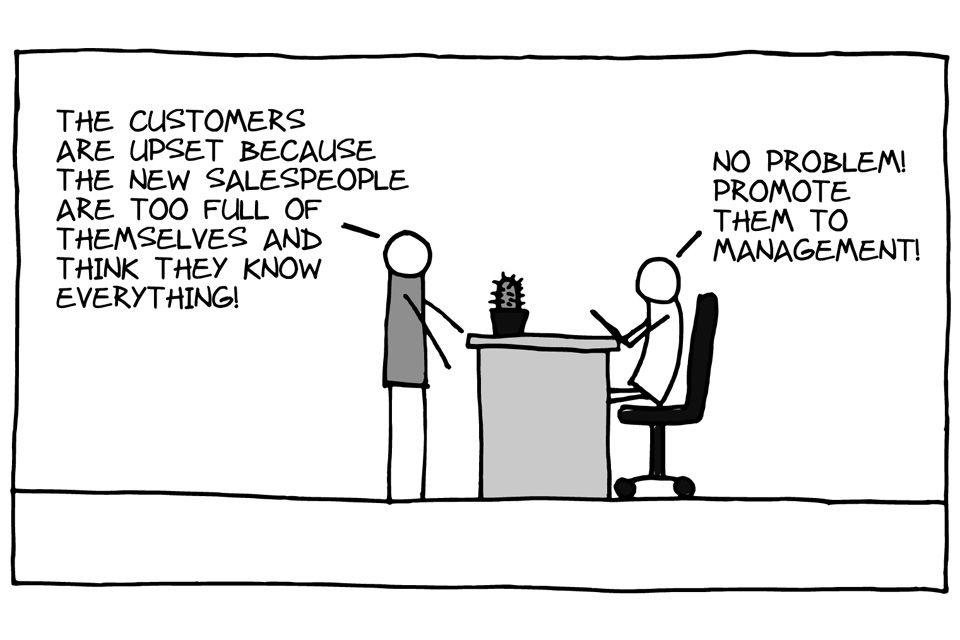
The cartoon strip is taken from The Business Times
This is dangerous in academia when you think that you know a lot and thus there is no need for you to learn or relearn something to upgrade what you already know. There is always new thing that we can learn from one another or through reading or doing research. Look at the diagram (taken from Marketcall),
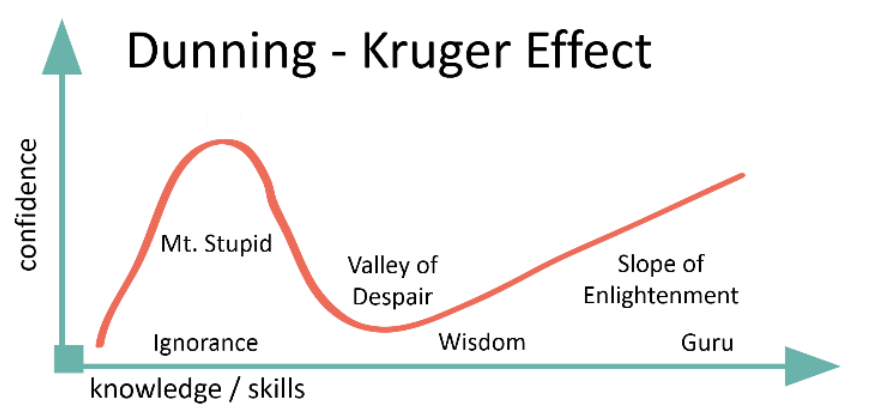
In psychology, it is called as Dunning-Kruger Effect,
“People tend to hold overly favorable views of their abilities in many social and intellectual domains. The authors suggest that this overestimation occurs, in part, because people who are unskilled in these domains suffer a dual burden: Not only do these people reach erroneous conclusions and make unfortunate choices, but their incompetence robs them of the metacognitive ability to realize it.” Excerpt from Justin Kruger and David Dunning (1999) article published in Journal of personality and social psychology.
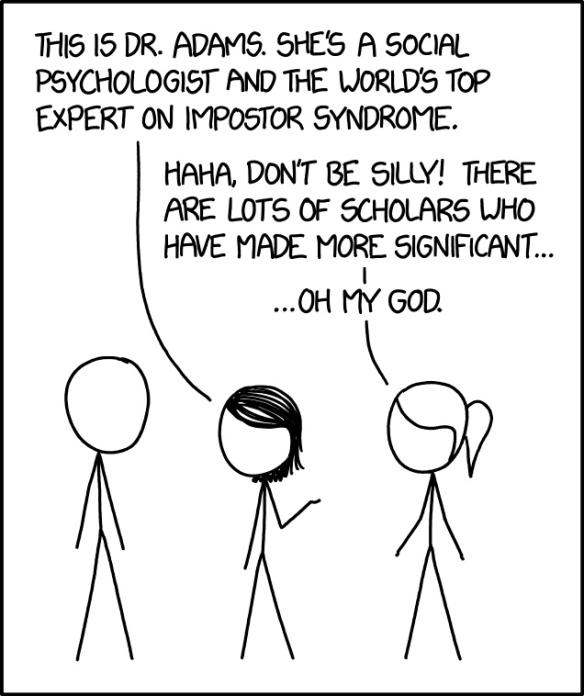
This is the opposite effect of Impostor syndrome.
The personality traits: Does it really define who we are?
When it comes to personality traits, most of the time, we are looking at how different individuals from others. But the differences are somewhat related to situation that individuals are dealing with. In this case, our traits are transcended from being characteristics that describe us as a person to how we react to certain situations based on what we have learned through cultural norms that are imposed on us or how we impose those cultural experiences on ourselves. Thus, there would be traits that seem to be out of place, as if we are out of character. But we have to look closely that we need to have a space or place to be ourselves. This is a time for us to recharge. This is what Brian Little said.
INTELLECTUAL PROPERTY FILING APPLICATION DEADLINE – 30 SEPTEMBER 2019
Dear researchers,
Please be informed that the deadline for applications for intellectual property protection via INNOCOMMS System is on 30th September 2019.
ICC has limited funding to process copyright an patents so it will be on a first come, first serve basis until funding is used up.
For your IP to qualify for eLPPT 2019 marks in the bonus section, you have to submit by 30th September 2019.
If you submit after the deadline, it will only be processed for eLPPT 2020.
Please submit your application as soon as possible.
Thank you.
Intellectual Property Unit
Innovation & Commercialisation Centre
Universiti Teknologi Malaysia
Industry Centre, UTM Technovation Park,
81300 Skudai, Johor.
Phone: +607 5591500
Fax: +607 5576904
Website: www.icc.utm.my
Seminar Pengenalan Penanaman Cendawan

Conjunctions: Activity worksheet
When I did my Latihan Ikhtisas, there are many activity worksheets that I found from the internet (from various websites). One of the websites that I frequently visited is Busyteacher. One of the worksheets that I used when I taught conjunctions is this.
The art of story telling
I attended a workshop on using storytelling as a method in teaching and learning practice. The facilitators are PM Hayati and Ir Razali. I am not a good storyteller but I try to improve the art through crafting cases i.e. stories for my class discussion activities and assignments. Here is one of the notes that I got from the workshop,
A rare chance not to be missed by IIUM alumni

Kursus teknik tanaman fertigasi

How to overcome impostor syndrome?
These are ten strategies that I excerpt from Impostor Syndrome website.
- Break the silence. Shame keeps a lot of people from “fessing up” about their fraudulent feelings. Knowing there’s a name for these feelings and that you are not alone can be tremendously freeing.
- Separate feelings from fact. There are times you’ll feel stupid. It happens to everyone from time to time. Realize that just because you may feel stupid, doesn’t mean you are.
- Recognize when you should feel fraudulent. If you’re one of the first or the few women or a minority in your field or work place, it’s only natural you’d sometimes feel like you don’t totally fit in. Instead of taking your self-doubt as a sign of your ineptness, recognize that it might be a normal response to being an outsider.
- Accentuate the positive. Perfectionism can indicate a healthy drive to excel. The trick is to not obsess over everything being just so. Do a great job when it matters most, without persevering over routine tasks. Forgive yourself when the inevitable mistake happens.
- Develop a new response to failure and mistake making. Henry Ford once said, “Failure is only the opportunity to begin again more intelligently.” Instead of beating yourself up for being human and blowing the big project, do what professional athletes do and glean the learning value from the mistake and move on.
- Right the rules. If you’ve been operating under misguided rules like, “I should always know the answer,” or “Never ask for help” start asserting your rights. Recognize that you have just as much right as the next person to be wrong, have an off-day, or ask for assistance.
- Develop a new script. Your script is that automatic mental tapes that starts playing in situations that trigger your Impostor feelings. When you start a new job or project instead of thinking for example, “Wait till they find out I have no idea what I’m doing,” try thinking, “Everyone who starts something new feels off-base in the beginning. I may not know all the answers but I’m smart enough to find them out.”
- Visualize success. Do what professional athletes do. Spend time beforehand picturing yourself making a successful presentation or calmly posing your question in class. It sure beats picturing impending disaster and will help with performance-related stress.
- Reward yourself. Break the cycle of continually seeking °© and then dismissing °© validation outside of yourself by learning to pat yourself on the back.
- Fake it ‘til you make it. Now and then we all have to fly by the seat of our pants. Instead of considering “winging it” as proof of your ineptness, learn to do what many high achievers do and view it as a skill. The point of the worn out phrase, fake it til you make it, still stands: Don’t wait until you feel confident to start putting yourself out there. Courage comes from taking risks. Change your behavior first and allow your confidence to build.
