Complex Cognitive Processes

Defining Complex vs. Simple Cognitive Processes

  • Simple Cognitive Processes: These are basic, often automatic mental activities like attention, perception, storing and memory recall (e.g., remembering multiplication tables).
  • Complex Cognitive Processes: These require conscious effort and involve understanding, applying, analyzing, synthesizing, and evaluating information. Bloom Taxonomy is based on the ideas of complex cognitive processes.

Concept Formation and Misconceptions

Concept formation is how individuals categorize ideas by identifying shared features.

  • Theories of Concept Formation:
    • Rule Theory: Identifying specific features or strict rules (e.g., a triangle must have three sides). This theory relies on defining attributes or specific features that must be present for something to belong to a category. It is most effective for teaching well-defined subjects like geometry or linguistics. For example: A “Proper Noun” must always begin with a capital letter and refer to a specific, unique entity (e.g., Malaysia, Universiti Teknologi Malaysia).
    • Prototype Theory: Comparing new info to a “best example” or typical member (e.g., a sparrow as a “typical” bird). Instead of strict rules, this theory suggests we use a “best example” or a mental average that represents the most common features of a category. New information is compared to this one ideal image. For example: If you think of a “bird,” you likely picture a standard two-legged animal with a beak, wings and can fly. While an ostrich or a penguin is technically a bird, it is further from your prototype.
    • Exemplar Theory: Storing multiple specific instances in memory to categorize new objects. This theory proposes that we store multiple specific instances (exemplars) in our memory rather than just one “best” version. We categorize new objects by comparing them to this collection of known examples. For example: You recognize a Husky as a dog because you have stored memories of many different types of dogs you have seen before, such as a Poodle, Beagle, or Labrador
  • Misconceptions: These are invalid concepts constructed from personal experiences. They include naïve Theories, undergeneralization (excluding relevant items), overgeneralization (including irrelevant items) and incorrect analogies.
  • Naïve Theories: It develops when individuals develop on their own without formal instruction or guidance from a teacher or expert. They represent a person’s “best guess” for how something works before they learn the scientific or factual reality. Example: A child might believe the wind is caused by trees waving their branches back and forth.
  • Undergeneralization: It occurs when an individual’s definition of a concept is too narrow, leading them to exclude items that actually belong in that category. Example: A student may correctly identify mammals as animals, but incorrectly believe that fish or worms are not animals.
  • Overgeneralization: This is the opposite of undergeneralization. It happens when an individual’s definition is too broad, causing them to include irrelevant items that do not belong in the category. Example: Assuming that all animals drink water in exactly the same way humans do.
  • Incorrect analogies: This involves using a familiar concept to understand a new one, but picking a comparison that is flawed or misleading, resulting in a misunderstanding. Example: Thinking that human memory works exactly like a video camera that records events perfectly.

Key Thinking Processes in Complex Cognitive Processes

  • Reasoning: The logical tool used to derive conclusions and evaluate evidence by drawing conclusions via Deductive (general rules to specific conclusions often through syllogism) or Inductive (specific experiences to general rules) methods.
    • Example of syllogism: Major Premise: All men are mortal. Minor Premise: Ali is a man. Conclusion: Therefore, Ali is mortal.
    • Syllogisms are a core part of Critical Thinking because they allow students to “think clearly and logically” to decide what to believe
  • Critical Thinking: Systematically examining evidence and analyzing information rather than accepting it at face value.
  • Creativity: Generating original and useful ideas. It is characterized by originality, fluency (many ideas), flexibility, and elaboration.
  • Decision Making: A complex cognitive process that involves evaluating alternatives and making choices. This process occurs within the broader context of thinking, where information is manipulated and transformed in the working memory. While making decision by evaluating alternatives, it can be hindered by cognitive biases.
  • Cognitive biases: Mental shortcuts that influence our thinking when making decisions, often leading to poor judgment. There are several types of cognitive biases:
    • 1) Confirmation Bias
      • This is the tendency to search for, interpret, or prioritize information that confirms your existing beliefs while ignoring contradictory evidence. The Trap: You only “see” what you want to see. Example: A student who believes a teacher dislikes them will fixate on every strict comment the teacher makes but will completely ignore or downplay instances where the teacher praises their work.
    • 2) Hindsight Bias
      • Commonly known as the “I-knew-it-all-along” phenomenon, this is the tendency to believe, after an event has occurred, that you predicted it or that it was obvious. The Trap: It creates a false sense of certainty about the past and can prevent you from learning from actual mistakes. Example: After receiving a failing grade on an exam, a student might claim, “I knew I was going to fail,” even if they were actually quite optimistic before taking the test.
    • 3) Overconfidence Bias
      • This involves an individual overestimating their own abilities, knowledge, or the accuracy of their judgments. The Trap: It often leads to a lack of preparation because the individual feels they have already mastered the task. Example: A student might be so certain they will excel on a math test that they decide not to study at all, only to be disappointed by the actual results.
    • 4) Belief Perseverance
      • This is the tendency to cling to a belief even after the basis on which it was formed has been completely discredited by strong evidence. The Trap: Unlike confirmation bias (which is about seeking info), belief perseverance is about refusing to let go of a belief in the face of direct proof that it is wrong. Example: A student may continue to believe the stereotype that “girls aren’t good at science” even after watching their female classmates consistently excel and outperform others in science projects.

Metacognition and Problem Solving

  • Metacognition: Defined as “knowing about knowing“. It involves Knowledge of Cognition (what you know) and Control of Cognition (planning, monitoring, and evaluating your learning).
  • Problem Solving: Moving from an initial state to a desired goal.
    • Strategies: Include Algorithms (step-by-step rules) and Heuristics (mental shortcuts like trial and error or working-backwards).
    • Expertise: Experts spend more time planning and have a larger repertoire of strategies than novices

Transfer of Learning

This is the application of previously learned knowledge to new contexts.

  • Positive Transfer: Past learning helps solve new problems; includes Near Transfer (similar contexts) and Far Transfer (different contexts).
  • Negative Transfer: Past learning hinders new learning (e.g., assuming a higher number always means more value regardless of currency).

More Examples of Quantitative Research Questions

The construction of quantitative research questions depends on the focus of your study i.e. “what” you want to do in your research. It has to be aligned with the research design that you choose.

1. Descriptive Research Questions

Focus: Describing the current state of a single variable.

  • Example A (Frequency): “What is the frequency of Generative AI tool usage (e.g., ChatGPT) for assignment preparation among postgraduate students at UTM?”
  • Example B (Level): “What is the level of digital literacy among primary school teachers in rural districts of Johor?”

2. Comparative Research Questions

Focus: Comparing two or more groups on a specific variable.

  • Example A (two groups): “Is there a significant difference in mathematics anxiety levels between male and female secondary school students during high-stakes examinations?”
  • Example b (more than two groups such as educational levels etc.): “Is there a difference in the perceived barriers to school engagement (e.g., time, language, or confidence) among parents across different educational levels?

3. Relationship / Causal Research Questions

Focus: Determining if one variable predicts or correlates with another.

  • Example A (Prediction): “To what extent does time spent on gamified learning platforms predict student performance in introductory physics courses?”
  • Example B (Relationship): “Is there any significant relationship between academic self-efficacy and social media addiction among undergraduate students?”

4. Moderating Research Question

Focus: Identifying the “volume knob” that changes the strength of a relationship.

  • Example: “To what extent does parental involvement moderate the effect of home-based online learning on the reading literacy of Year 1 pupils?”
    • Logic: Online learning might work well for kids with high parental support but poorly for those without it.

5. Mediating Research Question

Focus: Identifying the “bridge” or mechanism that explains how X leads to Y.

  • Example: “Does student motivation mediate the relationship between teacher’s feedback quality and student academic achievement?”
    • Logic: High-quality feedback doesn’t just “give” grades because it also boosts the student’s motivation, which in turn leads to better achievement.

Quick tips on how to construct quantitative research questions

When you want to construct quantitative research questions, you need to distinguish between quantitative and qualitative research questions primarily through looking at the intent of the study or “What is the thing that you want to research on?“

  • Quantitative questions focus on “How much,” “How often,” or “What is the relationship”, “What is the effect (using intervention research)?”
  • Qualitative questions seek to explore “how” or “why” (meaning and experience).

Here are several tips to help you ensure your research questions are strictly quantitative:

1. Focus on Variables, Not Experiences

In quantitative research, you are looking for measurable variables (factors that can change or be quantified).

  • Qualitative: Focuses on the “lived experience” or “perceptions” of individuals.
  • Quantitative: Focuses on the relationship between an independent variable (the cause) and a dependent variable (the effect).
    • When you want to explain the process or the “how” and “why” a relationship exists, you need a Mediating Variable (M) . A mediator acts as a bridge. Without the mediator, the relationship between the Independent Variable (IV) and the Dependent Variable (DV) might seem like a “black box.”
    • When you want to identify the boundary conditions i.e. the “when” or “for whom” a relationship holds true, you need a Moderating Variable (W)
    • A moderator changes the strength or direction of the relationship between IV and DV. It doesn’t explain why the relationship exists but it explains when it gets stronger, weaker, or disappears.
      • Use a moderating variable when: The relationship between IV and DV is inconsistent in previous research (sometimes it works, sometimes it doesn’t) or when you suspect that the effect of IV on DV depends on another factor (like gender, age, personality trait, or environment).

2. Use “Quantitative” Directional Verbs

The verbs you choose often dictate the methodology. Quantitative questions use language that implies quantification, measurement, prediction or comparison:

  • Use: Assess, investigate the influence, quantify, compare, measure, predict, correlate, evaluate or determine the difference.
  • Avoid: Explore, understand, describe (in-depth), discover, or illuminate.

Examples for quantitative research objectives and questions:

Objective that is Descriptive: To quantify the frequency and types of digital tools utilized by postgraduate students for academic purposes.

  • Research question: What are the most common types of digital tools used by postgraduate students, and how frequently are they utilized for academic purposes?

Objective that is Relational: To measure the correlation between the frequency of digital tool usage and the perceived level of learning autonomy among postgraduate students.

  • Research question: Is there a significant relationship between the frequency of digital tool usage and the perceived level of learning autonomy among postgraduate students?

Objective that is Predictive: To determine the extent to which specific categories of digital tools (e.g., AI, organizational, or collaborative tools) predict postgraduate students’ self-management scores.

  • Research question: To what extent do specific categories of digital tools (namely AI, organizational, and collaborative tools) predict the self-management scores of postgraduate students?

Objective that is Comparative/Impact/Effectiveness: To evaluate the significant influence of digital tool proficiency on students’ ability to self-monitor their academic progress.

  • Research question: Does digital tool proficiency significantly influence the ability of postgraduate students to self-monitor their academic progress?

3. Structure for Measurement

A quantitative question should ideally be answerable with a number, a percentage, or a statistical significance level. Use these common structures:

  • Descriptive: “What is the frequency of [Variable X] among [Population]?”, “What is the level of [Variable Y] among [Population]?”
  • Comparative: “Is there a significant difference in [Variable X] between [Group A] and [Group B]?”
  • Relationship/Causal: “To what extent does [Variable X] predict [Variable Y]?”, “Is there any significant relationship between [Variable X] and [Y]?”
  • Moderating: “To what extent does [variable W] moderate the effect of [variable X] on [variable Y]?”
  • Mediating: “”Does the [variable M] mediate the relationship between [variable X] and [variable Y]?”

Disclaimer: The explanation is brief because it is meant for a quick revision. The examples are more relevant to educational research.

Cognitive views of learning

Definition of Learning: An internal mental process involving the acquisition, storage, and retrieval of information. It is a change in the learner’s mental structures or “schemata.”

Role of the Learner: Active; the learner is an information processor who interprets and organizes their experiences.

Key assumptions:

  • The human mind as a complex, active information-processing system that involves internal mechanisms (attention, perception, memory etc.) that allow humans to acquire and apply knowledge.
  • Learning is the process of building, refining, and restructuring mental models.
  • For example:
    • A cognitivist teacher would explain that a student studies not just because of a past grade, but because they have internally processed the value of the information and organized it into their existing knowledge.
      • The Internal Fact: Instead of just seeing “10 problems finished,” the teacher looks for understanding. They might notice the student is using a specific mental strategy, like breaking a complex problem into smaller “chunks” to avoid overwhelming their working memory.
      • The “Why”: The student studies because they have developed a schema (a mental map) where “Math Skills” are connected to “Future Career Goals.” The motivation isn’t just a reaction to a grade; it’s a conscious decision based on expectancy: “I believe that if I put in this mental effort, I will successfully encode this information into my long-term memory.”

1. The Mind as a Processor (The Computer Analogy)

Explain that the human mind isn’t a passive sponge (just absorb information) but it’s an active processor.

  • Emphasis: Learning is the process of inputting information, encoding it (changing the format so the brain can store it), and retrieving it later.
  • Teaching Point: If a student “forgets” something, it might not be gone, but the “retrieval path” might simply be broken or the information was never encoded properly in the first place.

2. The Role of Prior Knowledge (Schema Theory)

This is arguably the most important concept for future educators. We don’t learn in a vacuum as we “attach” new info to what we already know.

  • Emphasis: Schemas are mental filing cabinets. A schema is a mental framework for any type of information, including auditory patterns.
    • Effective teaching is about helping students find the right “folder” to put new information into.
      • The brain processes verbal and visual information through different channels. When you present a concept using both words and images, the memory trace becomes stronger.
        • Principle in teaching: Using “dual-coded” materials (like a diagram paired with a verbal explanation) increases the likelihood of successful retrieval later.
  • Teaching Point: If a student lacks the necessary prior knowledge (the “anchor”), the new information has nothing to “hook” onto and will likely be lost from working memory.

3. Limited Capacity (Cognitive Load)

Students need to understand that the “workbench” of the mind (Working Memory) is very small.

  • Emphasis: Cognitive Overload. If you give a student too much information at once, or if the instructions are too complex, the “workbench” overflows and learning stops.
  • Teaching Point: This justifies why we use “chunking,” scaffolding, and clear visuals in our teaching materials.

4. Active Construction (Meaning-Making)

Contrast this with rote memorization.

  • Emphasis: Learning is an active process. For information to move into Long-Term Memory, the learner must do something with it such as to reorganize it, compare it, or apply it.
  • Teaching Point: This is why “interactive notes” are so effective. By embedding questions, you are forcing the students to engage in elaborative rehearsal rather than just passive reading.

Quick Comparison between Behaviorist and Cognitivist Views of Learning

Behaviorist Views of Learning

Introduction to Learning (Behaviorism or Behaviorist view)

  • Definition: Learning as a relatively permanent change in observable behavior as a result of experience.
  • The “Black Box” Metaphor: Behaviorists argued that because we cannot objectively observe a thought or a feeling, we should treat the mind as a “black box.” A black box is a system where you can see the input (what goes in) and the output (what comes out), but the internal workings are invisible or irrelevant to the observer. We don’t need to know what’s happening inside to understand, predict, or change behavior. This is why behaviorists prioritize measurable actions over internal mental processes.
  • Key Assumptions:
    • Learning processes are similar across species and the role of the environment.
    • Science requires data that multiple people can observe and verify.
    • For example:
      • If I say I am “motivated,” you have no way to measure that directly. However, if I finish 10 math problems in 5 minutes, we have a measurable, objective fact. Behaviorists believed that by focusing only on what could be seen, they were making psychology a “hard science” like physics or chemistry.
      • A teacher who believes in behaviorist perspective will explain that students study because, in the past, studying was followed by a high grade (Positive Reinforcement).

Behavioral theories: Classical Conditioning and Operant Conditioning

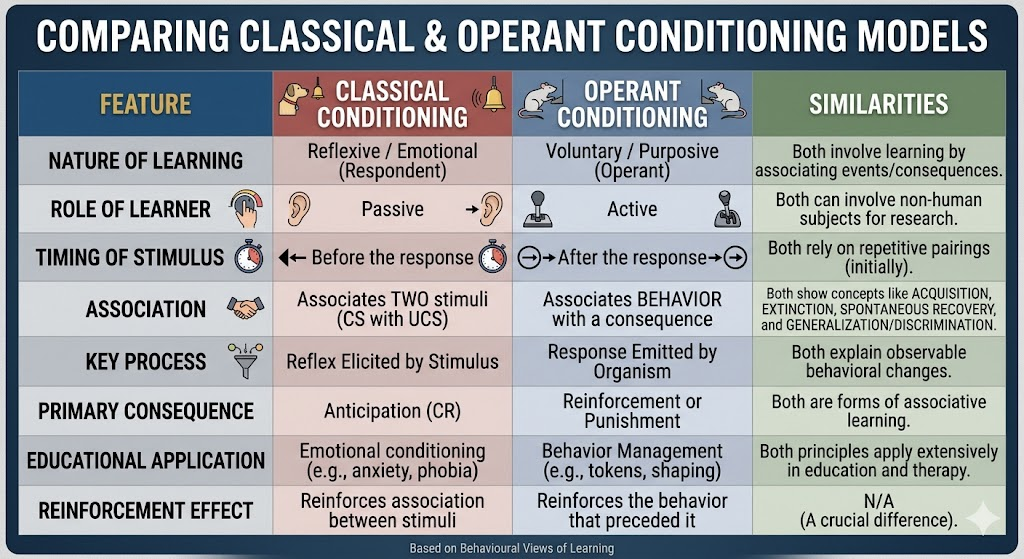
I. Classical Conditioning (Stimulus-Response Learning)

Focuses on involuntary, emotional, or physiological responses.

  • Two key figures in Classical Conditioning:
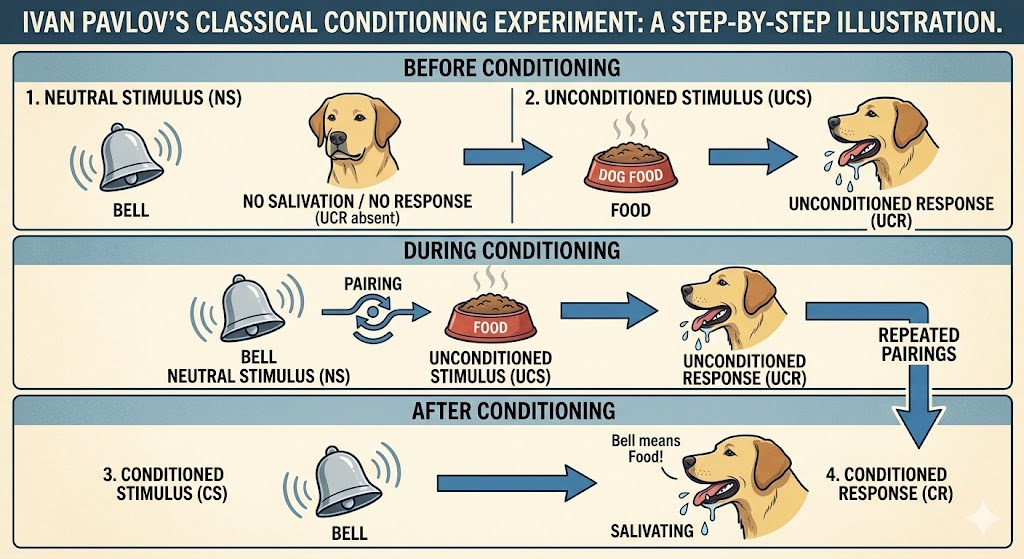
    • 1) Ivan Pavlov
      • The Pavlovian Foundation: Ivan Pavlov’s accidental discovery with dogs (he mechanics of classical conditioning with dogs)
  • 2) John B Watson
    • Father of Behaviorism: The man who brought classical conditioning into the human world. He is often called the “Father of Behaviorism” because he applied the mechanics of classical conditioning with children.
    • Watson wanted to prove that “nurture” (the environment) was more powerful than “nature” (instinct). He set out to condition a phobia into an 11-month-old infant known as Albert.
      • Before Conditioning: Albert showed no fear of a white rat (Neutral Stimulus). He only showed a natural fear of loud noises (Unconditioned Stimulus).
    • The Conditioning: Every time Albert reached for the white rat, Watson would strike a steel bar with a hammer behind the boy’s head.
    • The Result: After only seven pairings, Albert would burst into tears and crawl away at the mere sight of the rat, even without the loud noise.

  • Key Components of classical conditioning:
    • Unconditioned Stimulus (UCS) & Response (UCR): Natural, unlearned triggers (e.g., food leading to drool OR loud noise leading to fear).
    • Neutral Stimulus (NS): A trigger that initially means nothing (e.g., a bell OR a white rat).
    • Conditioned Stimulus (CS) & Response (CR): The learned association (e.g., bell leading to drool OR a white rat leading to fear).

  • Core Concepts:
    • Acquisition or Shaping: The “pairing” phase.
    • Extinction: What happens when the CS is presented without the UCS.
      • It is the process by which a learned response is weakened and eventually disappears. It occurs when the “rules” of the environment change, and the expected outcome no longer follows the trigger.
    • Generalization (This is John B Watson’s contribution): It is a phenomenon in learning where a subject responds to a new stimulus in the same way they respond to a known conditioned stimulus, simply because the two are similar.
      • Example: Watson found that Albert didn’t just fear the white rat; he became terrified of anything white and furry such as a rabbit, a dog, a sealskin coat, a teddy bear and even a Santa Claus mask with a white beard. Fears are learned, not necessarily innate. Once a fear is learned, it can “bleed over” into similar objects or situations.
    • Discrimination: It occurs when a specific stimulus is consistently followed by an Unconditioned Stimulus (UCS), while a similar stimulus is consistently not followed by it.
      • Example: Imagine a dog is conditioned to salivate to a specific bell tone (1000 Hz) (The Stimulus). You ring a slightly different bell by lowering the tone (900 Hz) (The Variation). If the 1000 Hz bell is always followed by food, the dog salivates. If the 900 Hz bell is never followed by food, the dog eventually learns to ignore it (The Learning Process). The dog has “discriminated” between the two tones. 1000Hz = food, 900Hz = no food (The Result)
    • Spontaneous recovery: It is a phenomenon where a previously extinguished response suddenly reappears after a period of rest.
      • It proves that extinction is not “unlearning” or erasing a memory; rather, it is the brain learning to suppress a behavior. The original association is still tucked away in the “black box,” waiting for a chance to resurface.

II. Operant Conditioning (Response-Stimulus Learning)

Focuses on voluntary behaviors shaped by consequences.

  • Thorndike’s Law of Effect: Behaviors followed by pleasant outcomes are strengthened.
  • B.F. Skinner’s Contributions: The Skinner Box and the shift from “respondent” to “operant” behavior.
  • Premack’s Principle (by David Premack): Premack’s core idea was that high-probability behaviors (things we want to do) can be used to reinforce low-probability behaviors (things we don’t want to do). Example: You have to eat your vegetables before you can have dessert.

  • The Mechanics of Consequences:
    • Reinforcement (Increasing Behavior):
      • Positive reinforcement: Adding a reward to increase desirable behavior (e.g. a token for submitting homework)
        • Negative reinforcement: Removing an unpleasant stimulus to increase desirable behavior (e.g., the seatbelt chime stopping (unpleasant stimulus) when we wear seatbelt (desirable behavior).
    • Punishment (Decreasing Behavior):
      • Positive punishment or also known as Type I punishment: Add a negative stimulus to decrease undesirable behavior (e.g. give a fine (denda) for late registration). Fine is negative or unpleasant stimulus and late registration is undesirable behavior that we want to decrease.
        • Negative or also known as Type II punishment): Removal of pleasant stimulus (e.g. taking away a privilege of using family car when coming back after curfew hours). Privilege of using family car is pleasant stimulus, and coming back late (after curfew) is undesirable behaviour.

  • Schedules of Reinforcement:
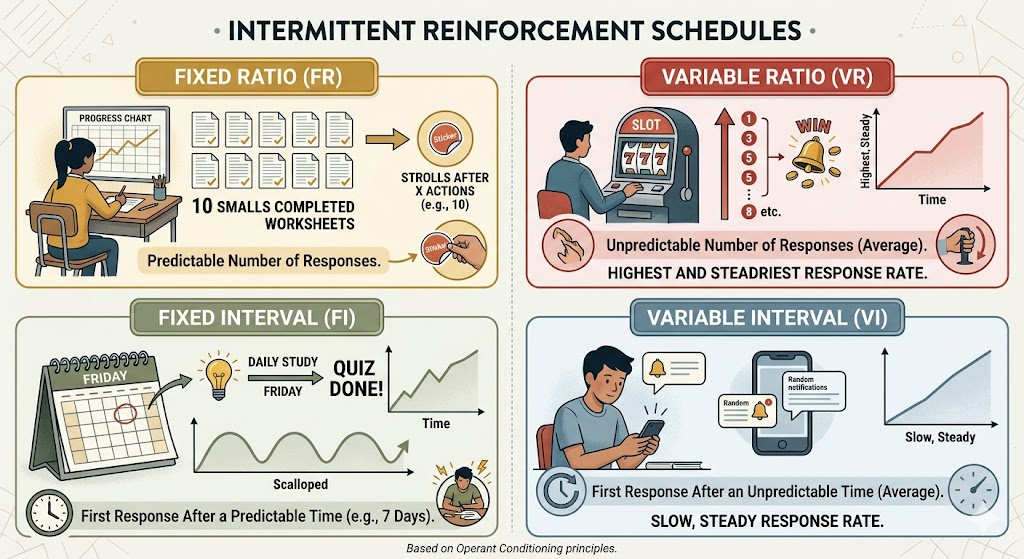
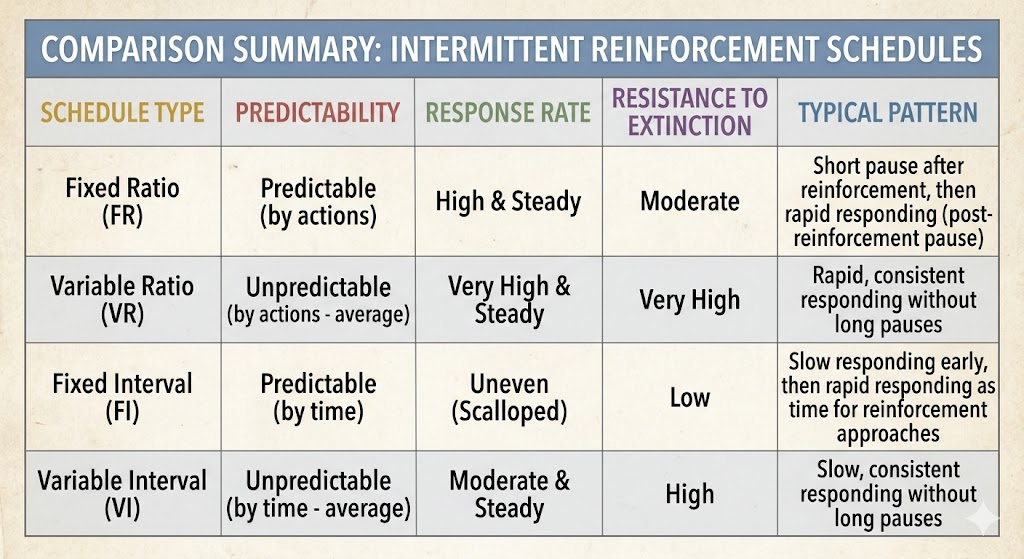
    • Continuous vs. Intermittent (Fixed Ratio, Variable Ratio, Fixed Interval, Variable Interval).

Examples of intermittent reinforcement in real life:

Fixed ratio: Retail Loyalty Programs (e.g. Buy 10 coffees, get the 11th free)

Variable ratio: Gambling or playing a claw-machine (we do not know when we will hit the jackpot or win something)

Fixed interval: The Monthly Paycheck (we will know when we will get our pay)

Variable interval: Fishing (we do not know when any fish will take the bite. Fish don’t bite on a fixed timer.) or listening to our favorite radio station waiting for favorite songs to play (we do not know when the songs will be played but normally even though the DJs may already inform when they will play the songs, yet, we will keep waiting because the time is not fixed).

Educational Application:

  • We can understand how “math anxiety” or school phobia is often classically conditioned.
  • Learning can occur with different effects either discrimination or generalization. While discrimination is about being “picky,” generalization is about being “broad.”
  • Context Matters: A behavior might be extinguished in one setting (at school) but still occur in another (at home)
  • As a teacher, if you notice that a student loves drawing but dislikes math, you can apply operant conditioning (taking Premack’s principle into consideration) such as by giving instruction “Once you finish these five math problems, you can spend ten minutes working on your drawing.” (The Application). In this regard, drawing (the high-probability behavior) reinforces math (the low-probability behavior) (The Result).

Carol Gilligan’s Ethics of Care vs. Ethics of Justice

Carol Gilligan’s theory emerged as a direct critique of Lawrence Kohlberg’s stages of moral development. While working as Kohlberg’s research assistant, Gilligan noticed that women often scored lower on his scale, typically landing at Stage 3 (focusing on interpersonal relationships) rather than Stage 4 or 5 (focusing on abstract justice).

She argued that Kohlberg’s model wasn’t showing that women were “less moral,” but rather that his model was biased toward a “Justice Perspective” (common in men) and ignored the “Care Perspective” (common in women).

Gilligan suggested that there are two distinct ways of looking at moral problems:

  • Ethics of Justice: Focused on individual rights, logic, and universal rules. Morality is about “not interfering with others’ rights.” (Kohlberg’s focus).
  • Ethics of Care: Focused on interpersonal relationships, compassion, and responsibility. Morality is about “not turning away from someone in need.” (Gilligan’s focus).

Gilligan’s Three Stages of Moral Development

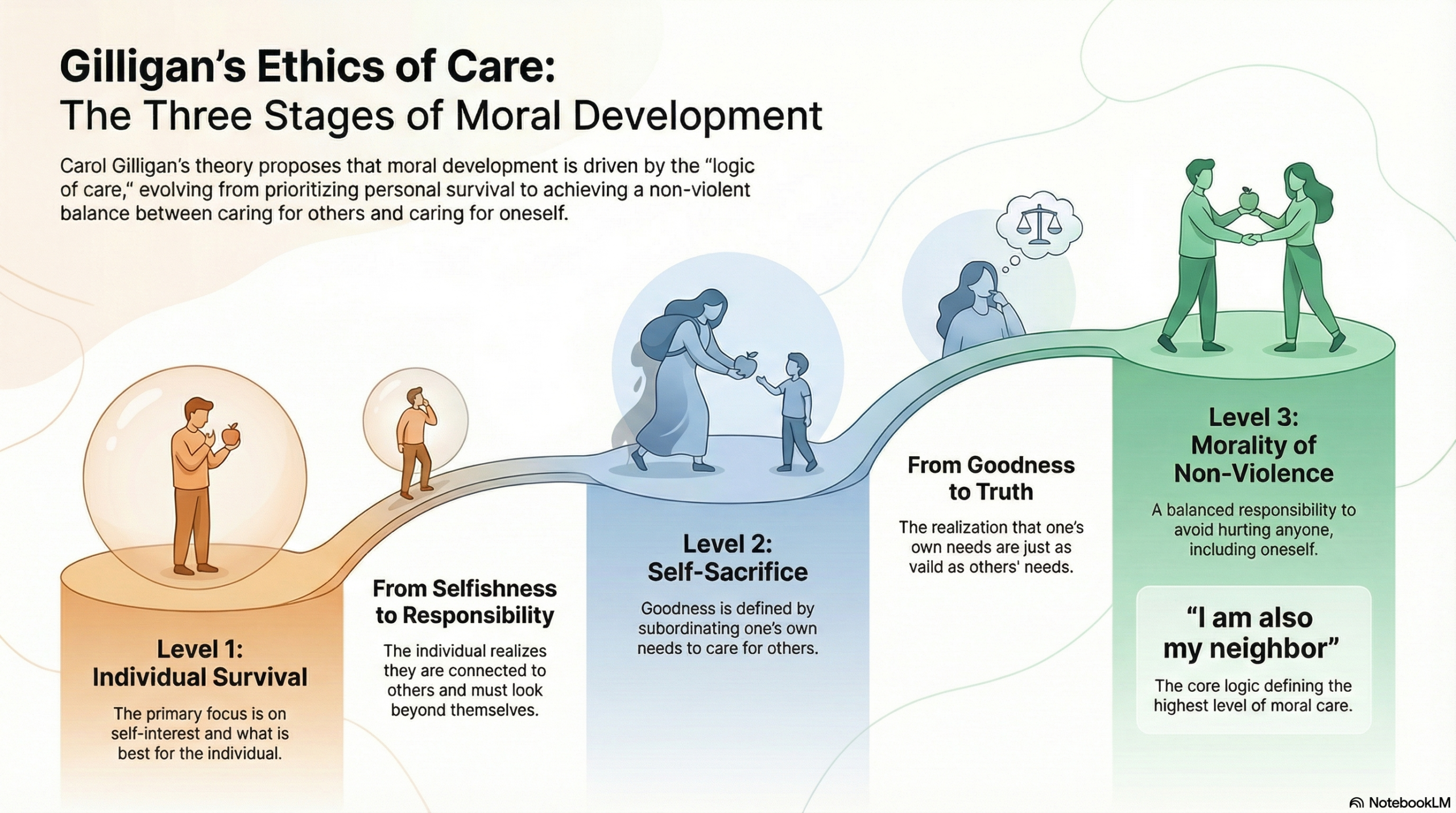
Similar to Kohlberg, Gilligan proposed three levels, but hers focus on how the “logic of care” evolves from self-interest to a universal concern for all.

Level 1: Orientation to Individual Survival

At this stage, the woman’s primary focus is on herself and what is best for her own survival.

  • The Transition: From Selfishness to Responsibility. The individual begins to realize that they are connected to others and that “doing the right thing” involves more than just looking out for oneself.

Level 2: Goodness as Self-Sacrifice

In this stage, “goodness” is defined as caring for others. The woman adopts societal values where she subordinates her own needs to the needs of others (parents, children, partners). She feels that being a “good person” means being self-sacrificing.

  • The Transition: From Goodness to Truth. The individual realizes that self-sacrifice is not the same as care. They begin to see that their own needs are just as valid as the needs of others.

Level 3: The Morality of Non-Violence

This is the highest level, where the individual achieves a balance between caring for others and caring for oneself. Morality is defined by a desire to avoid hurt to anyone, including oneself.

  • The Logic: “I have a responsibility to care for my neighbor, but I am also my neighbor.”

Lawrence Kolhberg’s moral development

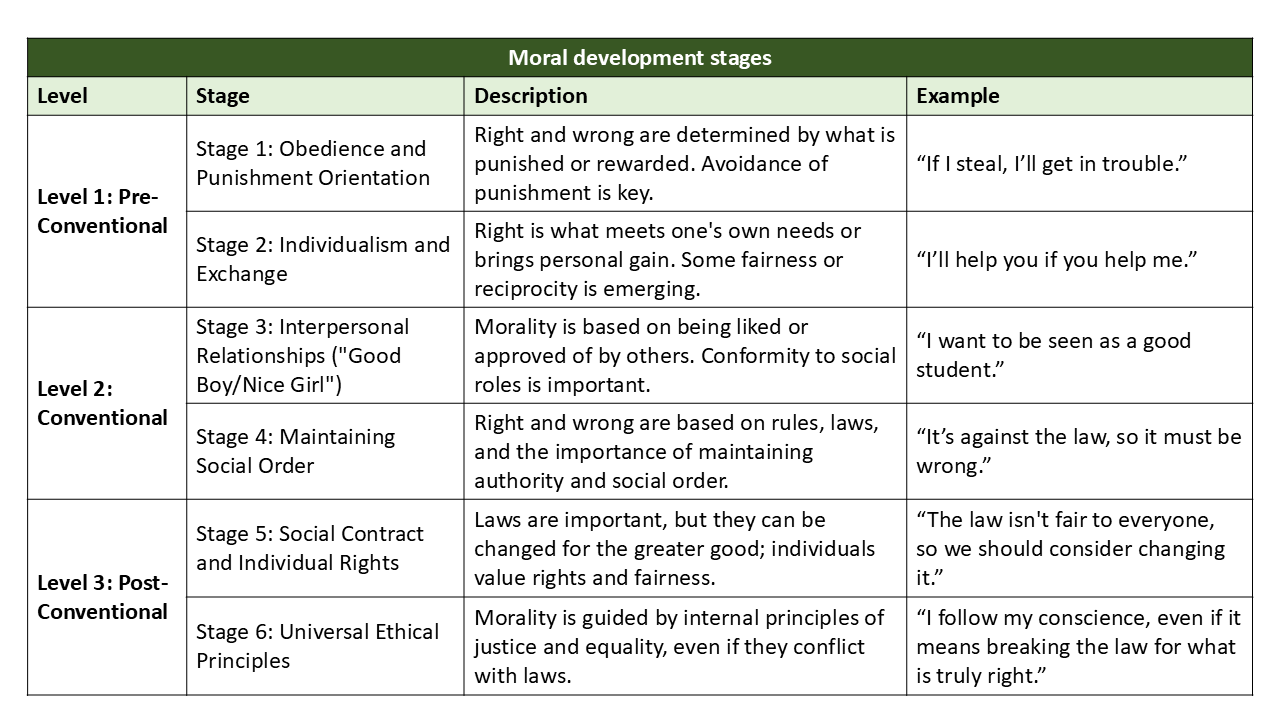
Level 1: Pre-Conventional Morality

At this level (common in children), morality is externally controlled. Rules are imposed by authority figures, and “right” or “wrong” is judged by the direct consequences.

Stage 1: Obedience and Punishment Orientation

The focus is on direct consequences. An action is perceived as wrong because the person is punished for it.

  • Logic: “I shouldn’t do it because I don’t want to get in trouble.”

Stage 2: Individualism and Exchange

Children recognize that there is not just one right view handed down by authorities. Different individuals have different viewpoints. “Right” is what meets one’s own interests or involves a fair trade.

  • Logic: “What’s in it for me?” or “I’ll help you if you help me.”

Note: If a student sees another student is bullying other student, he/she might feel in conundrum when he/she starts to see and recognise the power and authority that the bully has over others. So, to stop a bully from bullying others, he/she would think about “What is the benefit of helping others?”, “Will I be bullied if I help other who is being bullied?”, “If I join the bullying, will I get the benefits (i.e. power, control etc.)”? So, with that moral thinking at this stage, children need guidance from adults to learn what is acceptable or not in a society (cultural and religious conventions).


Level 2: Conventional Morality

At this level (typical of adolescents and adults), morality is tied to personal and societal relationships. Individuals continue to accept the rules of authority figures, but now because they believe it is necessary to maintain positive relationships and societal order.

Stage 3: Good Interpersonal Relationships

Often called the “good boy/nice girl” orientation. The individual is good in order to be seen as being a good person by others. The focus is fulfilling the social expectations and roles.

  • Logic: “I want people to like me and think I’m a good person.”

Note: At this stage, children who see bullying will start to understand that the importance of other’s expectation on them. If they are in a situation where bullying is condoned and regards as unacceptable behavior (social expectation), they will not involve in bullying or will stop bullying if they see bullying is occurring (it is favorable to be seen as a savior or hero).

Stage 4: Maintaining the Social Order

The individual becomes aware of the wider rules of society, so judgments concern obeying the law, respecting authority, and performing one’s duties so that social order is maintained.

  • Logic: “If everyone broke the law, society would fall apart. I must follow the rules.”

Level 3: Post-Conventional Morality

At this level, individuals move beyond the perspectives of their own society. Morality is defined in terms of abstract principles and values. People now believe that some laws are unjust and should be changed.

Stage 5: Social Contract and Individual Rights

The individual becomes aware that while rules/laws might exist for the good of the greatest number, there are times when they will work against the interest of particular individuals. Issues are not always clear-cut.

  • Logic: “The law should be changed if it doesn’t protect the rights of the people.”

Stage 6: Universal Ethical Principles

People at this stage have developed their own set of moral guidelines which may or may not fit the law. The principles apply to everyone (e.g., human rights, justice, and equality). The person will be prepared to act to defend these principles even if it means going against the rest of society in the process and having to pay the consequences of disapproval and/or imprisonment.

  • Logic: “I will do what is right because it is inherently right, regardless of what the law says.”

James Marcia’s Identity Status

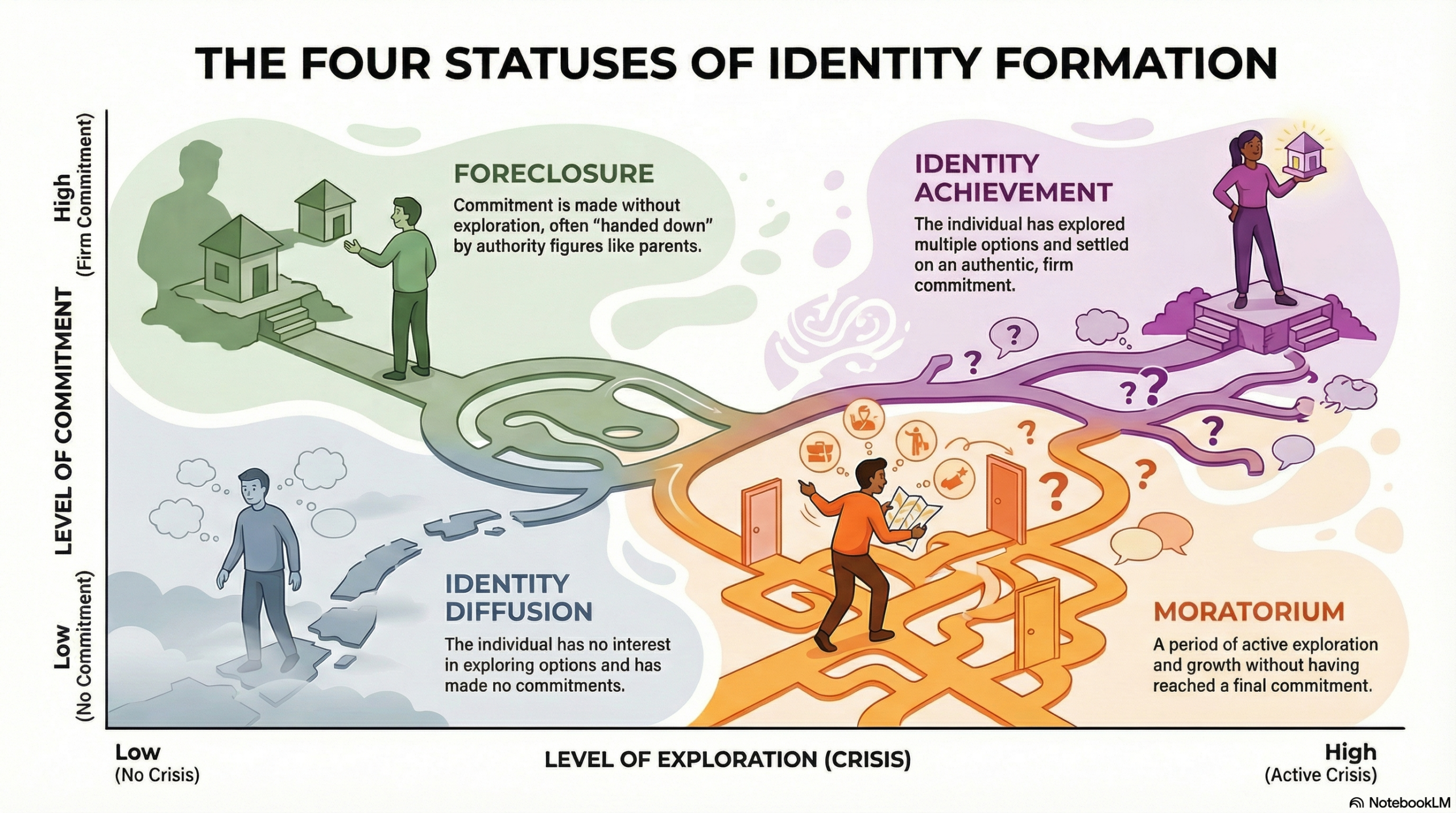
James Marcia extended Erik Erikson’s Identity vs. Role Confusion stage by explaining how identity develops by proposing that identity formation is not a single event, but a process driven by two key factors: Exploration (Crisis) and Commitment.

Instead of stages, Marcia proposed four identity statuses based on two dimensions:

  • Exploration (crisis) → actively questioning choices (e.g., career, beliefs)
  • Commitment → making decisions and sticking to them

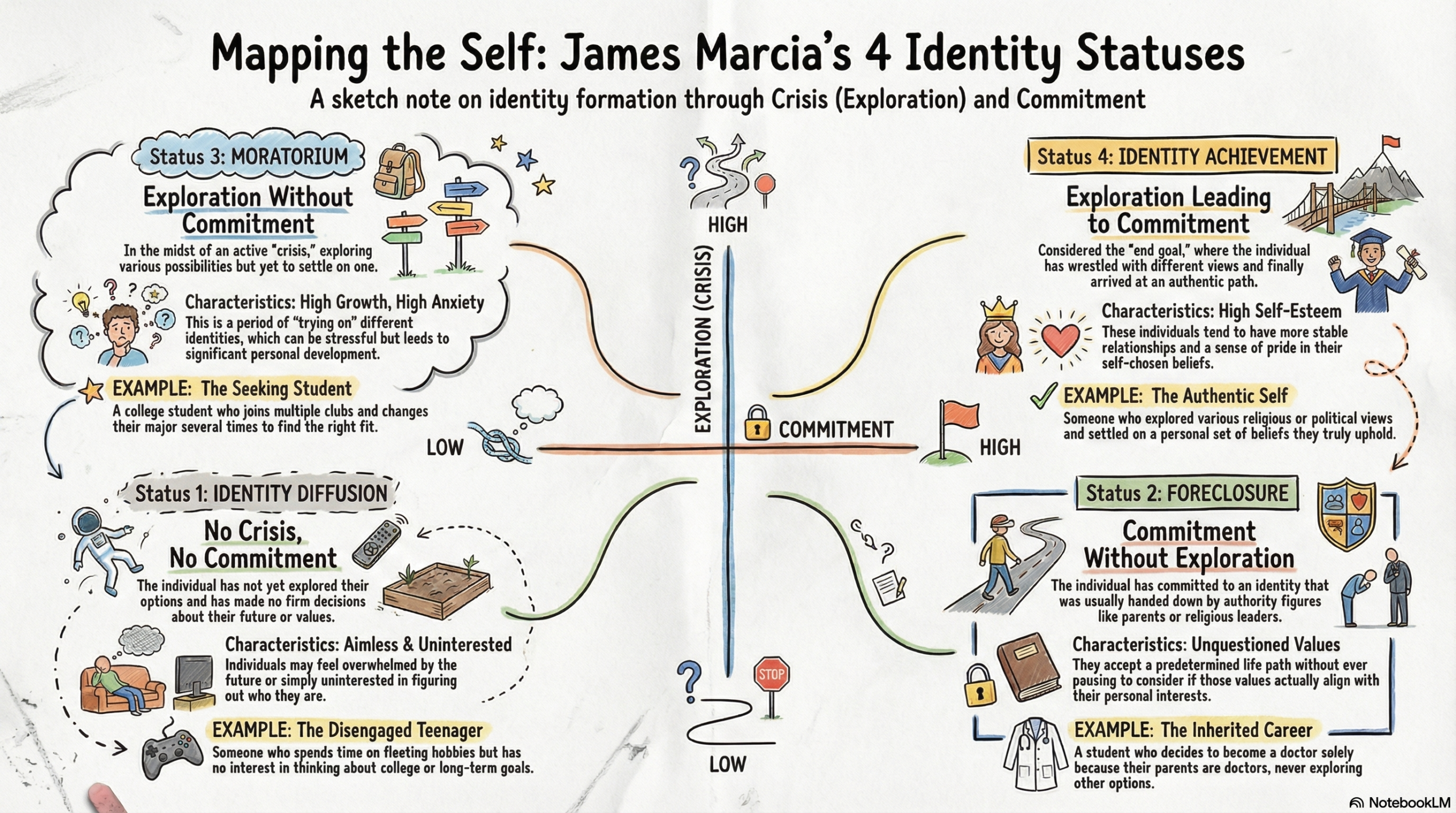
The Four Identity Statuses

1. Identity Diffusion

In this status, the individual has not yet experienced a crisis and has made no commitments.

  • Characteristics: They may seem aimless, uninterested, or overwhelmed by the idea of the future. They aren’t trying to figure out who they are, nor do they care to at the moment.
  • Example: A teenager who has no interest in thinking about college or a career and spends most of their time on fleeting hobbies without deep engagement.

2. Foreclosure

Here, the individual has made a commitment but has not explored other options.

  • Characteristics: Their identity is often “handed down” by authority figures (usually parents or religion). They accept these values without questioning them.
  • Example: A student who decides to become a doctor simply because their parents are doctors, without ever considering if they actually like medicine.

3. Moratorium

The individual is currently in the midst of a crisis, actively exploring, but has not yet made a commitment.

  • Characteristics: This is often a period of high anxiety but also high growth. They are “trying on” different versions of themselves—new styles, political views, or career paths.
  • Example: A college student who changes their major three times and joins various clubs to see where they fit best.

4. Identity Achievement

This is the “end goal” where the individual has gone through a crisis and made a firm commitment.

  • Characteristics: They have explored various possibilities and settled on a path that feels authentic to them. They tend to have higher self-esteem and more stable relationships.
  • Example: Someone who explored different religious and political views, wrestled with the contradictions, and finally arrived at a set of personal beliefs they are proud to uphold.

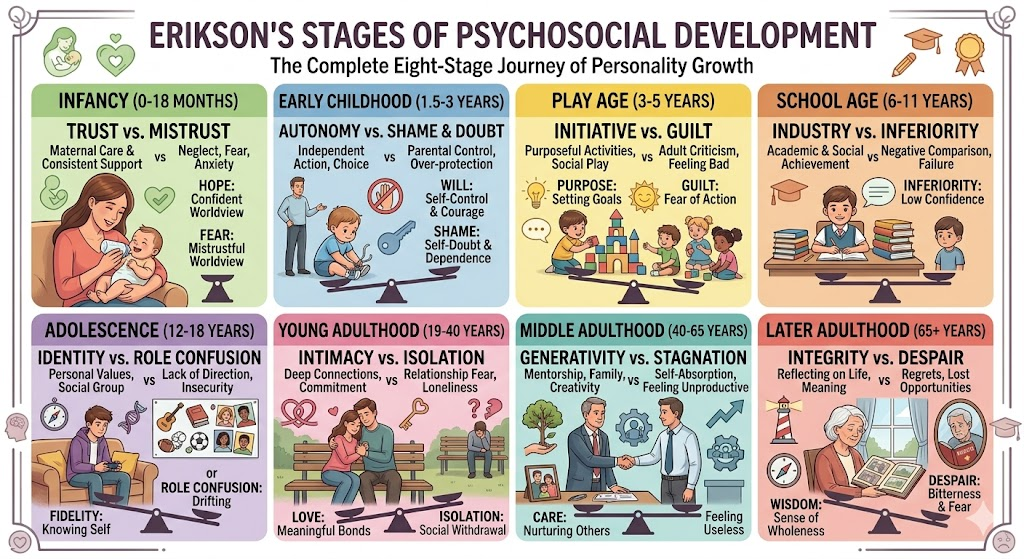
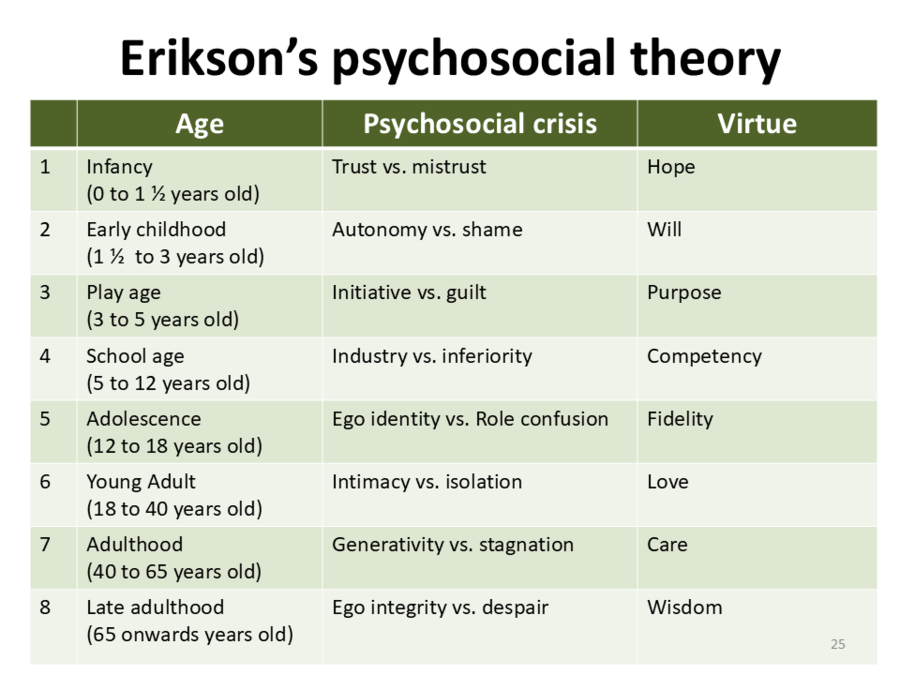
Erikson: Psychosocial Stages

Erikson viewed development as a series of crises that must be resolved. Each stage centers on a social struggle that impacts personality.

Stage 1: Trust vs. Mistrust (Infancy – 0 to 1.5 years old): Is the world a safe place?

Core issue: Can I trust the world?
Key factor: Consistent caregiving

  • Positive outcome: Trust, sense of safety
  • Negative outcome: Fear, suspicion
  • Phase where it serves as the foundation of attachment and emotional security

Stage 2: Autonomy vs. Shame/Doubt (Toddlerhood – 1.5 to 3 years old): Can I do things myself?

Core issue: Can I do things on my own? [Example: Eating with utensils such as fork and spoon without help]
Key factor: Encouragement vs. overcontrol

  • Positive: Independence, confidence
  • Negative: Shame, self-doubt
  • This phase is linked to early self-control and decision-making

Stage 3: Initiative vs. Guilt (Preschool – 3 to 5 or 6 years old): Am I good or bad at planning tasks?

Core issue: Is it okay to take initiative?
Key factor: Support for exploration

  • Positive: Initiative, leadership
  • Negative: Guilt, fear of trying
  • This phase is important for development of creativity and goal-directed behavior

Stage 4: Industry vs. Inferiority (School Age – 7 to 12 years old ): How do I compare to my peers?

Core issue: Am I competent?
Key factor: School and achievement

  • Positive: Competence, productivity
  • Negative: Inferiority, low confidence
  • This phase has a strong connection to academic self-efficacy

Stage 5: Identity vs. Role Confusion (Adolescence – 13 to 17 years old): Who am I?

Core issue: Who am I?
Key factor: Exploration of roles, values

  • Positive: Strong identity
  • Negative: Confusion, instability
  • This is a central stage in personality development and life direction

Stage 6: Intimacy vs. Isolation (Young adulthood – 19 – 40 years old)

Core issue: Can I form meaningful relationships?
Key factor: Emotional openness

  • Positive: Intimacy, strong relationships
  • Negative: Loneliness, isolation

Stage 7: Generativity vs. Stagnation (Middle adulthood – 40 to 65 years old)

Core issue: Am I contributing to society?
Key factor: Productivity, care for others

  • Positive: Generativity (giving back)
  • Negative: Stagnation, lack of purpose

Stage 8: Integrity vs. Despair (Late adulthood – 65 years old onwards)

Core issue: Was my life meaningful?
Key factor: Life reflection

  • Positive: Wisdom, fulfillment
  • Negative: Regret, despair

Diana Baumrind: Parenting Styles

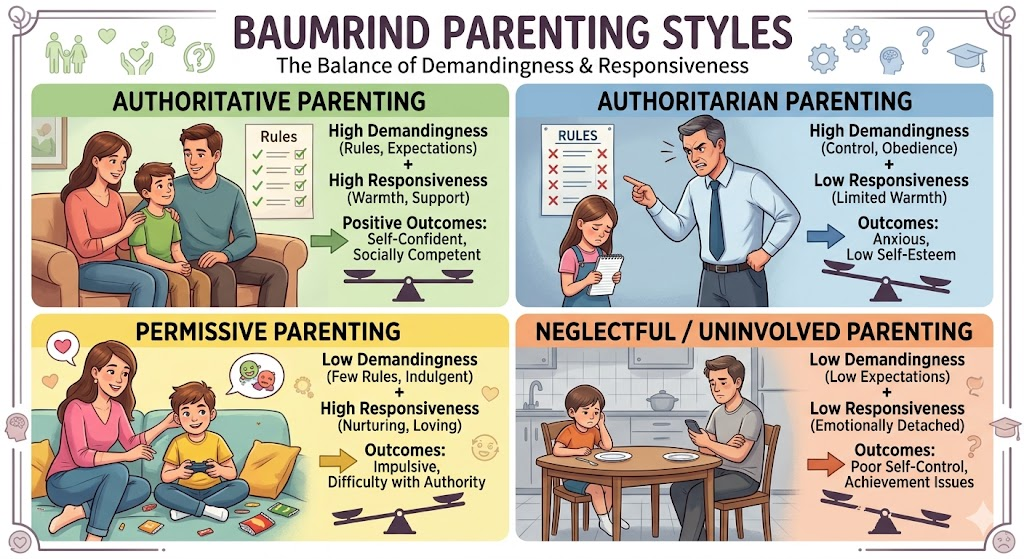
Diana Baumrind identified how the balance of responsiveness (warmth) and demandingness (control) shapes a child’s social competence. There are four types of parenting styles.

1. Authoritative Parenting (High Warmth, High Control)

Characteristics:

  • Warm, responsive, and supportive
  • Clear rules and expectations
  • Encourages independence and reasoning
  • Uses explanation rather than punishment
  • Considered the most effective style in many cultural contexts.

Example:
A parent explains why homework is important and sets a routine, while still listening to the child’s concerns.

Outcomes (research-consistent):

  • High self-esteem
  • Good social skills
  • Better academic performance
  • Strong self-regulation

2. Authoritarian Parenting (Low Warmth, High Control)

Characteristics:

  • Strict rules, high expectations
  • Low emotional warmth
  • Emphasis on obedience and discipline
  • “Because I said so” approach

Example:
A child is punished for breaking a rule without explanation or discussion.

Outcomes:

  • Obedient but less happy
  • Lower self-esteem
  • Higher anxiety or aggression
  • Poorer social skills

3. Permissive Parenting (High Warmth, Low Control)

Characteristics:

  • Very loving and indulgent
  • Few rules or boundaries
  • Avoids discipline
  • Acts more like a “friend” than authority

Example:
A child can decide bedtime, screen time, and routines without limits.

Outcomes:

  • Poor self-discipline
  • Impulsivity
  • Difficulty following rules
  • Lower academic achievement

4. Neglectful / Uninvolved Parenting (Low Warmth, Low Control)

Characteristics:

  • Lack of responsiveness and guidance
  • Minimal involvement in child’s life
  • Basic needs may be met, but emotional needs neglected

Example:
Parents are physically present but emotionally unavailable and uninvolved.

Outcomes:

  • Low self-esteem
  • Poor academic performance
  • Attachment issues
  • Higher risk behaviors

UTM Open Day