What are the impacts of Latihan Ikhtisas?

I have been wondering about it myself.  Well, to tell the truth, what I gain from the LI is a new experience of teaching adolescents (and its challenges).  Well, that’s it.  Networking?  Indeed.  Networking with the school.  Yup.  I still conduct tuition class and whatnot as a form of my after-LI-service.  

Making impact or difference in the students lives?  How on earth would I know that?!!!  I am not going to be overambitious on this part.  After all, only Allah knows best on this matter.  

Other than that?  Nothing much.  For example, did I get any  Industrial grant?  Nope.  So, it does resonate with the survey findings.  

Well, perhaps I can tell what I have gone through instead.  Yup.  It might take a while since I need to look at evidences that I collected in various forms such as daily journal, students reflective notes and such.  

I have posted some personal rambling on various posts.  Here are some of them:

Things that I produce when I did Latihan Ikhtisas_Part 1

Things that I produce when I did Latihan Ikhtisas_Part 2

Teaching poetry and literature

Latihan Ikhtisas Part 1

Latihan Ikhtisas Part 2

Latihan Ikhtisas Part 3

Latihan Ikhtisas Part 4

Latihan Ikhtisas Part 5

Gamification

I first came across this concept in late 2016.  I attended a one day course about Gamification by a former senior of IIUM (Zayd Ali Alsagof).  I never met him while at IIUM.  He was two years senior.  The chances that I would take the same class would be slim if he majored in psychology.  Most of the time, we would take the courses based on level (of difficulty).  Looking at the course code, you can understand that the course is meant for students at certain year of study.  It does not mean that if you are a first year student, you can’t take courses which are meant for final year student.  It is just that you will “struggle” a lot because the courses would be much complicated and most instructors would assume that you already know some of the theories that you would learn in different classes that you take in junior year.  

So, here I am teaching at a university and yet I am struggling to learn about the current things in education.  I went to this gamification workshop on volunteer basis because I feel that I need to improve my teaching practice.  I want to “inject” something new in my teaching every semester.  That’s my aim.  In sha Allah 

I learn a lot from the course.  But there are so many things that I have yet to explore even though some of the things are not free like Prezi. or Padlet.  One thing at a time. 

One of the things that I immediately implement in my class is online assessment. It is not that we don’t have online assessment on UTM elearning, but the feature is different from other online assessment such as Quizziz, Kahoot! and such. 

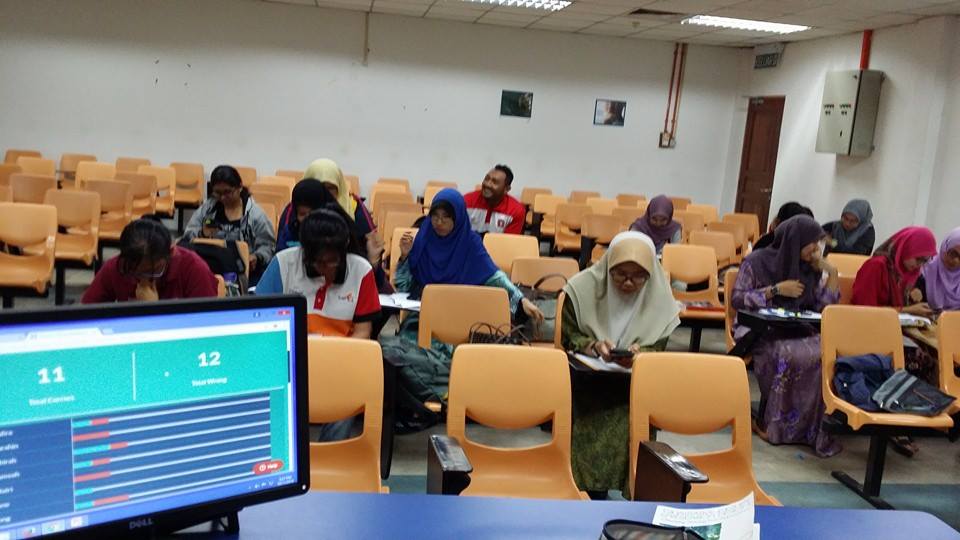
So, I tried Quizziz in my MPPU1024.  The students felt excited because it is like playing a game, rather than taking a test.  There are immediate feedback/answers using memes and there is also a ranking.  Yup.  All “players” will be ranked.  At the end of semester, I asked the students to give me feedback about the activities that we did in class.  Some of them give positive notes about Quizziz.  I wrote a paper and presented it in a conference in 2017.  Since then, I start to collect more data every time I use Quizziz in my class.  But, it is kind of challenging to get feedback from students unless it is considered as a part of the grading.  Another challenge, another way to tackle.  One thing at a time.  This is what make teaching interesting.  There would always be challenges that you need to deal with.   Never ends.  

Why do students leave question(s) unanswered?

I have just finished marking the final exam of one course.  Other than multiple choice questions, there are also open-ended questions (short answer questions).  Not that difficult or challenging.

How wrong I was?  When I first marked few of the students exam scripts, I was impressed because they can use their own words to explain various concepts.  So, I gave full marks for this.  Then, as I read the answers of other students (by this time, it was the tenth student), I started to notice a decline of satisfactory answer.  Am I being too strict because of the different time frame of marking?  The first tenth were marked after sahur and the remaining ones were after I have started fasting more than 2 hours.  No.  It couldn’t be that.  I was still feeling fresh and alert.  Am I being affected by the noise of scam phone ringing?  It couldn’t be it.  I felt a bit annoyed but I took a break for a while before continuing marking.  

I further read more exam scripts.  Yup.  I started to find that some students even left one or two questions unanswered.  What went wrong?  I guess, perhaps they cannot find any clue from the MCQ section.  Well, a good question will not give hint of any answer to the other question.  

When I looked again closely the five questions, well, the questions seem complicated but the answers to all of the questions are straight forward.  It does resonate with this saying “sometimes the questions are complicated and the answers are simple“.

So, why do students leave question unanswered?

There are many reasons.  One of it is perhaps they might not have enough time to write the answers.  Second, rather than writing a wrong answer, some might perceive that it is better not to write any answer at all.  Third, they simply do not know the answer or don’t have any idea/clue to write anything at all.  As a teacher, what should I do about this?

What a true academician and scholar….

I always admire this guy since I was young (I think when I started to read about an article that he wrote in the 1990s).  To envision myself as an academic like him, it is something that I have in mind.  It is not easy to choose this path but I will try my best to stay true to myself In sha Allah.  He was one of the co-authors of Rukun Negara (I googled about this).  I guess, every time I recite Rukun Negara, it will remind me of him.  

When I heard about his passing, I am sad.  As I browsed the news to read more about him, I came across his saying “The child is the father of the man. Educate and groom the young person, and he will grow up to be the right kind of adult. If you wait until he becomes an adult, it is too late”

What a true academic until the end!  


What does it mean to be a truly educated person?

As I marked the exam papers, I could not help from wondering this thing “What does it mean to be a truly educated person?”.  Looking at some of the lackluster inarticulate answers of my PG students, I was wondering what went wrong in my class.  Did I emphasis the wrong thing?  Did I emphasis exam results than what they should know regardless of whatever grade they might get? 

I encourage my students to be reflective.  I give them reflective questions.  When I found a note about what kinds of questions that self-regulated learners ask themselves, I share the note with my students.  In one class, I discussed with them about self-regulation model/theory and using the note, we discussed about how we can use it in different context of our lives.  I did my best in this case to guide my students not to be good test takers, but true learners.  But again, “you can lead a horse to water, but you can’t make it drink“.

But one thing that I notice is not many of my students are avid readers.  Meaning, not many of them like to read.  When I asked some of them if they have the textbook that I have recommended, NONE of them have the textbook (this was my UG class).  Unfortunately, it happens not only in my UG class, but also in my PG class.  The only difference is for my PG class, they realise the importance of having a textbook in the middle of semester, so by week 10 (there are only 14 weeks in one semester),  majority have the textbook.  Well, better late than never.  The UG class?  I rest my case. Perhaps they did borrow the textbook from the library and it is just that I don’t know about it (husn zahn in Arabic – or in English it means think positively or in Malay – bersangka baik)


Great things are done by a series of small things brought together

I was marking the personality psychology paper.  I am sad.  I thought that they could answer well because they were allowed to bring in notes.  Well, apparently, some of them didn’t study well.  It can be seen from their answers.  A copy -paste answer with lack of articulation.  So, I decided to take a break for a few minutes by checking my email.  Sengtat has promised me to submit a part of the first chapter of his thesis.  I have yet to receive any email from him yet.  Sigh. 

As I browse the title and sender of the emails that I received, my eyes caught something.   “Thank you, Dr Hadijah”. 

Jolyn gave me an email to thank me for the best wishes card that I gave them yesterday (the first student who did so).  I never thought and expected any student to thank me.  After all, it is just a card.  

But, I want to make difference in my students’ life (in positive ways).  Like what my mentors have done for me.  For example, Yedullah Kazmi gave me books, pencil and whatsnot.  Every time I read the books that he gave me, I always remember the time when I was his student.  Even though he used to call me SII (stupid, idiot, ignoramus), but I never sulked or felt bad about it.  I consider it as a form of endearment.  What a heck!  It is not easy to be the chosen one to be called as such.   

But, I do believe that we need to invest in relationship.  It is quite easy to invest in it using money, but most difficult one is time and concern (care?).   

I don’t know how far my effort will leave its impact, but I do believe that “Great things are done by a series of small things brought together“

Diberi betis hendak peha (similar proverb in English: Give them an inch and they’ll take a mile)

I have taught this course more than one semester.  It has been more than 5 years in fact.  I am not saying that I am an expert in this subject matter but I know the difficulty of remembering many theories related to personality which belong to different schools of thoughts.  It is not easy.  So, to help the students in this matter, I allow them to bring few pages (A4 size) of notes that they can bring to the exam hall.  

But I never thought that they would exchange their notes among themselves during the exam.  I never anticipate this thing could happen.  This was the first incident that happened in five years (and I hope this would be the last).  This is akin to cheating because you are looking at other people’s notes, rather than on your own.  I was informed by a student who saw this and I double checked it.  When I walked around nearby the conspirators, I noticed that there were notes with different hand-writing on both sides of them.  I knew instantly that what had been reported is true.  Indeed.

I didn’t want to spoil the “mood” so, I just kept it to myself.  But I would definitely not let this thing go without any punishment.  This is a classic example of “Give them an inch and they’ll take a mile” or in Malay “Diberi betis hendak peha“

Assessment of learning? Assessment for learning? Assessment as learning?: Which is which?

There are several types of assessments: 1) Assessment of learning, 2) Assessment for learning and 3) Assessment as learning

Assessment of learning

This refers to summative assessment.  It could be in a form of final examination or any examination that meant to see to what extent students have understood certain concepts.  

Assessment for learning

This refers to formative assessment.  One of the main purposes of formative assessment is to  see to what extent teachers could improve their teaching and support that they provide to students based on students’ performance.  For example, a quiz that is given to students based on certain topics covered.  Based on the quiz results, teacher would make a decision for improvement of teaching and learning activities in class.  

Assessment as learning

This refers to reflective self-evaluation.  This type of assessment is not meant for grading purposes but it is meant to help students to understand themselves better in terms of what they have learned and how well they have understood the concepts/topics they have learned.  

Can a quiz be formative and reflective self-evaluation at the same time?

For me, it can be when you let the students decide if they want to quiz to be graded or ungraded.  Meaning, they can take any quiz that I give without feeling pressure of being graded and this would be “assessment as learning” – because they take the quiz as a means to help them reflect on their understanding and learning i.e. reflective self-evaluation.  But at the same time, the same quiz can be considered as formative assessment [assessment for learning] if the students want the marks of the quiz to be graded.  

How can we (as teachers) implement all three assessments? 

In my case, what I normally do is, I have a mixture of assessments that I give to my students such as quiz, presentation, report and final exam.  Final exam is an example of summative assessment i.e. assessment of learning.  For quiz, I make it in such a way that there will be graded quizzes (formative assessment or assessment for learning) and there are also ungraded quizzes (assessment as learning).  For the ungraded quizzes , I normally give after we have finished discussing about a topic, for instance.  But for graded quizzes, it comprises of several topics.  So, in this case prior to take any graded quiz, students have self-assessed themselves on any given topic.  Of course, since it is ungraded, I notice that some students don’t take it seriously and thus, will not make any attempt to take the ungraded quiz.  I have seen it in the recent courses that I taught this semester (Semester 2, 2018/2019). 

What should I do then? 

Well, I give soft reminder several times but in the end of the day, I have to respect the students’ decision.  If they think it is the best for them to skip any ungraded quizzes, it is their right.  I have no right to force them in their learning.  After all, as adult learners, they should be responsible towards their learning.  They are not secondary school students.  The major difference between secondary school students and university students is for secondary school students, they need extra guidance when it comes to helping them in decision making.  University students?  What a heck!  They are adults, and they should be responsible and accountable with whatever decision that they make.  Welcome to adulthood!
The importance of adults for adolescents

The school conducted a programme (Program Ziarah Cakna) last Thursday (23 May 2019).   I went to the school because I paired with Teacher Ita (one of the English teachers) to pay a visit to one of the selected students.  I had a quick chat with some of the teachers to ask about what’s new and whatsnot since I left the school last March 2019.  I asked specifically about some of the students that I taught before.  I asked about their performance in the recent mid term examination.  I was worried that I had not covered many of the topics for the first two months but the teachers told me that I covered the topics according to the weekly plan according to scheme of work (SOW) of the respective classes.  What a relief!

Teacher Ita told me that Rahim is one of the students who frequently asked about me.  It is a classic case of attachment.  In this case, I do admit that as an adult, I might be his role model.  This is an example of how important an adult can be for an adolescent because he/she is in a phase of role confusion (or laymen commonly use “identity confusion” or in Malay – kecelaruan identiti).  Many studies in psychology have shown the importance of adults in helping adolescents in this transitioning phase between childhood and adulthood.   

What should I do with Rahim or any other students who are showing this kind of attachment? 

I never had any experience of dealing with school kids before because I teach university students since I start my teaching profession in 2005.  Well, for obvious reasons they are not adolescents, they are young adults and they have undergone the adolescence phase.  They are not in need of adult role models like me.  Their needs are different in this case.

I am still racking my brain in this case because I do not want him or any of my students to have “unhealthy attachment” or “transference”.  Transference is a term commonly used in counseling or clinical psychology which could happen during therapy sessions in which a person develops “certain feelings/emotions” toward the therapist.  But in education setting, transference could also happen in which a student may have certain feelings/emotions towards a teacher.  Well, it is not all bleak and gloomy but I don’t wish Rahim or any other male students especially to have “certain” feelings towards me, an old lady.  There are cases of relationships between teacher and student who develop into romantic intimate relationships.  Perhaps, I am a bit paranoid in this case but I guess there is nothing wrong to have extra precautions.   Prevention is better than cure.