About surayayaacob

Dynamic academician, researcher and consultant staying attentive to contribute more translational research for Malaysia. Enjoys creating customized plans and programs to spur more practical knowledge and innovation growth. Passion for data visualization, visual analytics, data analytics, data management, business intelligence, digitalization transformation and complex cognitive activities. Strive to facilitate more data-driven strategic planning, decision making and business process innovation in the organization.

Geran Universiti Penyelidik (GUP) UTM 2018 (revised GUP Tier 1 and 2 for 2019)

GUP juga dikenali sebagai RUG (Research University Grant). The fund is actually from MOHE (under RU budget). RU – Only five RU eligible – they got special grant from MOHE (Thats why we are scared of MYRA – MYRA1 to get 100% instruments to be RU. Then, from RU fund – go to UTM as GUP (RU Grant) – Geran Universiti Penyelidik. For 2018, UTM open 5 types of GUP. The slide is here Taklimat Geran GUP:
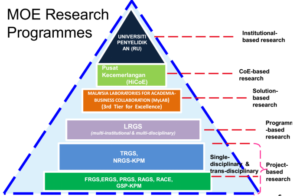
GUP Tier 1 RM50K for S&T

  • Project Leader Permanent sfaff – at least 2 members.
  • Must related to people on the ground – berkonsep penyelesaian masalah industri/komuniti/agensi kerajaan.
  • Proof of collaboration – e.g email:  Contoh Surat Sokongan Jabatan Laut Letter of Support. Contoh: Permohonan Surat Sokongan Untuk Penyelidikan.
  • 24 months
  • collaborators recommend to collaborate as in kind or monetary.
  • 20% travelling (v21) and 40% for buying equipment (v35)
  • Penilaian: 1 cycle (2 evaluators)
  • Output:
    • 1 indexed journal for 20K,
    • 100% geran luar (selain tajaan universiti dan networking grant iaitu geran sepadan daripada kerajaan, swasta, industri or antarabangsa)
    • 1 student.

GUP Tier 2 (20K) 2018 

  • Project Leader Permanent sfaff – at least 2 members.
  • NOT required but recommended: must related to people on the ground – berkonsep penyelesaian masalah industri/komuniti/agensi kerajaan.
  • Thats why, this is for people that do not have any grant.
  • 12-15 months
  • 20% travelling (v21) and 40% for buying equipment (v35)
  • Penilaian: 1 cycle (2 evaluators)
  • Output:
    • 1 indexed journal for 20K,
    • 100% geran luar (selain tajaan universiti dan networking grant iaitu geran sepadan daripada kerajaan, swasta, industri or antarabangsa)
    • NO NEED to produce 1 student.

For 2019, There are amendment for GUP Tier 2 (30K for S&T). Please refer here for the latest info.  GARIS PANDUAN GUP TIER 2 2019 -revised Dekan RA.

Basically, the Tier 2 is for new researcher to learn how to manage grants.  There must be 1 Prof Madya as a mentor and 2 members to guide the process. The output is – 2 Indexed Scopus Papers or 1 Q1/Q2.

GUP CRG (RM100K)

  • Project Leader Permanent sfaff – at least 2 members.
  • Must work with other university (40k for UTM, 60 for 3 collaborators)


Publication Process for Buku Ilmiah & Buku Karya Asli: Phase 3

Monograf — adalah buku penerbitan yang masih berbau tesis. Terma dan kandungan adalah seperti tesis. Mengandungi abstrak dan bab metodologi

Buku teks – tiada nilai penyelidikan. Boleh diambil daripada nota syarahan.

Edited volume – sama seperti research book. Cuma ada tambahan authors dalam TOC. Nama luar hanyalah nama editor sahaja.

Buku Ilmiah – ada elemen penyelidikan. Tidak berbau tesis dan sesuai untuk bacaan umum.

  1. Front Matter – muka judul, abstrak
    1. Half title page – penerbit akan buat – rekto
    2. title page – tajuk, nama penulis, publisher
    3. copyright page – verso – the back of the full title page, copyright notice, in addition most publishers, the name of the country, printing history
    4. dedication – optional the next right hand page – it should be simple – To my daughters with lots of love.
    5. acknowledgement
    6. epigraph – optional (kata-kata mutiara) – kata-kata Hamkha…
    7. table of contents – start rekto
    8. list of illustrations – social science or kalau tak banyak rajah maka tidak perlu.
    9. list of tables
    10. foreword (kata penghantar) – ditulis oleh orang lain. e.g pengarah, boss, menteri.
    11. preface – reason for writing the book, method of research and extended acknowledgements dan kepenggunaan (target audience). At least 2 page nampak cantik. Mentioned Geran, pelajar dan motivasi menghasilkan buku.
    12. introduction
    13. list of abbs
    14. editorial
    15. method
    16. list of contributors
    17. chronology/list of event
  2. Content – content minimum 5 chapter (perlu organize setiap chapter dan paragraph supaya sama panjang).
    1. Ayat simple dan senang faham. ayat pendek-pendek.
    2. 2-3 chapter awal tulis dengan mudah supaya orang senang faham.
    3. Must start with Recto – belah kanan.
    4. Subhead – cantik berhenti hingga level 2 sahaja.
    5. Reduce 1 size from text to table.
    6. Check type settings sehingga CRC.
    7. Reduce citations. cite only the important/factual
  3. Back Matter – references & indexed (wajib dibuat)
    1. Index – begins on a recto page, name and subject, entry penulis perlu sediakan.
    2. References
    3. Glossary
    4. Back cover – Blurb (short promotional piece) and author biodata.
  4. Book size – standard novel( 6×9 inches), textbook size (7×10 inches)
    1. Page numbering – bergantung kepada penerbit
    2. Typography – determines typefaces and font sizes.
    3. Title – pendek dan 2 lapis.
    4. Pages – 150 cantik untuk spine.
    5. Spine – author, title and publisher.

Langkah menulis

  1. Pre-writing – choose a topic, choose a format (ikut UTM Press), gather material, plan basic structure (from basic to go deeper 1. to 1.1. to 1.1.1)
  2. drafting – get your ideas on paper, use sentences and paragraph, follow the basic structure of the genre you have choosen, dont worry about getting it perfect, you can fix it later. After you finish your first draft, you should get someone to revise it – what do you like about my piece, what is unclear, what questions do you have, what do you have to improve it.
  3. revision – add details, examples and illustrations to strengthen and clarify. Rewrite awkward or unclear sentences or paragraphs. Cut any words that not related.
  4. editing = editing, correct, spelling, grammar, punctuation and style.
  5. publishing – Turn it in, post it to a blog, submit it to a publication, any other ideas?
    1. Manuscript is reviewed by appointed reviewer

Bibliografi – tak semestinya ada citation. References – mesti ada dalam citation.

Fasa 3: Perbincangan dengan Penerbit (MPWS)

  1. Ubah tajuk lebih santai + akademik. Buka target market postgrad untuk pasaran yang lebih luas. Jadik semua, mohon untuk cadangkan tiga tajuk – yang ada unsur santai + akademik . Tajuk aritu ialah menuju phd. Diantara tajuk yang diorang dah ada dan tak recommend kita guna ialah: 1. Hikayat seorang phd. 2. Travelog phd.
  2. Grafik Buku
    MPWS ada designer. Once dah confirm tajuk – nanti diorang will design accordingly.
  3. Permohonan ISBN.
    Untuk dapatkan ISBN, buku perlu ada: 1. kata pendahuluan, 2. abstrak dan 3. Table of Content. Tqvm, yang ini Dr Ib dah siapkan.
  4. Proof Read.
    Terima kasih uols – kita sedang pusing proof read kan. Then bila siap nanti bagi kepada mereka, diorang akan proofread sekali lagi.
  5. Medium Penerbitan:Pilihan 1: eBook (foc) pilihan yang diberikan kepada kita ialahterbit dalam bentuk eBook. Sebab diorang uruskan semua dan marketing pun mereka uruskan. Kos penulis ialah FOC. Keuntungan ialah 60% publisher dan 40% kita.Pilihan 2: cetak – Sekiranya hendak diterbitkan dalam bentuk buku, kadar bayaran ialah RM 1000 (kos pengurusan) + RM 4000 (kos cetak untuk 120 pages). Kos ini ditanggung oleh penulis (kira sorang dalam RM400-500 la kan). Then hak buku dan royalti semua ialah pada penulis. Kita boleh minta mereka uruskan marketing dengan cara kita jual buku kita tuh kepada mereka pula – supaya mereka boleh edarkan kepada kedai buku IPTA, MPH dan pesta bukuPilihan 3: ebook then cetak (cadangan mereka kita buat ebook dulu). Then dah siap ebook memang terus boleh cetak (kalau mahu). Sebab katanya memang begitulah cara trainer MPWS lain buat duit. Diorang jual buku diorang masa kelas dan dalam seminar.
  6. Tambahan kandungan setelah perbincangani. Tambah 1 bab perkahwinan/support system. Ini adalah optional contribution daripada penulis (nama sebenar tidak akan disiarkan). Bab ini akan dibuat dalam bentuk kompilasi. 1/2 – 1 page seorang. Hantar selewat-lewatnya pagi isnin ini.ii. Kesimpulan daripada perjumpaan semalam ialah teruskan mengedit – last sekali akan tiba pada saya kan? then nanti saya pas balik dan discuss dengan Dr Ib untuk softcopy. Jadi kita teruskan proses macam biasa ok, samada ebook sahaja, cetak sahaja atau ebook dan cetak – prosesnya ialah sama.iii. Keputusan untuk kaedah publication dan tajuk nanti kita buat round table – semua kena bagi pendapat untuk tajuk dan pilih kaedah publication

Active Learning using Interactive Tools

http://c4lpt.co.uk/directory-of-learning-performance-tools

active learning  – Engaging Learners through active learning by Prof Khairiyah UTM

Bookends Approach

  • Advanced Organizer – introduce the topic 10-15 minutes
  • Intermittent Discussion – informal cooperative learning, repeated every 10-15 minutes
  • Closure Focused Discussion – summarize the class session around 5 minutes.

Update 19 feb 2020. Tools for active learning

  1. edpuzzle

Here is a directory that compile interactive tools online. This effort will support us to execute active learning in lecture. The directory contains over 1,000 entries in which categorized in four main areas – instructional tool, content devolopment tools, social tools, personal & professional tools.

Among the tools we can use:

1. Prezi – be careful, your audience can be dizzy

2. Padlet – organize and plan your padlet well – it can be your contents for eLPPT. CTL can give you extra marks if you really utlize your subject content here.

3. Kahoot – kahoot can lead you to edutainment ctl. There are a few of edutainment apps. We can download at CTL UTM

4. Powtoon – http://www.powtoon.com. It is a powerful tool for us to animate the presentation tools. This will lead us to UTM-MIT-Blossoms.

5. Wideo – create video online

6. Creaza – https://www.creaza.com. Creaza is a digital learning tool that enables students to work with different subjects and topics by creating mind maps, presentation, comic strips, movies and audio productions.

7. Storybird – http://storybird.com. Visual storytelling for everyone. A plafform for writers and bloggers.

8. be funky – https://www.befunky.com. Photo editing & graphic design made for everyone.

9. Coggle – a clear way to share complex information – mind map.

Last but not least – we can use powerpoint – but put more on active learning activities (e.g. blank page in the middle of class, unique elements after 20 minutes lecture, a game or interactive picture. I think the most relevant and cute one is actually the storytelling element to help students understand the gist of our lecture in a narrative and interesting way).

Powerful Presentation

Handling students copies of your presentation – (e.g power point slides – hardcopy or elearning)

  • Before the class – they will be well prepared before the class and this can improve student learning, opportunities for active learning.
  • After the class – students underutilized the notes, they don’t pay attention during the class, refused to attend the class, fail to develop good note taking skills.”many students and teachers believe that writing down new information in their own fashion helps them learn”
    (Carrier et al, 1988).
  • Make up and organize your powerpoint.

 1. Prepare opening questions – please come out with positive and negative answer.

Reflect and relate this question with the topic we want to teach. And also relate with the

previous lesson.

2. Clarify the lesson’s objectives.

3. Ask students to think for 2 minutes

4. Ask students to stretch their body

5. Rearrange their positions from one position to others

6. Do active learning presentation

7. Pause every 12-15 minuters – what we should do?