3rd Game – UTM Inter-Deparment Badminton

We just played our 3rd game tonight, which is the first in this knock-out stage. This time we battled Faculty of Science. Surprisingly, I was asked to play single. Hesitated, I obliged with the decision by our team leader / manager (Prof. G). The game started.

If you just read this post, you should read 2 earlier post here and here, to know the complete overview of our game.

Result:

(1) 1st double (PM Dr. Asnizam & Ahmad MPRC) – we LOST unfortunately.

(2) Single (ME) – surprisingly I won (YES)! I was lucky I guessed 🙂 God helped me! And it was a straight set. My opponent was exhausted and slightly heavier than me. That’s some advantage for me.

(3) 2nd double (Prof G. & Roslan Jas) – the decider – again, we lost unfortunately.

OVERALL – We LOST and will not proceed to the quarter final tomorrow.

Well, it’s ok. It’s just a nice game. I treated it as an activity for me to exercise (but during the game, it can turned out to be very tense!)

InsyaAllah, we’ll try next year 🙂

Go FCEE!
 

2nd Game – UTM Inter-Deparment Badminton

After the first game versus Bendahari, we fought Perpustakaan team. In this game, I partnered Ahmad MPRC again as FCEE first double. We played first. Followed by single (Dr. Nazri) and finally second double (Dr. Lau and Be Cheer).

Result…

We won all game 3-0.

All games were won with straight set. Unbelievable. Unstoppable. We emerged as champion for group C.

We will proceed to the next round, but this time it will be tougher. The game will be tonight. Let’s pray and hope for the best. Go FCEE!!!


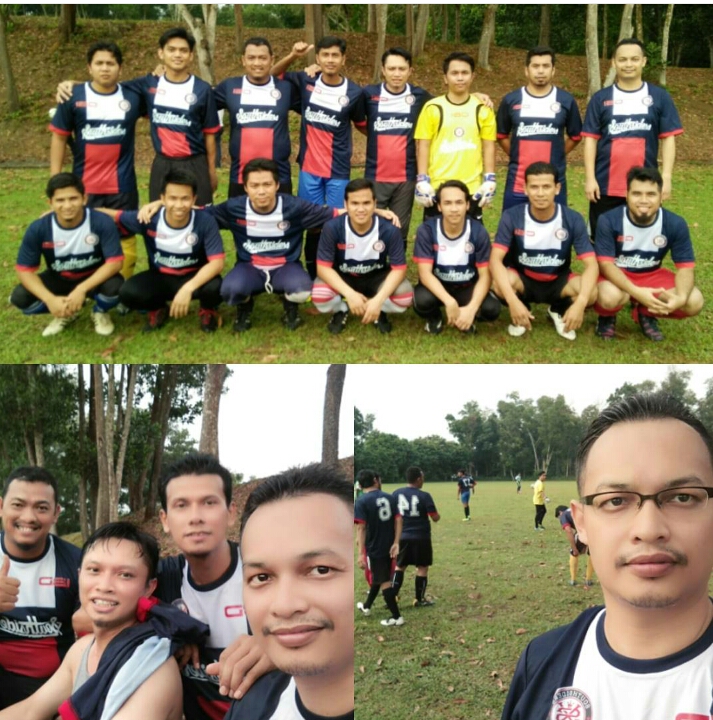
UTM Inter Departmental Soccer Tournament

This is surprisingly my 1st soccer game in a space of 4 years. Previously I played for the faculty, but since I experienced some pain in my knees (in 2012), I have to relaxed and considered stop playing. But, yesterday…haha… it was a comeback. I anticipated to play for 10 minutes, but it ended I played for 45 minutes. Need to work on my stamina.

My Google Scholar Stat Info (20th July 2016)

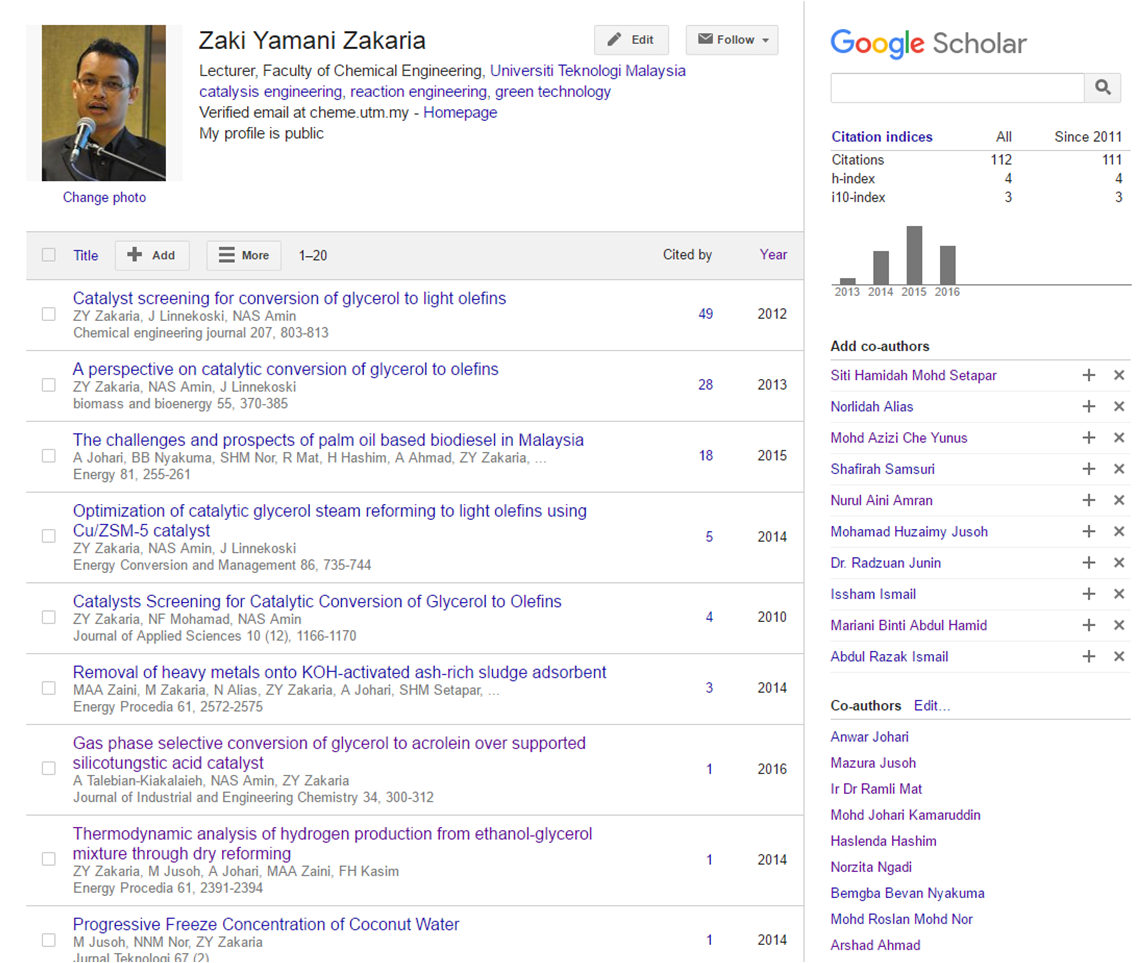
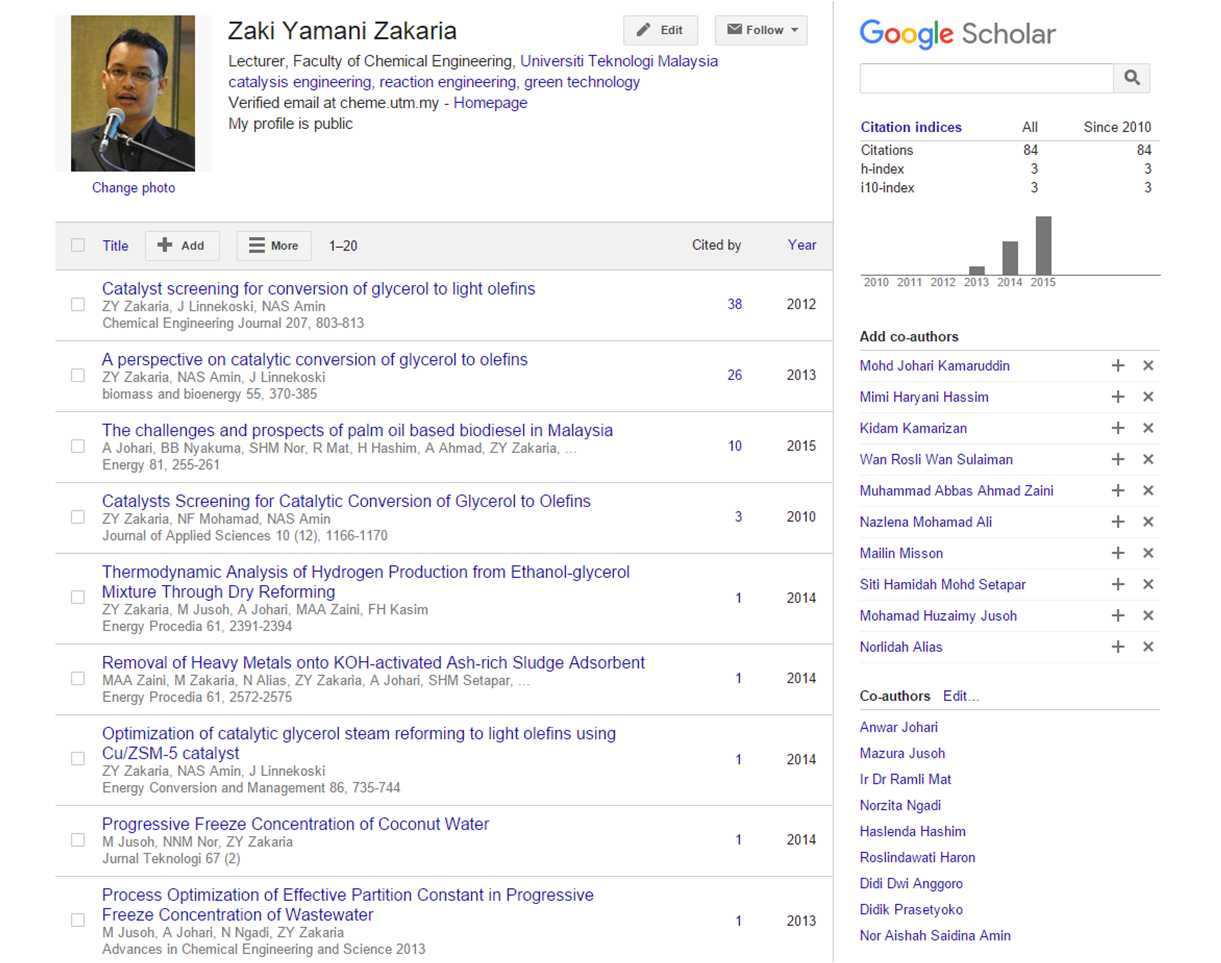
Every academicians / researchers in a university all over the world will have their own Google Scholar Account by this era. I’m included. Like other comrades, I am striving hard to contribute as much as I can to the scientific community, especially those that dwell within the regions of Chemical Engineering. My Google Scholar stat info as per shown below (If you are interested to see, just click the image below to enlarge it). This is for my personal record to see, to assess, to evaluate, to reflect later in future, how I am performing as an academician / researcher. For record, I uploaded Figure 1 and Figure 2.

zaki-yamani-google-scholar-chemical-engineering-utm-2016

Figure 1: My Google Scholar Stats (updated till 20th July 2016)

……………………………………………………………………………………………………………………………………………

Summary of my Google Scholar Stat (20th July 2016) :

Citation – 112
h-index – 4
i10-index – 3
 ……………………………………………………………………………………………………………………………………………
Summary of my Google Scholar Stat 6 months ago (31th December 2015) (ref):
Citation – 84
h-index – 3
i10-index – 3
……………………………………………………………………………………………………………………………………………

zaki-yamani-google-scholar-chemical-engineering-utm-2015

Figure 2: My Google Scholar Stats (updated till 31th December 2015)

My 2 cents

As a new lecturer it is not easy to straight away jump and show colourful glaring Google Scholar Stat.  There are so much to do such as prepare/write/submit research proposal to get research grants, get some students (good students), supervise and monitor research, write and publish in reputable journal, participate in conferences, perhaps write 1 or 2 book chapters etc. The impact of all this hardwork will only be materialize in the next few years. Well, I just completed my Ph.D in 2013 , struggled to secure some research grants in 2014 and managed to have some good students in 2015. So, now is the time to work smart and hard. I hope my Google Scholar stats will be more decorative in the coming 2017. InsyaAllah

MKK Master Chemical Engineering – First Stage Assessment

Today I examined 2 MKK students, mixed mode alongside with Associate Professor Ir. Dr. Ramli Mat. Both students were David (from Nigeria) and William (from Kenya). Both are great fantastic brilliant students. Both presented well and the works that they have/will be doing are impressive. Both students are presently supervised by Prof. Ir. Dr. Nor Aishah Saidina Amin (NASA) and co-supervised by Dr. Tahir.

After lunch, it was my student’s turn to be examined. Ammaru (from Nigeria) was evaluated by Dr. Tahir and Dr. Mahadhir, with Dr. Abbas as the chairman. Ammaru did great and he need to improve a bit in his proposal. Nothing much to worry though 🙂

My 2 cent

It’s good to be both examiner and supervisor at almost the same time. I personally learned a lot from this exercises, which is crucial for personal development and improvement. giving advice and inspiring the student to do better is another angle of which we need to be good at. Working on that 🙂


ISO 9001:2015 Awareness Briefing for our Chemical Engineering Faculty

ISO-9001-chemical-engineering-UTM

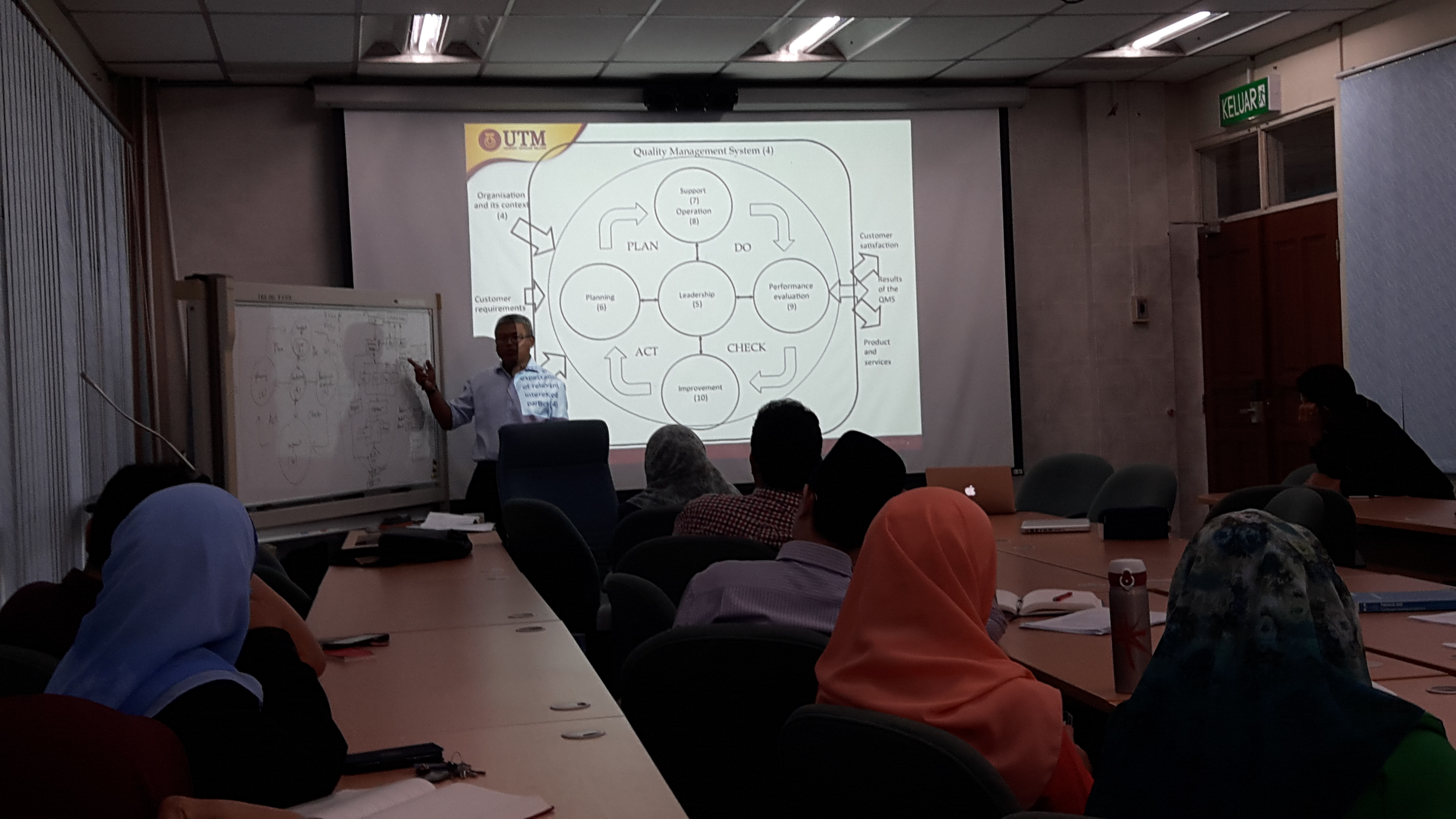
ISO 9001:2015 Awareness Briefing

iso-awareness-1

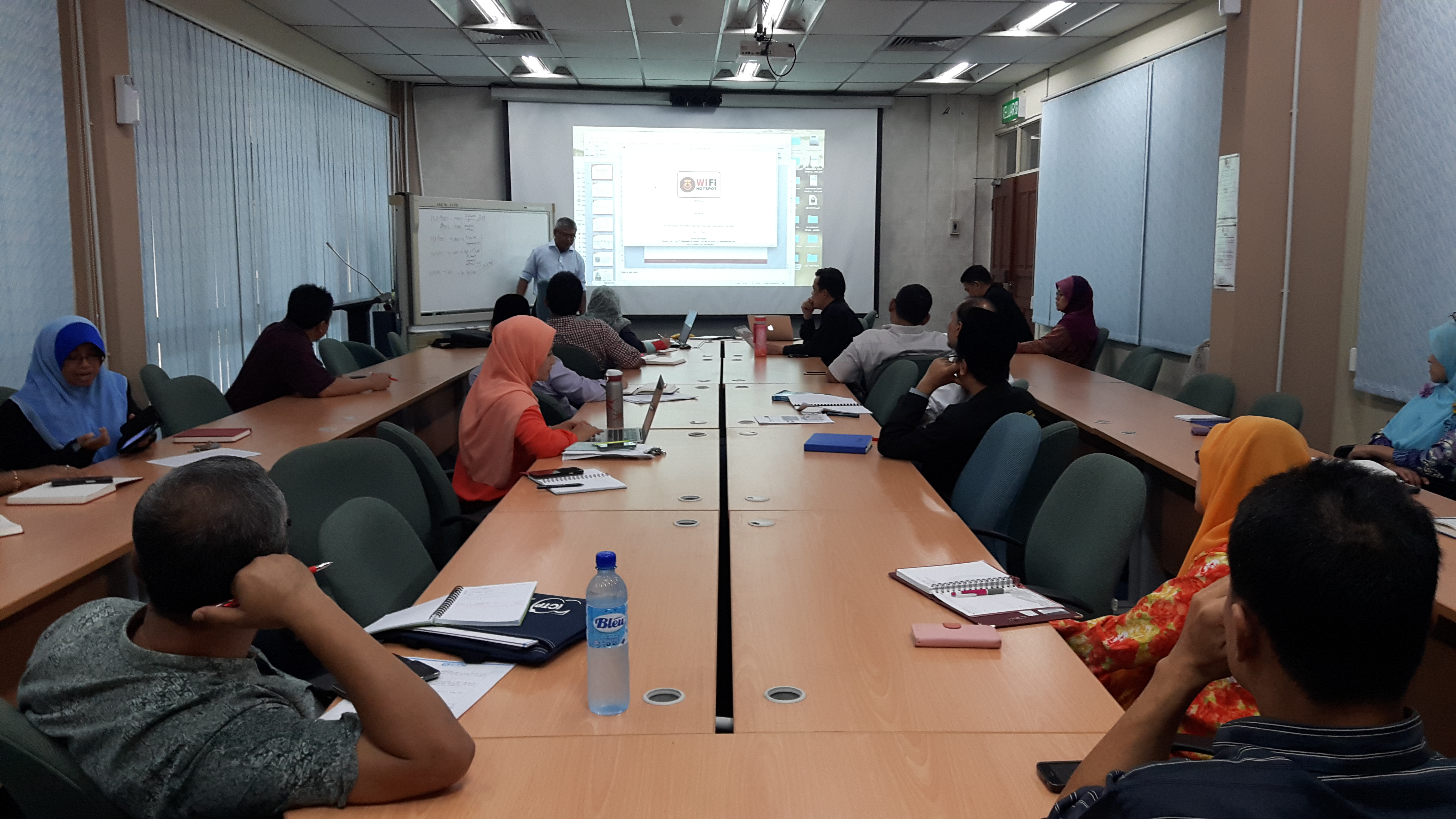
All the staffs are trying hard to understand the implementation and concept of ISO 9001 in education context

After intense EAC and other exercises, our faculty has taken a new step to upgrade and implement ISO 9001 in our faculty. The briefing which took place on 17th January 2016 (Sunday) at 14.30 hours were attended by both academic and support staffs. This ISO 9001 implementation could be a challenging one as we will attempt to integrate it with what we have in EAC efforts. Although I have some experiences in ISO as an implementer and internal auditor when I worked as an engineer few years back, I can say that this one will be a tough one. Anything new will be a tough one. From nothing to having it implemented and applied exclusively in the faculty. I personally think it is a massive and great effort but will take several years. Hopefully it can be fast and smooth one.

Introduction to Matlab for Engineering Students

Matlab is a very important and powerful software. It is very useful for various application such as thermodynamic modelling, solving simultaneous equations, genetic algorithm, optimization and so much more. To study Matlab, several books are available. If you are interested, you can get the book written by David Houcque from Northwestern University. Following is a snapshot from the book:

. .

INTRODUCTION TO MATLAB FOR ENGINEERING STUDENTS
  .
David Houcque
  .
Northwestern University
  .
(version 1.2, August 2005)
  .
Chapter 1
  .
Tutorial lessons 1
  .
1.1 Introduction
  .
The tutorials are independent of the rest of the document. The primarily objective is to help you learn quickly the fi rst steps. The emphasis here is \learning by doing”. Therefore, the best way to learn is by trying it yourself. Working through the examples will give you a feel for the way that MATLAB operates. In this  introduction we will describe how MATLABhandles simple numerical expressions and mathematical formulas. The name MATLAB stands for MATrix LABoratory. MATLAB was written originally to provide easy access to matrix software developed by the LINPACK (linear system package) and EISPACK (Eigen system package) projects.
  .
MATLAB [1] is a high-performance language for technical computing. It integrates computation, visualization, and programming environment. Furthermore, MATLAB is a modern programming language environment: it has sophisticated data structures, contains built-in editing and debugging tools, and supports
object-oriented programming. These factors make MATLAB an excellent tool for teaching and research.
  .
Continue reading —-> (introduction-to-matlab).
  .

Welcome to Zaki Yamani Official UTM Website

Some Back Ground

I was inspired to choose chemical engineering when I first saw the chemical formula from my father’s chemistry book. The chemical formula shapes look fascinating and interesting to me.

My father is an organic chemistry lecturer in Universiti Teknologi Malaysia (UTM). When I was 14, I read his organic chemistry book and willingly learnt from it by myself. When I was 17, I wanted to have a career associated with chemistry. Back then, my first choice was chemical engineering and my second choice was biochemistry. To be honest, I was unaware of what chemical engineers do and what the industry is like. I could not imagine it due to lack of exposure and information.

After completing my high school education, I pursue my A-Levels and took 3 core subjects which are essential for engineering: Physics, Chemistry and Mathematics. Then I continued my degree in chemical engineering. I managed to get a place in Bradford University, United Kingdom. I was unlucky because in our contract, practical training or sandwich course is not included by our sponsors. Therefore, we don’t have any valuable practical and industry exposures. That doesn’t matter and I keep on studying until I graduated in 1999.

Post graduate – Research and Development

After completing my degree, I returned to Malaysia and was appointed as a research assistant for 5 months in UTM. I joined “Chemical Reaction Engineering Group” (CREG) which its main research was developing the single step conversion of natural gas to gasoline using zeolite catalyst. It was a very interesting topic and that encouraged me to further my chemical engineering masters degree in it. Hence, I then became a full time research student and my research title was “Optimization of Oxidative Coupling of Methane (OCM) Using Experimental Design”, which is part of the natural gas to gasoline research project. As a master’s student, I conducted a thorough research, synthesized catalysts, run experiments, optimized reaction, published technical papers, presented posters and participated in related science-technology exhibitions. I learned and used various analytical equipments such as X-Ray Diffraction (XRD), Scanning Electron Microscopy (SEM), Fourier Transform Infra Red (FTIR), Atomic Adsorption Spectroscopy (AAS), Nitrogen Adsorption (NA), Nuclear Magnetic Resonance (NMR) and Gas Chromatography (GC). Besides that, I developed my own experimental rig to study the reaction of natural gas and the catalysts that I synthesized. To optimize the experiment, I used “Response Surface Methodology” (RSM) – “Central Composite Design” (CCD) from Statistika software. The software enabled me to arrange my experiment systematically and I can easily obtain a model equation for the reaction. With CREG, we won numerous local and international awards from our research and inventions. It was such a great honor to be part of a successful research group.

Oil & Gas Exposure – Servicing Company

After completing my masters, I was offered a job as chemical technologist for a local oil and gas servicing company. In a year, I became a project/chemical engineer in the same company. My main task was to lead the “internal pipeline chemical cleaning” project for a local oil company. We basically have to assist the oil company to reduce corrosion activities inside the downstream pipeline and prolong the life span of it. The pipelines were chemically treated using degreaser and corrosion inhibitors; and physically cleaned using pigs. It was part of my responsibility to ensure correct formulations as well as performing necessary test to ensure the chemicals were fit to perform its duty. To efficiently and effectively monitor corrosion activities in the pipelines, we utilized latest corrosion monitoring techniques such as electronic resistant probe (ER) and field signature method (FSM).
zaki offshore

I was also in charged of the oil and gas specialty chemicals. I traveled to a number of offshore platforms in East Malaysia to conduct deoiler and descaler tests for their oil reserved. It was very challenging and fun performing those tasks. I love going offshore because the working hours are less compared to the amount of time we spent on the platform. The foods are marvelous and comparable to 5 star hotels. Entertainment and other activities such as television, movies, snooker, ping-pong, gymnasium and reflexology chair are made available for the platform dwellers. To be able to go offshore, I have to undergo Helicopter Under Water Escape (HUET) training and get myself an offshore passport.

With this job, I traveled extensively and visited neighboring countries, Singapore and Indonesia, for work purpose of course. In Kalimantan, Indonesia, I joined our company principal to conduct bottle test field trial for local oil company on their onshore oil rig. It was a very interesting and exciting assignment because I got to see how simple the setting of an onshore oil rig because in Malaysia we only have expensive and complicated offshore oil rigs/platforms.

Oil & Fats Industry – Refinery and Other Challenges

I love my oil and gas career but I was unfortunate because I could not continue being in that industry. The company management has bigger plans and they moved to Kuala Lumpur, the capital of Malaysia. I was instructed to transfer which I could not do because I don’t want to hinder my wife’s career establishment as a lecturer/researcher/consultant in UTM and we also have just purchased a house in Johor Bahru in the same year.

zaki offshore

I was also in charged of the oil and gas specialty chemicals. I traveled to a number of offshore platforms in East Malaysia to conduct deoiler and descaler tests for their oil reserved. It was very challenging and fun performing those tasks. I love going offshore because the working hours are less compared to the amount of time we spent on the

I seek for other jobs and managed to get one in a physical refining plant associated in the oil and fats industry. This is a whole new chapter and totally different from my previous job. I’m required to scan in and out every time we enter or exit the factory. Life is no longer as flexible as before. I don’t have ample time to do my work and that made me work longer hours and I always reach home when it’s already dark. I don’t really mind because it’s a new working environment and I know I have to learn as fast as possible. I set my target to know everybody around my circle of work as soon as possible.

My first task given by my boss was to identify and list down all the valves in the plant I’m in charged of. It was an interesting and good assignment. It made me traced the entire pipeline from the feed tank to the plant and to the product tank. I learned a lot of stuff regarding valves. I know and understand various types of valves, brand/ origin, sizes, spare parts, principle/operation, tag number etc. In addition to that, indirectly, I learned about the plant process and operation. That was just the beginning.
Being in a process plant is a perfect place to learn and put in practice your unit operation knowledge. It also gave me a better comprehension on what process control is all about. I learned about other supporting units like heat exchangers, cooling towers, boilers, utility boilers and much more. The learning curve continued everyday and never stopped.

Not only that I learn about all the technical stuff, handling manpower and conflict is another challenging area that I made myself good at. Manpower is not an easy matter to deal. Some of my down line manpower never experienced any disciplinary action taken when they violated certain laws such as coming in late and simply not coming to work. Despite a series of reminder and warning, the bad attitude still continues. I could not stand it. With the support of my senior colleague, I enforced the discipline and forced them to obey. I gave the problematic staffs some disciplinary action. I want them to learn some lesson and be more serious on their responsibility and work.

During plant shut down or some called it turn around, I learned a lot. Techniques on ensuring the fastest and effective way to cool down the plant, managing and coordinating a team of people to service the plant, conducting air test, steam test and driving the plant start-up are among some knowledge I acquired during 4 shutdowns of my plants.

Academia and Research

1st July 2008 was the day I reported duty as a lecturer. It’s a new career that I love and endure. I learned that being a lecturer demands me to be more discipline, because the role of the huge role as a lecturer. A lecturer does not only lecturers but they have to research,

A Little Something from Me

There are a lot more to share, but it’s impossible to include everything here. I’m glad to have experienced chemical engineering in three different areas; research (academics); oil and gas; and oil and fats. Each area has their own challenges, advantages and unique.

Being very vague about the chemical engineering industry during my student life urged me to improve the situation. Wouldn’t it be nice if somebody can tell and share what they can expect from the industry? It will be some sort of a chemical engineering informal education for the students and other junior engineers. That is why despite of my busy life as a process engineer, I progressively and continuously share some of my experiences in my “Chemical Engineering World” blog that I created on July 2006. A year after that, I created Chemical Engineering Net 2.0 . I sincerely hope it can provide at least some useful information for fellow young chemical engineers. I believe it’s a good thing if other professional and practicing engineers out there can do the same for others to benefit. It will be a great contribution.

I can be contacted or followed via the following mediums:

Facebook.com/zakiyz

Twitter.com/zakiyamani

Linkedin.com Zaki Yamani

Publication in Chemical Engineering Journal

Alhamdulillah, I managed to publish a new manuscript in a Q1 rated journal. The title of my paper is “Catalyst screening for conversion of glycerol to light olefins”, Chemical Engineering Journal 207–208 (2012) 803–813.

Here is the abstract:

Catalyst screening for conversion of glycerol to light olefins

Screening of modified ZSM-5 catalysts for conversion of glycerol to light olefins has been investigated. In this study HZSM-5, Al/ZSM-5, Ca/ZSM-5, Cr/ZSM-5, Cu/ZSM-5, Li/ZSM-5, Mg/ZSM-5 and Ni/ZSM-5 zeolite catalysts were prepared, tested and screened. The catalysts were characterized to relate their properties with catalyst activity. XRD and FTIR characterization results demonstrated that the structure of the catalysts remained intact while BET revealed the surface and micropore areas decreased after metal loading. TPR data exhibited the reduction phenomenon of the catalysts. NH3-TPD analysis indicated that Cu/ZSM5 catalyst has relatively more moderate and strong active acid sites compared to others. GC TCD/FID analysis detected light olefins and paraffins; methane, CO and CO2 in the gaseous product stream. The acidity of the catalyst affected olefin production, but no direct correlation between surface area and olefin yield was observed. The turnover frequency (TOF) for Cu/ZSM-5 and Cr/ZSM-5 catalysts were significantly high comparatively. Cu/ZSM-5 produced the highest light olefins selectivity and yield due to the synergistic effect of the physico-chemical properties between the parent ZSM-5 and the metals.

To read the paper, just click here to download the PDF.

It is also listed in my Publication > Journals Tab in this site.