When I did my Latihan Ikhtisas, the English teachers in my school attended a workshop/seminar conducted by Google Educator Group Johor. Well, since I am not the “real” teacher, for obvious reason, I was not selected to attend the seminar because there was an allocation for teachers to attend such event by school. I was not a teacher = Not selected. Kind of sad to be in such equation. But, that’s life. For all English teachers, check this out.
What to write in your TESDCP teaching portfolio?
There are four aspects that you need to write.
- Goals of student learning,
- Philosophy,
- Beliefs and practices of assessment and
- Self-reflection of teaching development over time.
Some tips:
- Write from your heart (either in English or Malay) in Words doc file first (the system is linked to UTMPORTAL, so if you leave it for a while, you will lose all of the things that you have written if you don’t save it)
- Highlight NALI (use certain terms commonly related to NALI)
- Don’t worry too much about grammar (this is not an SPM essay though. But, please do proofread your writing because it might reflect your language proficiency as an academician teaching at university).
- If you have written somewhere that reflect your belief in either one of the aspects, you can link the URL too (there is a column under each heading of the four aspects). For example, I link a post that I wrote here in my TESDCP about my belief in assessment.
Monthly engagement with UTM VC
How to fill in information on Teaching Excellence System (TES)?
First of all, you need to be UTM staff.
Next, log in to MYUTM (using your ACID and password) to go to UTM Staff Portal (Portal Staf UTM).
On your left hand side under Sistem UTM, scroll down to Akademik (click). Choose Profile Akademik (click).
On your right hand side under Quick Links, choose and click Teaching Excellence System.
Under Teaching Excellence Report, there are four (4) headings: Blended Learning, OBE, NALI & HIEPS and E-content.
a) Blended Learning
To look at your Blended Learning report (this is based on your eLearning), click Blended Learning. To see a list of courses that you teach or have taught, scroll down the heading Semester Session. Click the semester that you want to see the report. You can see the report any time during the semester. You don’t have to wait until the end of the semester to see the report.
There is nothing you can add here. If you want to see the change, make any change by adding activities, notes etc. on your eLearning.
2) OBE
To look at your OBE report (this is based on your OBE), click OBE. So, once you complete your CAR report on your OBE, the status will automatically change to Complete. If you have a course (like a module type kind of course) that you don’t need to create a CAR report, let your IT manager knows about it. For example, in School of Education, there are MPPU1060, MPPU1070 and MPPU1080 (for Full research and mixed mode students). There is no final examination and there is no grading except students need to comply certain requirements to get a status of PASS or FAIL (LULUS atau GAGAL). So, if there is this kind of course that you teach, it might appear INCOMPLETE because there is no CAR report in the OBE (Don’t worry though. It is just a report. During audit, you can let the auditors know that it is not normal courses with final exam and such.
3) NALI & HIEPS
To look at your NALI & HIEPS report (this is based on ePPP), click NALI & HIEPS. In your ePPP, there are questions about your teaching practice (strategies, activities that you do in class). But however, students might not know and aware that when you do, let’s say a discussion on cases in class refers to case based learning. So, they might not answer the question about case-based learning accurately (they might not state that you use case-based learning in your class). Sometimes, it is worth to highlight the activity that you do in class is related to certain teaching approach. For example you might say “You will be given a case based assignment. You have to do it in group. I want to emphasize case based learning and active learning in this class. So, I give you assignment relating to case-based learning“.
But normally, you assign the assignment on the first two weeks of semester, so students might not remember it by the time they have to fill in the ePPP which is at the end of semester (Week 13 onwards). So, don’t be disheartened if you don’t see any NALI strategies appear on your report even though you apply it in your teaching. That is why it is really important to explain your teaching strategies etc. in TESDCP (this one is different from TES) on a) Goals of Student Learning, b) Philosophy, c) Beliefs and Practice of Assessment, d) Self-reflection of Teaching Development.
4) e-Content
To look at your e-content report (this is based on whatever things you do in class as long as you use the internet), click e-content. Then select +Add New (on your right side). There are several headings will appear.
The several headings are:
- Reference no (no need to fill in anything here)
- Project name (if it is based on a project, state the name of the project. If not, just leave it empty)
- Session/Semester (you need to scroll down to make your selection).
- Subject Code (you need to type subject code of the course that you teach/taught).
- Category (you need to scroll down to make your selection)
- URL (you need to link a webpage URL here. See further explanation below).
- From (this is the date/duration that you use the material)
- To (this is the date/duration that you use the material)
Make sure you have your materials ready to be linked. For example, to add category “Gamification”, make sure you have an online quiz on Kahoot or Quizziz or elsewhere that is open for PUBLIC view. Don’t set it as PRIVATE (that one might need you to activate the viewing with certain password or code). After that, copy-paste the link. For example, HERE is an online quiz that I have made for Research Methodology class (Topic: Pilot study or Kajian Rintis) for Gamification category or HERE is a note for a topic for Educational Psychology class (Topic: Classroom Management) for Learning Management System category. Using the respective link, I paste it on URL.
Note of plagiarism: Quizziz and Kahoot allow users as administrator of a quiz to use/take questions from other existing quizzes. So, in this case, please make sure that you add some questions of your own even though you also take other questions from other quizzes.
Final word
For the marking and evaluation, even though you put more than one quiz under gamification category, the panel would only give one mark for that. So, make sure you diversify your e-Content category
Disclaimer: I am a novice in this thing. So, if you need extra help, don’t hesitate to contact Assoc Prof Dr Mohd Nihra Haruzuan (the facilitator of TES workshop). 😀 We are all together in this. So, let’s support one another in our journey to be the best educators in our respective field.
If you need the notes from the TES workshop that I attended on 26 June 2019 (Wednesday), click HERE. I took some personal notes on TES on e-content rubric (my own interpretation though) and others.
Teaching Excellence System (TES) workshop_Part 3
Measures of Student Learning
Basically, the information in Average score in ePPP and Feedback and Testimony from ePPP is generated from ePPP. So, what you can do is you have to make sure your students would evaluate you every semester without fail and request them to give narrative feedback about you. Any narrative feedback will appear in Feedback and Testimony from ePPP.
But, for Feedback and Testimony (From others), upload any message, cards etc. (written feedback) that you get from your students. If you receive a Whatsapp message from your student, screen shot it and then covert it into PDF format before uploading it to your TES.
Psst…. so next time when your students want to say thank or whatsnot, you can request them to write it in a form of note. No need card. Just a simple A4 paper would be enough. 😀
Teaching Excellence System (TES) workshop_Part 2
Blended learning would be based on several aspects or criteria: Course information (CL1), Learning materials (C2), Activities (C3), Assessment (C4) and student access to elearning (C5).
How to get marks for e-content?
- Get 1-2 mark (receptive): Upload a note/voice-video of your notes on people.utm.my (this notes have to be different from the ones that you upload on elearning). Link the webpage (people.utm.my) where you put your note on your elearning so that your students will get access to it by using elearning. In this case, you will increase your elearning hits as well as get a marks for the econtent (you will only get one mark for econtent)
- Get 3-4 marks (interactive): Link your Kahoot! or Quizziz to your econtent (at least 2 media i.e. if you use Kahoot and Quizziz, you comply to the requirement). Make sure you make your online quiz at Kahoot or Quizziz as public. As an example, for my pre-teaser quiz for Educational Psychology, I have an online quiz at Kahoot and Quizziz that I set as public. So, anybody can get access to it. Click HERE (Kahoot) and HERE (Quizziz). [Note: However, I could not upload it on my TES e-content though]
In addition, you also can link your interactive note from different sources like Padlet or Prezi. I use Prezi (I have to pay annually to have certain features as administrator/instructor though 😀 ).
- Get 5 marks (cooperative): You need to show that there is brainstorming interactive group activity/interaction
Teaching Excellence System (TES) workshop_Part 1
I attended a workshop on TES on 26 June 2019 (Wednesday) at N24.
I learn about many things like e-Content and whatsnot.
Some of the materials that I got from the workshop are as follow:
Why do I create unrelated posts in people.utm.my?
First of all, after I ended my Latihan Ikhtisas, I was astounded that I have to “maintain” my people.utm.my webpage or blog. Norah told me that I need to maintain it on regular basis to make UTM visible. I was thinking at time, how am I going to do that? Norah teaches me how to maintain it and in her own word “Ala, kau cuba tengok aku punya. Tak payah letak benda-benda serious pun. Aku letak resipi. Nanti ada bengkel webometrik ni, jangan lupa pergi balik. Cuba ingat balik apa yang aku dengan Nihra dulu pernah ajar. Kau pernah pergi kan yang bengkel aku dengan Nihra buat dulu kat fakulti?” [Translated: Just look at mine. No need to put serious stuff. I put recipe. If there is a workshop on webometric, don’t forget to register and attend it. Refresh back what Nihra and I have taught you before. You have attended the workshop that we conducted at the faculty, right?”]
So, I start to post various things that I think might be important to me or benefit others in one way or another especially certain posts that contain information that I get from attending workshop like TES workshop, journal and whatsnot. Like the half-day workshop on commercialization and Intellectual Property (IP) that I attended this morning (9 to 12 pm 25 June 2019, Tuesday), I think I have attended similar workshop before I made some notes but I don’t remember where I put the notes now. So, as I listen to the facilitator (and ask questions), I also write down the notes using this platform i.e. people.utm.my. So, perhaps there might be some colleagues who need some information about commercialization (for example), might use my webpage as a guide because I would also link whatever relevant webpage on the post (this is to ensure that I know where to get detailed information myself).
One of my colleagues said that it is not right to just copy-paste link to here but in my case, I will make sure that I will put some introduction of the link that I provide. That’s the least I can do.
Secondly, I am not getting any younger. So, I have the tendency now to forget things that I write on notebook and stuff. On top of that, I cannot share it with others immediately as compared to if I write it on a post like this. In a way that, I want to help others and myself just in case if we need some important information relevant to our work.
Of course, I also write nonsense random rambling like about cat, recipes and whatsnot. This is a way that I used to do when I did my PhD. When I experienced writer’s block, I would write blog. So, just to make sure that I would keep on writing no matter what. My former supervisor, Steve said to me “Hadijah, if you cannot write or edit your thesis, don’t make yourself of not writing at all in a day. You need to keep on writing in different format, style or place. You will not lose the writing momentum“. After not writing any journal article for one whole year during Latihan Ikhtisas (except editing my students’ articles), I feel as if I am starting to lose my writing style. I need to do something about this. When I told Norah about it, with a smile on her face, she replied “Sebab tu lah kau kena tulis post kat sini, Dijah” [Translated: That’s why you need to write any post here, Dijah].
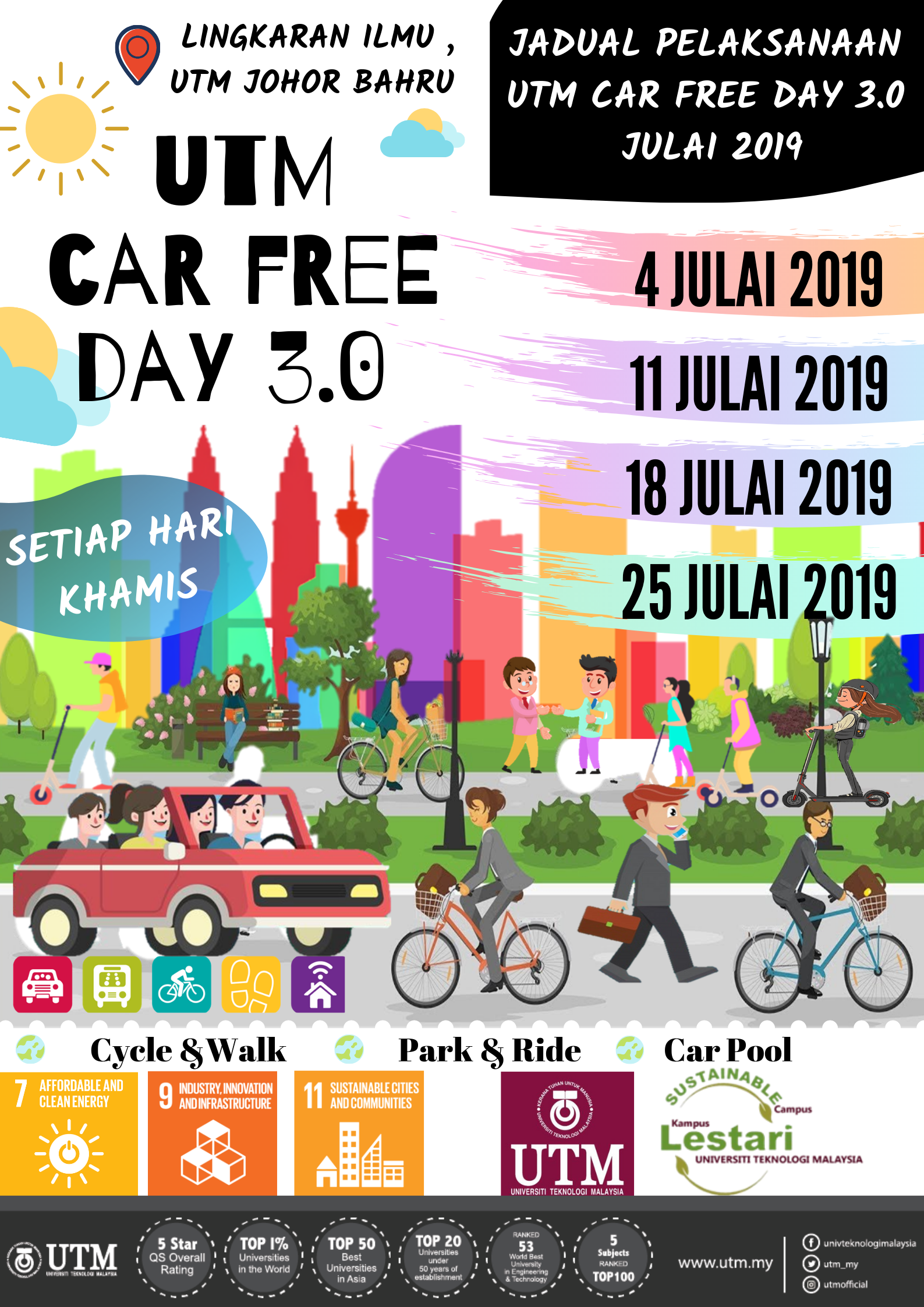
Thirdly, sometimes I forget how to do certain things even though there are posters about it such as how to apply leave using MyUTM, or about conferences or events like Car Free Day. I want to make sure that I can remember those events or conferences and at the same time, help to disseminate the information to others.
There you go. My reasons of writing nonsense random rambling posts. 😀
Authentication system in UTM
What can be commercialised based on products with Intellectual Property (IP)?_Part 2 by UTIM
Commercialization of Intellectual Property
Why do we have to commercialize?
- Benefit for others
- Income generation
- Create employment opportunity (spin-off company – syarikat hiliran)
- Experience for business and networking
What should you do before commercialization?
- Get Intellectual Property first
- Marketability (have to do market survey first)
- Know about commercial acts
Note: Make sure that whatever you commercialize would be based on your expertise. For example, if you have a cosmetic product but your expertise is in educational psychology, you can file for IP but it won’t be counted in MyRA.
But let’s say you have a module but Penerbit UTM does not want to publish it, you can copyright it first under InnoComm and then print it yourself and register your training in UTIM. So, you can use your module for every single training that you do and then even though Penerbit UTM does not hold the copyright, yet you can still commercialize it under UTIM. In this case, you commercialise your service and product i.e. module.